How to Build Self-Improving Claude Skills
TL;DR
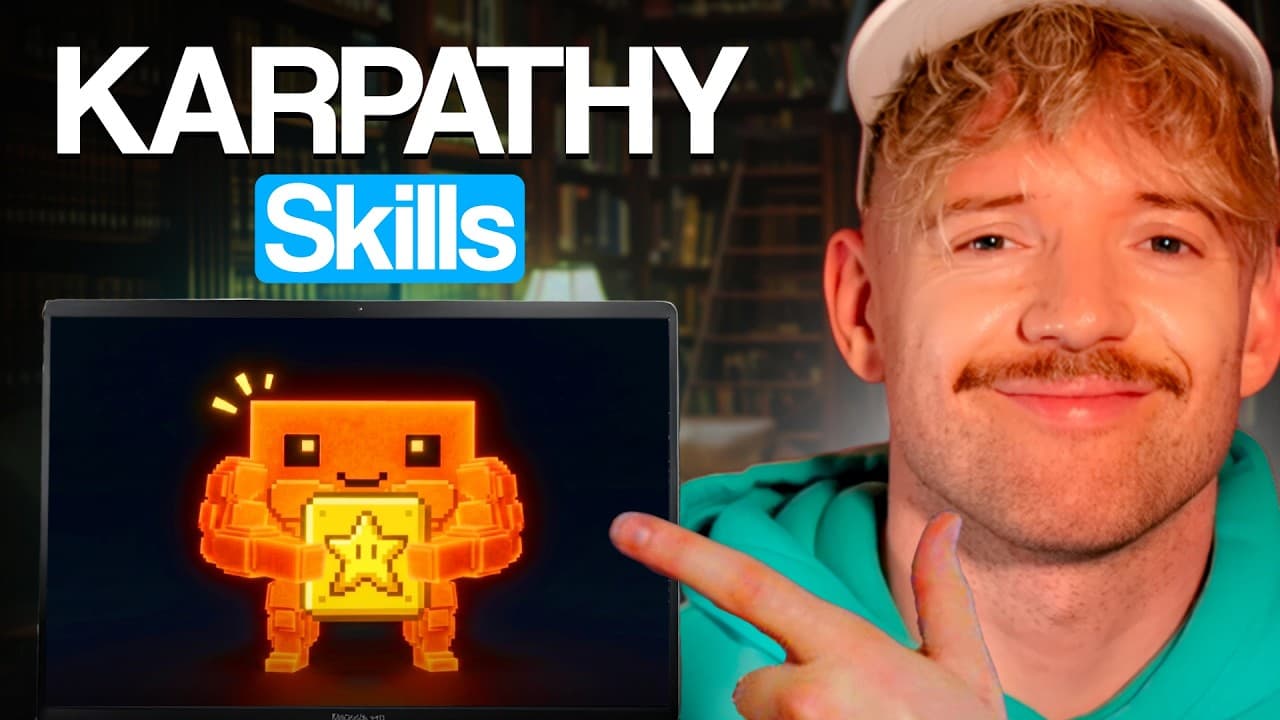
Karpathy's principles can be used to build 'super skills' in Claude Code, which are self-improving, have infinite memory, and are tailored for specific tasks. These skills can remember past interactions, use specific tools, and improve over time, making them valuable for business applications. The video guides on setting up these skills using a four-tier system: creation, data, memory, and refinement.
Transcript
Skills are Cl code's most important feature, but 99% of people are using them incorrectly. Using Andre Kapathy's system, I found a new way to build these super skills that are self-improving, have infinite memory on the kinds of things that clients pay me thousands of dollars for. And in this video, I'll show you exactly how to build them for any o... Read More
Key Insights
- Super skills are advanced Claude skills that remember, improve, and use specific tools.
- Karpathy's principles guide the development of effective AI skills.
- Skills must be properly configured to unlock their full potential.
- Effective skills are self-improving and adapt based on feedback.
- A memory operating system can enhance skill functionality by retaining past interactions.
- Data connectors are crucial for accessing diverse information sources.
- Obsidian and Pinecone are tools for managing AI memory systems.
- Feedback loops are essential for skill refinement and improvement.
Install to Summarize YouTube Videos and Get Transcripts
Explore YouTube Video Summarizer or Get YouTube Transcript Extractor
Questions & Answers
Q: How to build self-improving skills in Claude Code?
Building self-improving skills in Claude Code involves using Karpathy's principles to create 'super skills.' These skills are configured to remember past interactions, use specific tools, and improve over time. The process includes setting up a memory operating system, integrating data connectors, and establishing a feedback loop to refine the skills continuously.
Q: What are Karpathy's principles for AI skills?
Karpathy's principles for AI skills focus on simplicity, minimalism, and goal-driven execution. These principles guide the creation of skills that think before coding, avoid unnecessary complexity, and are designed to improve over time. By adhering to these principles, AI skills can become more effective and adaptable.
Q: Why is a memory operating system important for AI skills?
A memory operating system is crucial for AI skills as it allows them to retain past interactions and knowledge, enabling them to improve and adapt over time. This system ensures that skills have access to long-term and short-term memory, which enhances their ability to provide relevant and accurate outputs based on historical data.
Q: What role do data connectors play in AI skill development?
Data connectors are vital in AI skill development as they provide access to diverse information sources, allowing skills to gather and process data effectively. By integrating connectors, skills can pull in real-time information and insights, making them more robust and capable of handling complex tasks.
Q: How does feedback improve AI skills?
Feedback is essential for improving AI skills as it provides insights into their performance and areas for enhancement. By analyzing feedback, skills can adjust their algorithms and processes, leading to more accurate and efficient outputs. This continuous improvement cycle ensures that skills evolve and remain effective over time.
Q: What is the difference between utility skills and super skills?
Utility skills are basic, straightforward tasks that are easy to set up and use, such as URL shortening. In contrast, super skills are advanced, self-improving skills that remember past interactions and use specific tools for complex tasks. Super skills are built on Karpathy's principles and are tailored for specific business applications.
Q: How can Pinecone and Obsidian be used in AI skill development?
Pinecone and Obsidian are used in AI skill development as tools for managing memory systems. Pinecone offers scalable vector search capabilities, making it suitable for handling large datasets. Obsidian is effective for smaller datasets but may incur higher token costs. Both tools help organize and retrieve information, enhancing skill functionality.
Q: What are the four tiers of the super skill system?
The four tiers of the super skill system are creation, data, memory, and refinement. Creation involves setting up skills correctly with clear requirements. Data focuses on integrating connectors for information access. Memory involves using systems like Pinecone or Obsidian to retain interactions. Refinement is about using feedback loops to improve skills continuously.
Summary & Key Takeaways
-
Super skills in Claude Code are built using Karpathy's principles, ensuring they remember past interactions, improve over time, and use specific tools for tasks. This makes them valuable for business applications.
-
The video outlines a four-tier system for creating these skills: proper creation, integrating data connectors, using a memory system, and establishing a feedback loop for continuous improvement.
-
By leveraging data and memory systems like Obsidian or Pinecone, these skills can be tailored to specific needs and evolve with ongoing feedback, unlocking their full potential.
Read in Other Languages (beta)
Share This Summary 📚
Summarize YouTube Videos and Get Video Transcripts with 1-Click
Try YouTube Summary with ChatGPT & Claude or YouTube Transcript Generator
Explore More Summaries from Jack Roberts 📚





Summarize YouTube Videos and Get Video Transcripts with 1-Click
Try YouTube Summary with ChatGPT & Claude or YouTube Transcript Generator