How to Build an LLM from Scratch with PyTorch
TL;DR
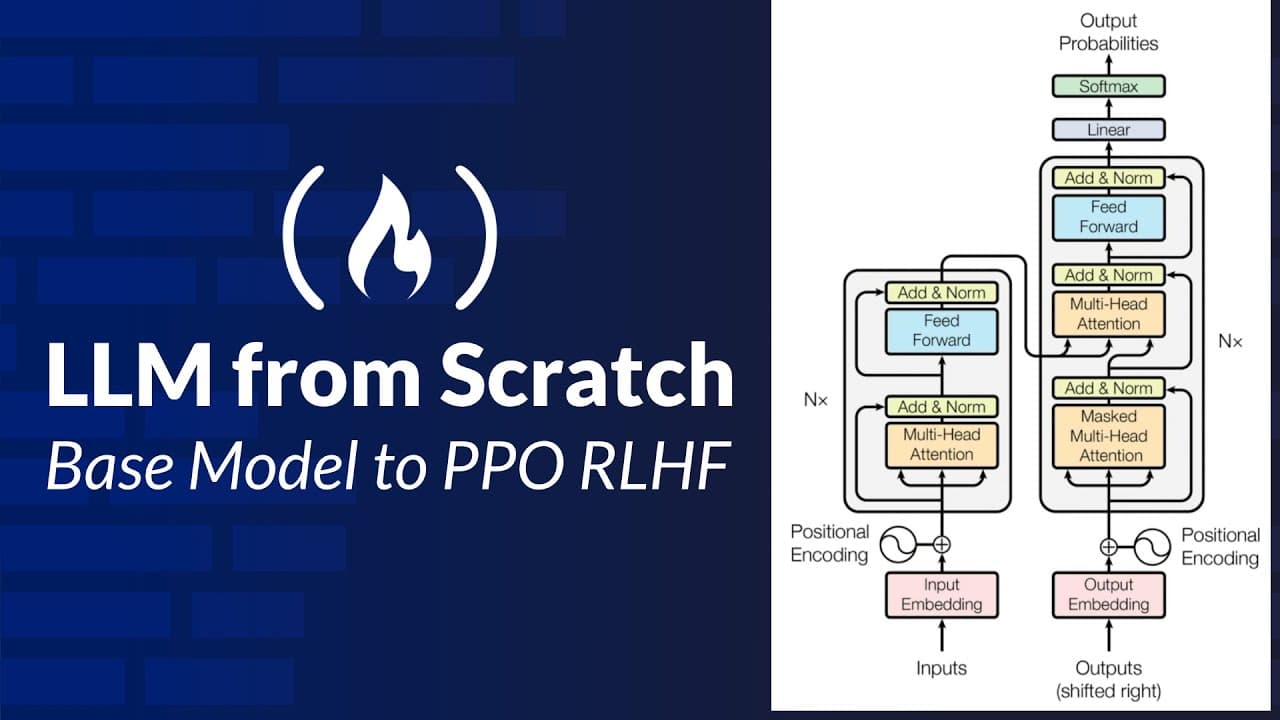
You can build an end-to-end LLM from scratch in PyTorch by implementing the core transformer architecture, training a tiny model, adding modern tricks like RMSNorm and mixture of experts, then performing supervised fine tuning and reward modeling followed by RLHF with proximal policy optimization. The course guides you through production ready scaling and alignment techniques step by step.
Transcript
Learn to build a complete large language model from scratch using only pure PyTorch. This course takes you through the entire life cycle from foundational concepts to advanced alignment techniques. You'll begin by implementing the core transformer architecture and training a tiny language model. From there you will modernize and scale the model wit... Read More
Key Insights
- The core of an LLM is the transformer block, including attention, feed forward networks, layer normalization, and residual connections.
- The training flow starts with a tiny model on local hardware before scaling up with techniques like gradient accumulation and mixed precision.
- Modern LLMs use enhancements such as RMSNorm, rotary embeddings, and KV cache to improve stability and efficiency.
- Mixture of Experts introduces routing and gating to widen capacity without a proportional compute cost.
- Supervised fine tuning aligns the model behavior with human intent using instruction data and formatted prompts.
- Reward modeling uses pairwise preferences and specific losses to shape the reward function for RLHF.
- RLHF with PPO ties the model outputs to a reward model, adding a KL penalty to balance exploration and safety.
- All modules are designed to be run from an orchestrator entry point to facilitate learning by doing and experimentation.
- More videos from this channel:
- More from this channel: freeCodeCamp.org
Install to Summarize YouTube Videos and Get Transcripts
Explore YouTube Video Summarizer or Get YouTube Transcript Extractor
Questions & Answers
Q: How to start building an LLM from scratch in PyTorch
Begin with the core transformer architecture including attention, QKV projections, and feed forward layers. Implement positional embeddings and layer norms, then stack multiple blocks to form a decoder only model. Train a tiny version locally using a simple dataset to understand loss computation and evaluation, before adding production level optimizations and scaling techniques.
Q: What are the first steps to train a tiny LLM
Create a small dataset, implement tokenization and batching, define a cross entropy loss, and run a baseline forward pass through the transformer blocks. Start with a small sequence length and batch size, then gradually introduce learning rate schedules, gradient accumulation, and mixed precision to improve training efficiency.
Q: How do modern tricks like RMSNorm and rotary embeddings help
RMSNorm stabilizes training by normalizing activations without scaling parameters, reducing training variance. Rotary embeddings provide efficient position information for attention, improving long context handling. Together these tricks help scale models while maintaining stable optimization and better generalization.
Q: What is the purpose of mixture of experts in LLMs
Mixture of Experts expands model capacity by routing parts of the input to different expert blocks, allowing a larger effective model with less global computation. It enables specialization and can improve performance on diverse tasks while keeping resource usage manageable.
Q: What happens in supervised fine tuning
Supervised fine tuning adapts a base model into an assistant like behavior by training on instruction data and curated prompts with corresponding responses. This step shifts the model from pure next token prediction toward following user intent and producing helpful, aligned outputs.
Q: What is reward modeling in this context
Reward modeling builds a separate model to score outputs based on preferred human feedback, creating a reward signal. This score guides the subsequent reinforcement learning step by indicating which completions are more aligned with desired behavior.
Q: How does PPO RLHF integrate with the model
PPO RLHF uses the reward model to optimize the policy with a KL penalized objective to balance exploration and safety. It updates the model to maximize expected reward while maintaining stability and preventing drastic output changes.
Q: Why is an orchestrator.py entry point useful for learners
An orchestrator.py entry point provides a single starting point to run different demos and modules, helping learners explore components step by step. It structures the project, making it easy to follow the lifecycle from core transformer blocks to scaling and alignment experiments.
Summary & Key Takeaways
-
This section outlines the end to end workflow of building an LLM from scratch in PyTorch, starting with the transformer core and moving through training, modernization, scaling, and alignment techniques. It emphasizes a hands on, modular approach with code you can run and extend.
-
The video stresses a practical path from a toy model to a production like system, including tokenization, batching, cross entropy loss, and evaluation, then progressing to gradient accumulation, mixed precision, and checkpointing for larger scale experiments.
-
The course culminates with alignment via reward modeling and PPO based RLHF, mirroring the stages used in well known models while keeping the implementation accessible and well commented for learners.
Read in Other Languages (beta)
Share This Summary 📚
Summarize YouTube Videos and Get Video Transcripts with 1-Click
Try YouTube Summary with ChatGPT & Claude or YouTube Transcript Generator
Explore More Summaries from freeCodeCamp.org 📚



Summarize YouTube Videos and Get Video Transcripts with 1-Click
Try YouTube Summary with ChatGPT & Claude or YouTube Transcript Generator