Is Software Engineering Dead? How AI Is Changing Dev
TL;DR
AI coding tools now let a single engineer replicate most of a billion-dollar product part-time in two weeks without hand-writing code. Signals like Cloudflare rewriting Next.js in a week and Jack cutting 40% of Block's staff while it grows show the dev world is changing fast, though speed from idea to product also makes cloning trivial.
Transcript
I'm sure you've all seen the meme. We're 6 months away from AI taking our jobs as developers forever. And while this is a meme that we've been saying for years, I'm starting to really feel it. There have just been so many signals that things are actually changing now. From baby Keem using OpenClaw to the top G-Talking on it to Cloudflare rewriting ... Read More
Key Insights
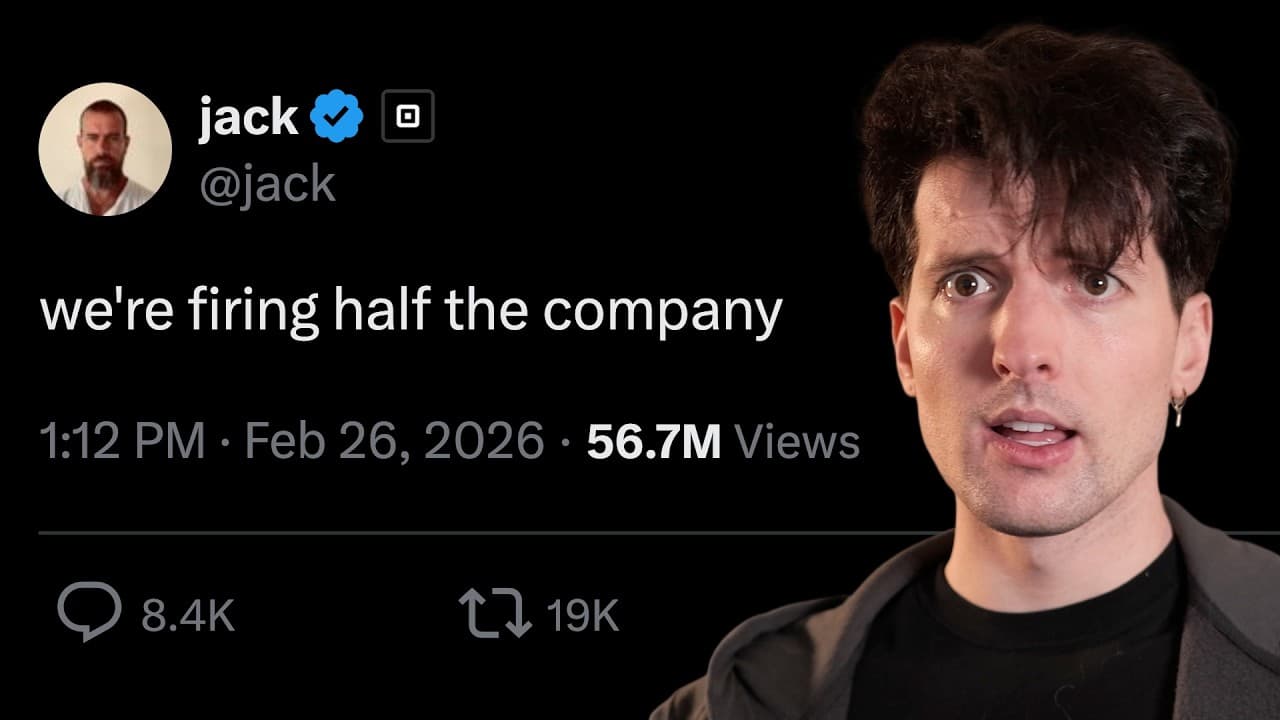
- Jack laid off 40% of employees at Block even though the company is profitable and growing, which is rare during expansion, signaling that smaller teams moving faster with AI can now overtake larger companies for cheaper.
- Lawn, an alternative to the video review platform Frame.io, was built part-time in two weeks with no lines of code hand-written, replicating most of the functionality of a product Adobe acquired for $1.3 billion in 2021.
- Ideas have become both more and less valuable at once: dropping a novel idea is powerful because idea-to-product speed has never been lower, but cloning someone else's product is now more trivial than ever.
- AI-built products need not be slop. Lawn was fully vibe coded, including UI and background image, yet feels great to use, loading instantly through data-loading patterns like pre-warming and subscriptions on hover.
- Establishing a pattern once and documenting it in an agent MD file lets the AI apply it across the whole codebase automatically, fixing missed links when the developer points them out in plain language.
- AI code review is essential when shipping large volumes of AI-generated code. CodeRabbit caught issues like a build directory that should have been git ignored in a 3,000-line PR no human would fully read.
- The speaker open-sourced Lawn despite it making the product trivial to clone, arguing cloning could have happened anyway, which reflects how little exclusivity ideas now provide.
- Real-world signals of change include CEOs who barely code building whole apps and cloning billion-dollar companies in days, and Cloudflare rewriting Next.js in a week using AI.
Install to Summarize YouTube Videos and Get Transcripts
Explore YouTube Video Summarizer or Get YouTube Transcript Extractor
Questions & Answers
Q: Why did Jack lay off 40% of Block's employees?
Jack laid off 40% of his employees at Block even though the company is profitable and growing. The speaker explains it is rare for a company to do mass layoffs while revenue and profits are increasing, but Jack tends to be ahead of market trends. The reasoning is that smaller teams moving faster with AI now pose a real risk of overtaking a company's position for cheaper, so cutting staff is his responsibility to keep the business as likely to succeed as possible.
Q: What is Lawn and how was it built?
Lawn is an alternative to Frame.io, a video review platform where teams upload edits, ad spots, and videos for review and approval, similar to code reviews and pull requests but for video. The speaker built it part-time in the background over two weeks using AI dev tools, without writing a single line of code himself. He structured the APIs and core application logic by describing how things should work and letting the AI write proposals he approved.
Q: How much was Frame.io acquired for and by whom?
Frame.io was acquired by Adobe in 2021 for $1.3 billion. The speaker uses this to illustrate how much has changed: it took Frame.io years to build that $1.3 billion valuation, yet he was able to replicate the majority of its functionality part-time in an app that he says genuinely feels better to use, all within two weeks. He argues this shows how dramatically the effort required to build software has dropped.
Q: How much revenue does Lawn make?
Lawn has a monthly recurring revenue of about $350 a month. The speaker is upfront that it is not going to make real money and will probably lose money. He built it mainly to explore the video review space and experiment with AI dev tools, not as a serious revenue product. He even open-sourced it, which makes it easy for others to clone and self-host, potentially costing him revenue, though he argues cloning could have happened anyway.
Q: Can AI-generated code produce a good product or is it just slop?
According to the speaker, AI-generated code is not necessarily slop. Lawn was fully vibe coded, including the UI and even the background image, all AI generated, yet once you use it, it feels great and everything loads instantly. He achieved this with specific data-loading patterns around pre-warming and subscriptions on hover. He describes the result as genuinely more joyful to use than the paid product it replaces, arguing the code is not bad.
Q: What does CodeRabbit do for AI-generated code?
CodeRabbit is an AI code review tool that reviewed nearly every line of code the speaker wrote in recent months and prevented many bugs from shipping. It understands complex codebases well and has a memory tool that learns from feedback to reduce noise. In one example it flagged a build directory that should have been git ignored inside a 3,000-line pull request, provided a copy-paste prompt to fix it, and caught a novel async cleanup bug involving promise abuse.
Q: Why does the speaker say ideas are both more and less valuable now?
The speaker argues ideas have become more and less valuable at the same time. Dropping something novel and coming up with a good idea is powerful because the speed from idea to usable product has never been lower, so a good idea can be realized quickly. But at the same time, cloning someone else's product and idea is more trivial than it has ever been. This dual reality is why he says ideas have not been valuable for a long time and are cheap.
Q: How does the speaker make Lawn feel so fast to use?
The speaker made Lawn feel fast by coming up with specific data-loading patterns around pre-warming and subscriptions on hover, so pages and videos load instantly when clicked. Once he established that pattern and mentioned it in the agent MD file, the AI applied it across the codebase automatically. When it once missed adding pre-warming to a link in the top navigation, he simply told it which link was broken and it found and fixed the issue.
Summary & Key Takeaways
-
The developer world is changing rapidly as AI coding tools mature. Signals include Cloudflare rewriting Next.js in a week, non-coding CEOs cloning billion-dollar apps in days, and Jack laying off 40% of Block's staff despite the company being profitable and growing.
-
The speaker built Lawn, a Frame.io alternative for video review, part-time in two weeks without writing a single line of code himself. He structured the APIs and core logic with AI, and the product loads instantly and feels more joyful than the paid tool it replaces.
-
Frame.io was acquired by Adobe in 2021 for $1.3 billion after years of work, yet most of its functionality was replicated part-time. Ideas are now cheap because idea-to-product speed is unprecedented, but that also makes cloning products trivial, and these tools are only going to improve.
Read in Other Languages (beta)
Share This Summary 📚
Summarize YouTube Videos and Get Video Transcripts with 1-Click
Try YouTube Summary with ChatGPT & Claude or YouTube Transcript Generator
Explore More Summaries from Theo - t3․gg 📚






Summarize YouTube Videos and Get Video Transcripts with 1-Click
Try YouTube Summary with ChatGPT & Claude or YouTube Transcript Generator