What Is the Pinacol Rearrangement Reaction?
TL;DR
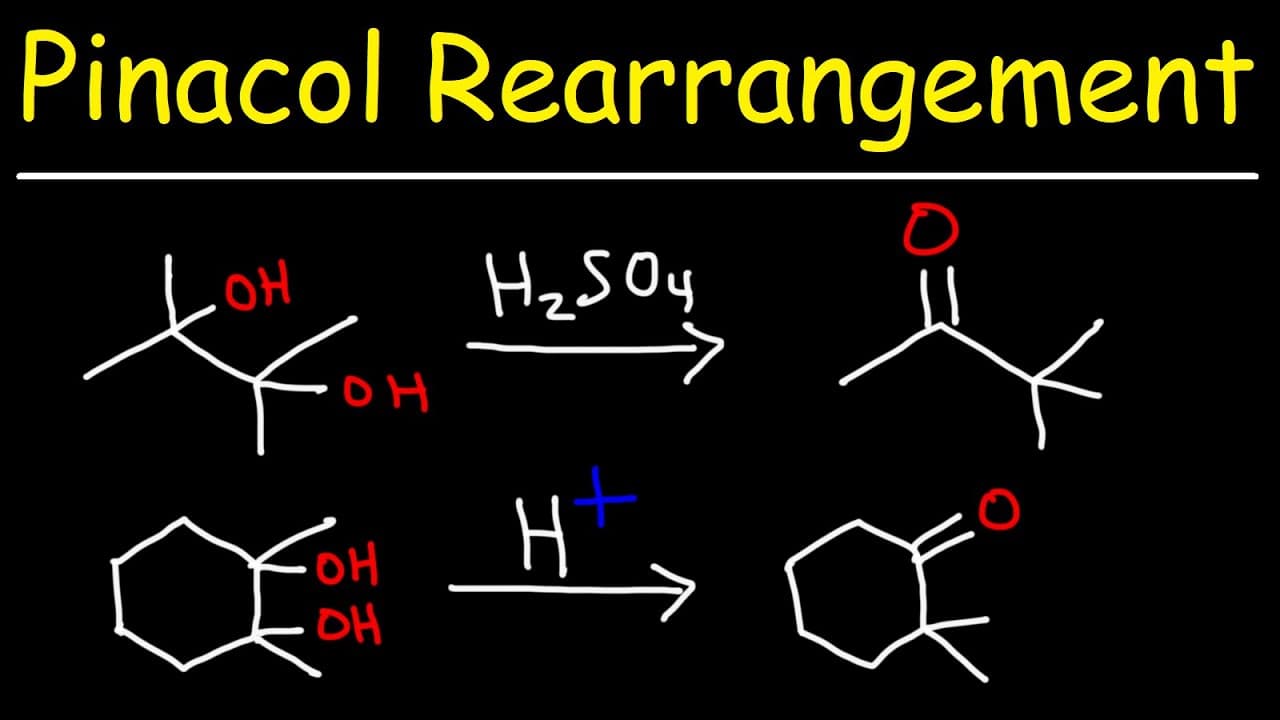
The Pinacol rearrangement reaction transforms 1,2-diols into ketones using an acid catalyst. This involves protonating the hydroxyl group, generating a carbocation, leading to rearrangement, and finally converting the carbocation into a ketone. Notably, this reaction can result in a ring contraction that stabilizes carbocations by placing the positive charge on an oxygen rather than a carbon.
Transcript
in this video we're going to focus on the Pinnacle rearrangement reaction in this reaction we're going to convert a 1 2 diol into a ketone so here we have two three dimethylbutane two three diol as our starting reactive and we're going to react it with sulfuric acid and we're going to heat the solution so we can put h plus to represent sulfuric aci... Read More
Key Insights
- 💁 The Pinnacle Rearrangement Reaction converts 1,2-diols into ketones through a series of steps involving protonation, carbocation formation, rearrangement, and deprotonation.
- 🥺 Tertiary carbocations are typically stable, but the presence of oxygen can facilitate the formation of a more stable carbocation, leading to rearrangement reactions.
- 😋 Ring contraction can occur in the Pinnacle Rearrangement Reaction, where a more stable carbocation is formed by forming a five-carbon ring instead of a six-carbon ring.
- 👻 The stability of carbocations can be influenced by the presence of oxygen, allowing for resonance stabilization and a more favorable location for the plus charge.
- 👥 Sulfuric acid serves as an acid catalyst, providing protons and aiding in the conversion of the hydroxyl group into a better leaving group.
- 😋 The Pinnacle Rearrangement Reaction showcases the interplay between carbocation stability, resonance, and ring size in determining the final product.
- 💁 The reaction mechanism requires careful consideration of protonation, rearrangement, and deprotonation steps to accurately predict the formation of ketone products.
Install to Summarize YouTube Videos and Get Transcripts
Explore YouTube Video Summarizer or Get YouTube Transcript Extractor
Questions & Answers
Q: How does the Pinnacle Rearrangement Reaction convert 1,2-diols into ketones?
The reaction involves protonation of the hydroxyl group to form a carbocation, followed by rearrangement due to the presence of oxygen, resulting in a more stable carbocation. Finally, the protonated ketone is deprotonated, leading to the formation of the ketone product.
Q: Can ring contraction occur in the Pinnacle Rearrangement Reaction?
Yes, ring contraction can occur when going from a 6-carbon ring to a 5-carbon ring. This is driven by the formation of a more stable carbocation with the plus charge on the oxygen atom, compensating for the loss in stability due to the ring contraction.
Q: How is the stability of carbocations affected by the presence of oxygen?
Tertiary carbocations are generally stable, but the presence of oxygen allows for the formation of a more stable carbocation through resonance. The carbocation can be stabilized by placing the plus charge on the oxygen atom instead of a carbon atom.
Q: What is the role of sulfuric acid in the Pinnacle Rearrangement Reaction?
Sulfuric acid acts as an acid catalyst, providing the necessary protons for protonating the hydroxyl group and initiating the reaction. It also helps in creating a more favorable leaving group in the form of water.
Summary & Key Takeaways
-
The Pinnacle Rearrangement Reaction converts 1,2-diols into ketones by protonating the hydroxyl group, forming a carbocation, undergoing rearrangement, and finally protonating the resulting protonated ketone.
-
Tertiary carbocations are typically stable and do not undergo rearrangements, but the presence of oxygen can lead to a more stable carbocation and subsequent rearrangement.
-
Ring contraction can occur in the Pinnacle Rearrangement Reaction, resulting in the formation of a more stable carbocation with the plus charge on the oxygen atom.
Read in Other Languages (beta)
Share This Summary 📚
Summarize YouTube Videos and Get Video Transcripts with 1-Click
Try YouTube Summary with ChatGPT & Claude or YouTube Transcript Generator
Explore More Summaries from The Organic Chemistry Tutor 📚




Summarize YouTube Videos and Get Video Transcripts with 1-Click
Try YouTube Summary with ChatGPT & Claude or YouTube Transcript Generator