How will aging be slowed and lifespans extended?
TL;DR
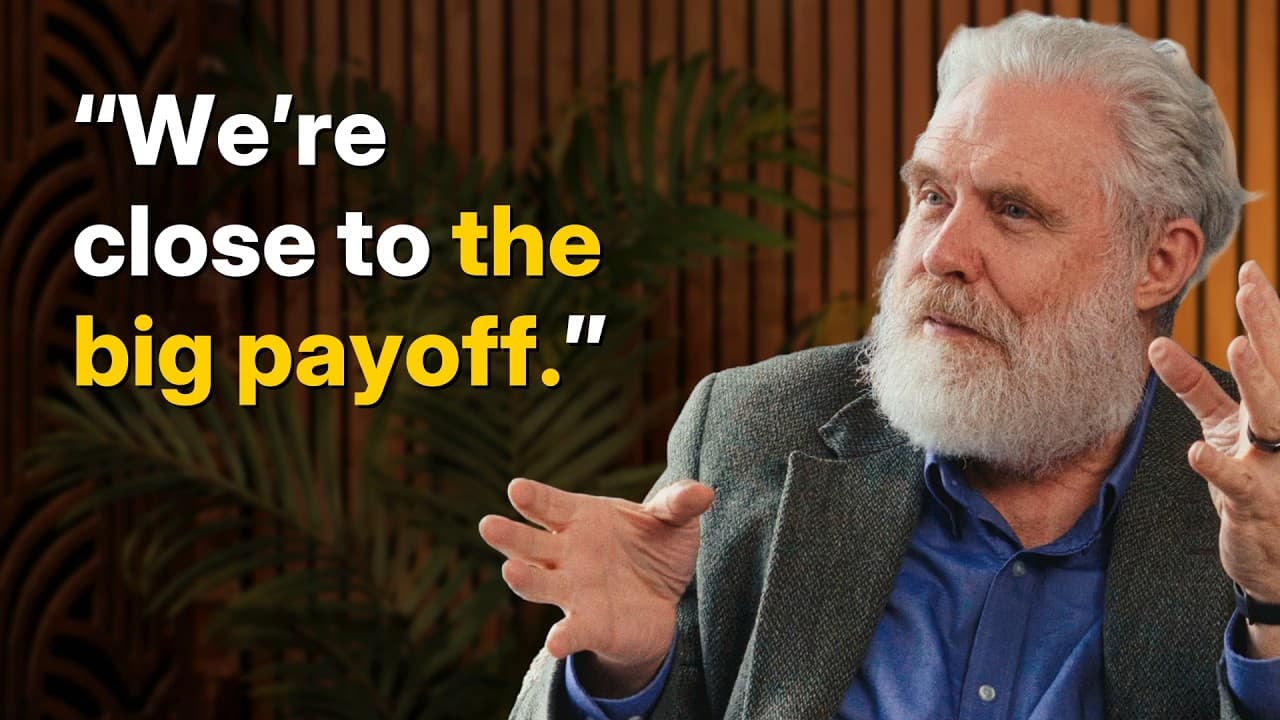
The core claim is that biotechnology is advancing exponentially, bringing aging therapies closer to real, broad impact. If these trends continue, 2050 could mark a point where healthier aging is possible for many people, possibly extending lifespans by decades through somatic gene therapies, tissue targeting, and repeated interventions.
Transcript
Today I have the pleasure of interviewing George Church. I don't know how to introduce you. This is not even an exaggeration, it would honestly be easier to list out the major breakthroughs in biology over the last few decades that you haven't been involved in— from the Human Genome Project to CRISPR, age reversal to de-extinction. So you wer... Read More
Key Insights
- Aging is treated as a cellular and systemic phenomenon that can be influenced by circulating factors in the blood.
- Somatic gene therapy is favored over germline approaches due to practical and ethical considerations and the 8 billion people not sharing germline opportunities.
- Delivery to every cell is not yet possible, but tissue targeting is improving and could reach many cell types in time.
- Recent biotech programs show that targeted delivery can improve outcomes, as in a hundredfold enhancement in neuron targeting by Dyno Therapeutics.
- The brain presents a particular challenge for replacement therapies due to its complex circuitry and memory.
- The Ship of Theseus metaphor is used to discuss maintaining identity while replacing cells, especially in neural networks.
- Reductionism helps in developing modular therapeutic widgets that can be reused across contexts and species.
- Minimal edits can sometimes achieve significant phenotypic changes, illustrating a path toward scalable gene therapy strategies to treat disabilities or enable enhancements.
Install to Summarize YouTube Videos and Get Transcripts
Explore YouTube Video Summarizer or Get YouTube Transcript Extractor
Questions & Answers
Q: What is the idea behind aging as a biosystem problem that could be solved with therapies?
Aging is described as a cellular and systemic issue where signals in the blood and other factors contribute to age-related phenotypes. Therapies that can address these systemic signals or replace cells to restore youthful function could, in theory, reverse or slow aging. The discussion frames aging as something potentially modifiable by targeted interventions across multiple tissues rather than single-point fixes.
Q: Why is somatic gene therapy favored over germline therapy in the discussion?
The speaker notes there are 8 billion people who missed germline opportunities, implying germline modifications would not apply broadly. Therefore, somatic approaches are favored because they can be applied to present individuals without altering heritable genetics. This distinction reflects practical, ethical, and societal considerations about who benefits from genetic interventions.
Q: How does the conversation describe delivering gene therapy to the whole body?
The transcript states there is nothing close to a mechanism that delivers therapy to every single cell today, but it also argues that there is no physical law preventing it. The debate includes how many injections are needed and how targeting can improve, suggesting gradual progress toward widespread distribution over time with better delivery platforms.
Q: What role do delivery platforms like Dyno Therapeutics play in this vision?
Dyno Therapeutics is highlighted for demonstrating a hundredfold improvement in targeting neurons in the brain through extensive AI-guided testing of millions of capsid variants. This example illustrates how sophisticated delivery platforms can dramatically enhance the reach and efficacy of gene therapies, enabling broader tissue access and potentially more durable effects.
Q: What is the Ship of Theseus analogy used for in this context?
The Ship of Theseus analogy is used to discuss maintaining connections and memories while replacing old cells with new ones. It frames the brain as a system where neural circuits must remain coherent and functional as cellular components are updated, highlighting the complexity of achieving true rejuvenation without losing identity or function.
Q: How does the speaker view minimum versus maximum edits in synthetic biology?
The speaker explains there is value in both questions. What is the minimum number of edits to achieve a neural phenotype, for example, and what is the maximum or best possible version? This dual focus drives research into both simple, scalable interventions and more ambitious, multi-gene strategies that could yield broader improvements.
Q: What is the potential for using biology to address environmental or societal goals?
The conversation notes that synthetic biology could be used to fix environments or balance carbon to benefit humans, though the outcomes are uncertain. The underlying point is that biotech solutions might be cost-effective and impactful, motivating exploration of how engineered biology can contribute to large-scale societal challenges.
Q: Why is reductionism considered useful in biotechnology development?
Reductionism is described as a practical approach that helps translate complex biology into usable tools and therapies. By breaking down traits into modular widgets or focusing on key factors like growth hormone, researchers can create targeted treatments and build a toolkit of reusable components that will aid medicine and cross-species translation.
Summary & Key Takeaways
-
Aging is described as a cellular phenomenon influenced by blood-borne signals, implying that therapies could target systemic factors rather than isolated tissues.
-
The discussion highlights somatic versus germline gene therapy with a likely emphasis on somatic approaches, because billions of people lack germline modification opportunities.
-
Delivery of gene therapies to all cells is considered theoretically possible but not yet achievable, with current limits on tissue targeting and injection strategies.
-
Advances in targeted delivery, such as Dyno Therapeutics, are cited as substantial improvements that could broaden where therapies reach.
-
The concept of replacing cells to rejuvenate tissue is framed as plausible but technically challenging, especially for the brain where memory and circuits present unique hurdles.
-
The talk uses Ship of Theseus as a metaphor for maintaining function and connections while replacing cells, underscoring the complexity of aging at the network level.
-
Reductionism is acknowledged as a useful tool for medicine and product development, even though not all traits will translate across species or contexts.
-
There is interest in both minimum edits to achieve a trait and the possibility of larger, multi-gene strategies to address complex phenotypes like height or aging.
Read in Other Languages (beta)
Share This Summary 📚
Summarize YouTube Videos and Get Video Transcripts with 1-Click
Try YouTube Summary with ChatGPT & Claude or YouTube Transcript Generator
Explore More Summaries from Dwarkesh Patel 📚



Summarize YouTube Videos and Get Video Transcripts with 1-Click
Try YouTube Summary with ChatGPT & Claude or YouTube Transcript Generator