How to Build an AI Content Team That Wins Clients
TL;DR
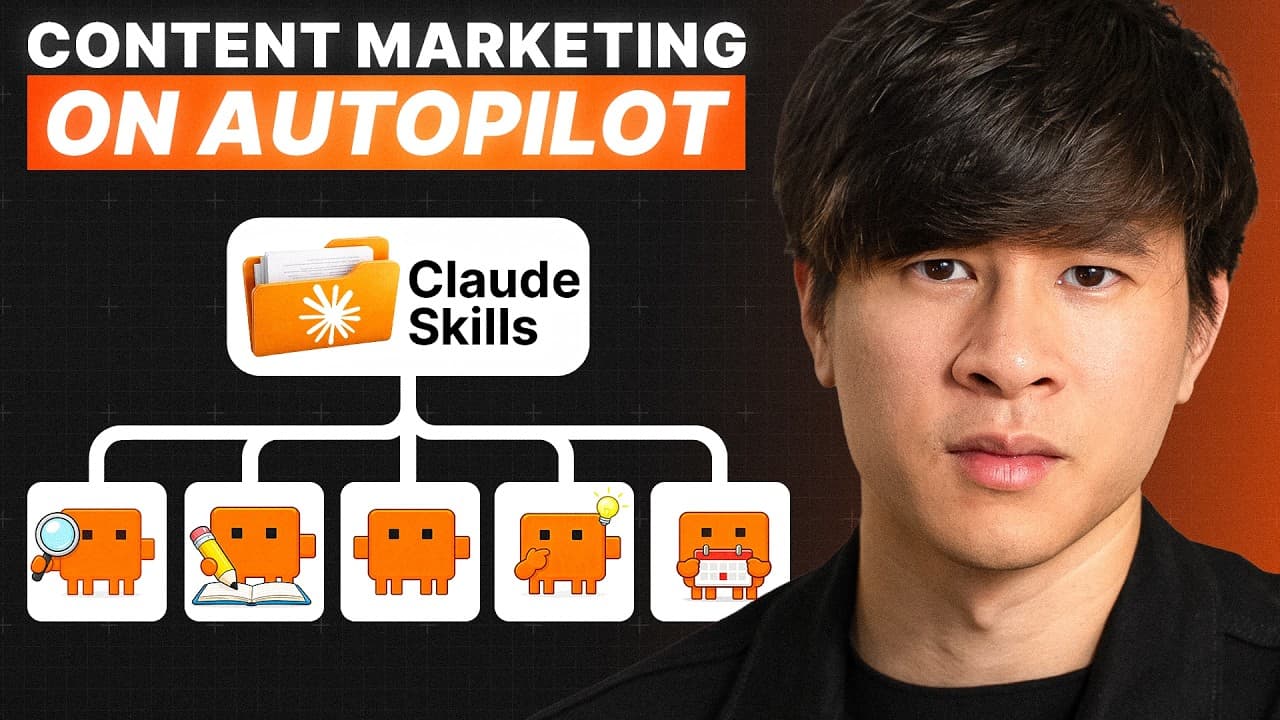
Build an AI content team by mastering each workflow manually, documenting it as a specialized Claude skill, and judging automation by content quality and client results. Start with positioning and packaging, then use AI to accelerate research and scripting while retaining human judgment for taste, differentiation, filming, editing, and performance review.
Transcript
Everyone's talking about how they've automated their entire marketing department with clot, but when you actually look at the outputs and the work they're actually producing, it's totally mediocre. And the people teaching this don't even practice what they preach. And even if you were to try to follow their methods, why would you spend 80% of your ... Read More
Key Insights
- Content automation is only reliable after the creator can perform and evaluate the process manually. Without firsthand knowledge of effective scripting or packaging, the creator lacks the judgment required to distinguish strong AI output from content that merely appears complete.
- A small automation can create meaningful cumulative savings without requiring a fully automated marketing department. The recommended starting point is a proven task that saves roughly one hour per day, followed by gradual expansion only after its output consistently meets the creator's standards.
- Content quality is the primary test of an AI workflow. A creator should ask whether the final work is worthy of representing the personal brand, because efficient production has little value when posts receive little attention or fail to support client acquisition.
- Brand positioning is the foundation of the content machine. It defines what the creator wants to be known for, how the creator differs from competitors, and which personal qualities or perspectives make the resulting content recognizably unique.
- YouTube packaging consists of the idea, thumbnail, and title, considered in that order. Packaging accounts for an estimated 70–80% of success according to the creator, because viewers cannot watch or respond to content they never choose to click.
- The content workflow is a recurring cycle of positioning, packaging, scripting, filming, editing, and analytics review. Performance data identifies strengths and weaknesses, allowing the creator to revise the process rather than treating each publication as an isolated project.
- Claude works best as a specialized assistant supported by human taste and judgment. It can analyze data and recommend actions, but the creator must decide whether those recommendations fit the brand, meet quality expectations, and can compete within the chosen niche.
- Claude skills are specialized MD files that teach an assistant how to perform a defined task. They can be found online, created independently, or generated with Claude's built-in skill creator by describing a capability such as researching promising YouTube ideas.
Install to Summarize YouTube Videos and Get Transcripts
Explore YouTube Video Summarizer or Get YouTube Transcript Extractor
Questions & Answers
Q: How do you build an AI content team with Claude skills?
Begin by mapping the content workflow into distinct stages such as positioning, packaging, scripting, filming, editing, and analytics review. Perform each process manually at least once, then create a specialized Claude assistant for a task you understand well. Give each assistant a focused MD skill file, evaluate its actual output, and expand automation gradually while keeping human judgment involved.
Q: What should you automate first in a content workflow?
Automate a task that you can already complete manually and evaluate confidently. The first automation does not need to cover most of the workflow. Even a process that saves one hour per day can produce valuable cumulative benefits. Start with a repeatable task, confirm that its output meets your standards, and add further automation only after the first process works reliably.
Q: Why should content creators master a process before automating it?
Manual experience gives creators the judgment needed to recognize quality. Someone who cannot write or assess a strong YouTube script will struggle to tell whether an automated script is persuasive, distinctive, or useful. Completing the process at least once also exposes its real stages, decisions, and standards, which makes the instructions given to Claude more precise and the resulting automation easier to evaluate.
Q: What is the correct order for creating YouTube content?
Start with brand positioning, then develop the packaging through the idea, thumbnail, and title. Once the concept and click decision are clear, write the script, film the material, edit it, and publish it. Review the analytics afterward to identify what performed well and what did not, then apply those findings when repeating the cycle for future content.
Q: Why are positioning and packaging important for YouTube growth?
Positioning determines what the creator will be known for, how the content differs from competing material, and what makes it personally distinctive. Packaging translates that position into an idea, thumbnail, and title that viewers may choose to click. The creator estimates that packaging accounts for 70–80% of YouTube success, since a strong video cannot be watched if its presentation attracts no clicks.
Q: How should Claude skills be organized for content creation?
Organize Claude skills around narrow, specialized responsibilities instead of expecting one assistant to handle every part of the content operation. A skill can focus on a task such as researching YouTube ideas, while other stages remain separate. The skills are stored as MD files and can be sourced online, written personally, or generated by describing the desired capability to Claude's built-in skill creator.
Q: What is the difference between Claude chat and co-work?
Chat is presented as the simpler option for general use, but it does not retain everything previously discussed. Co-work saves work to files, which gives the system persistent material it can reference later. Co-work can also support scheduled tasks, such as recurring YouTube idea research, although the creator recommends running research manually when needed rather than scheduling it every morning without a clear reason.
Q: How can AI-generated content help attract high-ticket clients?
AI can accelerate parts of a content system, but client attraction still depends on strong positioning, compelling packaging, useful content, and a final result the creator is proud to publish. The workflow should be evaluated by views and client outcomes, not by the percentage automated. Human judgment remains necessary to protect quality, express a distinctive personal brand, and reject outputs that would weaken credibility.
Summary & Key Takeaways
-
Effective content automation begins with a proven manual workflow. A creator must understand what strong output looks like before delegating tasks to Claude. Starting with a small automation that saves one hour per day is more practical than connecting numerous tools before the underlying content process produces results.
-
The content machine follows a repeatable sequence: establish brand positioning, develop the idea, thumbnail, and title, write the script, film, edit, and review analytics. Positioning determines why the content is distinctive, while packaging drives the click. Analytics then reveal what worked and guide the next production cycle.
-
Claude skills can turn AI into a group of specialized content assistants. Each assistant should handle one clearly defined function rather than many unrelated tasks. Skills can be created as MD files through Claude's skill creator, while chat supports simpler work and co-work stores files and can schedule recurring research tasks.
Read in Other Languages (beta)
Share This Summary 📚
Summarize YouTube Videos and Get Video Transcripts with 1-Click
Try YouTube Summary with ChatGPT & Claude or YouTube Transcript Generator
Explore More Summaries from Patrick Dang 📚


Summarize YouTube Videos and Get Video Transcripts with 1-Click
Try YouTube Summary with ChatGPT & Claude or YouTube Transcript Generator