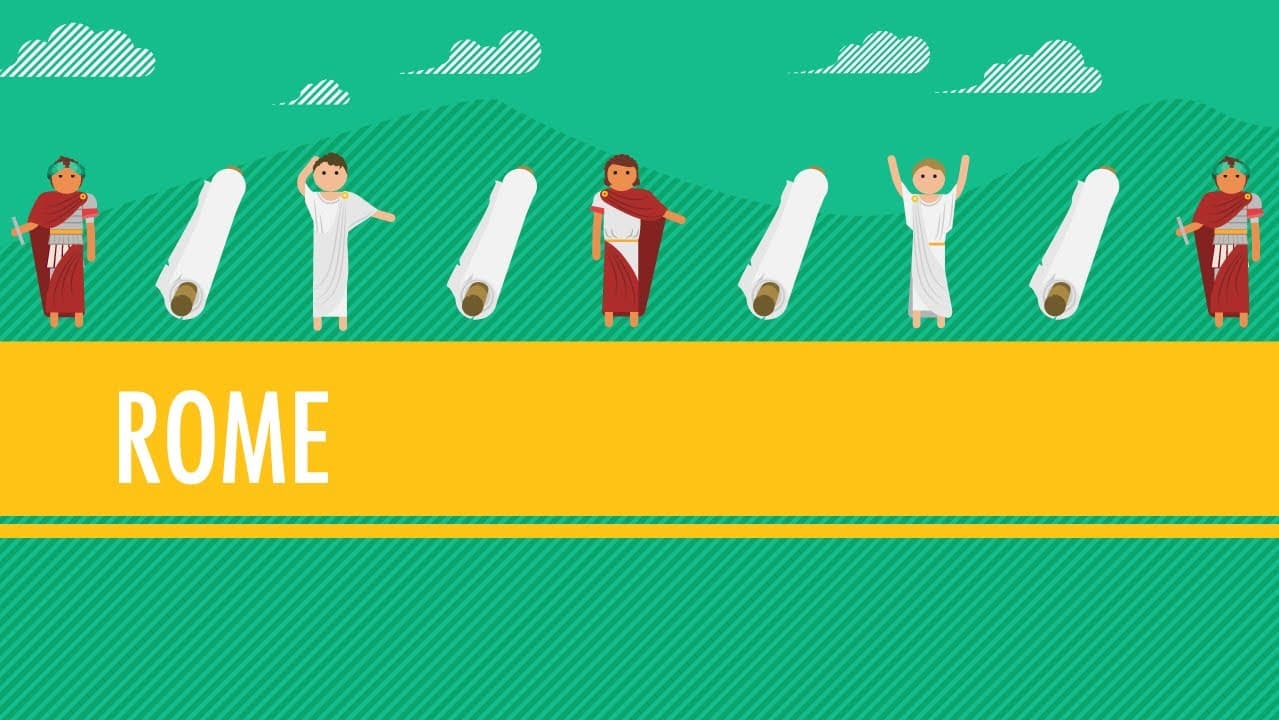
The Roman Empire. Or Republic. Or...Which Was It?: Crash Course World History #10
TL;DR
Julius Caesar's rise marked Rome's shift from Republic to Empire.
Transcript
Hi, I’m John Green; this is Crash Course World History and today we’re going to learn about the Roman Empire, which of course began when two totally nonfictional twins, Romulus and Remus, who’d been raised by wolves, founded a city on seven hills. Mr Green, Mr Green, what… what does SPQR stand for? It means shut pie hole quickly, rapscallion. No, i... Read More
Key Insights
- The Roman Republic was characterized by a blend of monarchy, aristocracy, and democracy, making it a unique political system.
- Julius Caesar rose to power through military success and alliances, notably with Crassus and Pompey, forming the First Triumvirate.
- Caesar's reforms, including land pensions and debt restructuring, were popular among Romans but led to his assassination by the Senate.
- The assassination of Caesar did not restore the Republic; instead, it led to the rise of the Second Triumvirate and eventually the Roman Empire under Augustus.
- Rome's transformation from Republic to Empire was gradual, marked by military expansion and the concentration of power in generals.
- The Punic Wars were pivotal in Rome's expansion, leading to its control over territories like Spain and the destruction of Carthage.
- The Roman Senate, once a powerful political body, became a rubber stamp under Augustus, marking the end of the Republic.
- Rome's need for continual military expansion to provide land for soldiers contributed to the rise of powerful generals and the empire's formation.
Install to Summarize YouTube Videos and Get Transcripts
Explore YouTube Video Summarizer or Get YouTube Transcript Extractor
Questions & Answers
Q: What characterized the Roman Republic's political system?
The Roman Republic's political system was characterized by a blend of monarchy, aristocracy, and democracy. This unique structure was praised by historians like Polybius for its balance and was primarily governed by the Senate, which was composed of elite Patrician families. This blend allowed for a measure of checks and balances within the Republic.
Q: How did Julius Caesar rise to power in Rome?
Julius Caesar rose to power through a combination of military success, political alliances, and strategic reforms. He formed the First Triumvirate with Crassus and Pompey, which helped him secure the consulship. His military campaigns in Gaul and subsequent conquests expanded his influence, while his reforms, such as land pensions for soldiers, increased his popularity among the Roman populace.
Q: What were the consequences of Caesar's assassination?
Caesar's assassination by the Senate, who feared his concentration of power, did not restore the Roman Republic as intended. Instead, it led to further turmoil and the eventual rise of the Second Triumvirate, composed of Octavian, Mark Antony, and Lepidus. This power struggle ultimately resulted in the establishment of the Roman Empire under Augustus, marking the end of the Republic.
Q: How did Rome's military expansion contribute to its transformation into an empire?
Rome's military expansion was crucial in its transformation from a Republic to an Empire. The need to provide land for retired soldiers drove continuous conquests, which in turn increased the power and influence of military generals. This expansion brought diverse subject peoples under Roman control and shifted political power towards military leaders, paving the way for the imperial system.
Q: What role did the Punic Wars play in Rome's expansion?
The Punic Wars were pivotal in Rome's expansion and its transformation into an empire. The conflicts with Carthage, especially the famous campaigns of Hannibal and his war elephants, resulted in Rome gaining control over territories like Sicily and Spain. The complete destruction of Carthage in the Third Punic War further solidified Rome's dominance in the Mediterranean region.
Q: How did the Roman Senate's role change under Augustus?
Under Augustus, the Roman Senate's role was significantly diminished. While Augustus maintained the appearance of Republican forms, the Senate became a mere rubber stamp for his decrees. Augustus centralized power in his own hands, effectively ending the Republic and establishing the imperial system, with the Senate losing much of its political influence.
Q: What factors led to the concentration of power in Roman generals?
The concentration of power in Roman generals was driven by the need for continuous military expansion and the personal loyalty of soldiers to their commanders. Generals like Marius and Sulla set precedents by promising land to soldiers, which required new conquests. This loyalty to generals over the state facilitated the rise of figures like Julius Caesar and the eventual transition to imperial rule.
Q: Why is it argued that Rome became an empire before having an emperor?
It is argued that Rome became an empire before having an emperor because it exhibited key imperial characteristics long before Augustus. These included a unified system of government, military expansion, and a diversity of subject peoples. The Republic's structure could not accommodate the vast territories and diverse populations under its control, necessitating a shift towards centralized imperial rule.
Summary & Key Takeaways
-
The Roman Republic's political system blended monarchy, aristocracy, and democracy, with the Senate playing a crucial role in governance. Julius Caesar's rise to power, aided by alliances with Crassus and Pompey, marked a turning point in Roman history.
-
Caesar's reforms and military conquests increased his popularity but led to his assassination by the Senate, who feared his growing power. This assassination failed to restore the Republic, instead paving the way for the Roman Empire under Augustus.
-
Rome's expansion through the Punic Wars and the concentration of power in military generals marked its transformation from Republic to Empire. The Senate's role diminished under Augustus, solidifying the empire's structure and ending the Republic.
Read in Other Languages (beta)
Share This Summary 📚
Summarize YouTube Videos and Get Video Transcripts with 1-Click
Try YouTube Summary with ChatGPT & Claude or YouTube Transcript Generator
Explore More Summaries from CrashCourse 📚
Summarize YouTube Videos and Get Video Transcripts with 1-Click
Try YouTube Summary with ChatGPT & Claude or YouTube Transcript Generator