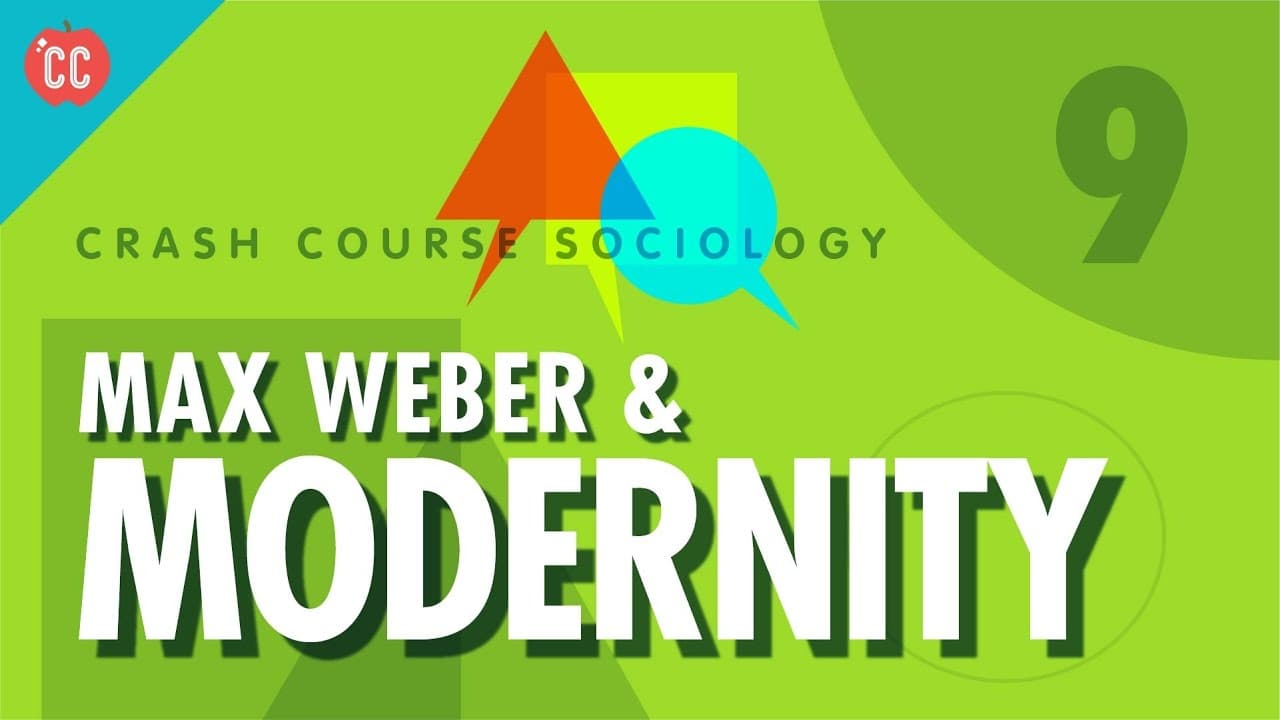
What Is Max Weber's Theory of Modernity and Rationalization?
TL;DR
Max Weber's theory of modernity centers on rationalization, a process involving calculability, methodical behavior, and reflexivity. He argued that the Protestant Reformation initiated this shift by emphasizing individual responsibility over divine order. Bureaucracy exemplifies rationalization, characterized by hierarchy and impersonality, while Weber expressed concern about the 'iron cage' effect, where rationalized systems become routine and lack meaningful reflection.
Transcript
Take a second and imagine life just over five hundred years ago. Say you’re in Europe, at the tail end of the Middle Ages. If you had to name the biggest change between then and now, what would you choose? Maybe the internet, or industrialization, or the incredible advances in health and medicine. Maybe you'd think back to Marx or Durkheim and say ... Read More
Key Insights
- Max Weber viewed rationalization as the defining change from traditional to modern society, emphasizing calculability, methodical behavior, and reflexivity.
- Weber argued that the Protestant Reformation initiated the rationalization process by shifting focus from divine order to individual responsibility and success.
- Bureaucracy, according to Weber, is a hallmark of rationalization, characterized by hierarchy, specialization, formal communication, and impersonality.
- Weber identified three types of legitimacy in modern states: traditional, legal-rational, and charismatic, each playing a role in governance.
- Social stratification, in Weber's view, involves class, power, and status, which can vary independently and affect societal roles.
- Weber was concerned about the 'iron cage' of bureaucratic capitalism, where rationalized systems lose meaning and become routine.
- His ideas influenced both micro-level symbolic interactionism and macro-level theories on rationalization and culture.
- Weber's theories continue to shape sociological understanding of modernity, bureaucracy, and social stratification.
Install to Summarize YouTube Videos and Get Transcripts
Explore YouTube Video Summarizer or Get YouTube Transcript Extractor
Questions & Answers
Q: What is the central concept Weber identified as distinguishing modern society?
Weber identified rationalization as the central concept distinguishing modern society from traditional society. He defined rationalization as a process characterized by calculability, methodical behavior, and reflexivity, which fundamentally altered how individuals and societies approached work, governance, and social organization.
Q: How did Weber link the Protestant Reformation to modern rationalization?
Weber linked the Protestant Reformation to modern rationalization by arguing that it shifted the focus from a divinely ordained social order to individual responsibility and success. This change emphasized personal accountability and the accumulation of wealth as a sign of divine favor, laying the groundwork for rational, capitalist societies.
Q: What are the characteristics of bureaucracy according to Weber?
According to Weber, bureaucracy is characterized by a clear hierarchy of positions, specialized roles, formal written communications, technical competence, adherence to detailed rules and regulations, and impersonality. These traits make bureaucracy a highly rational and efficient form of organization, essential to modern governance and administration.
Q: What types of legitimacy did Weber identify in modern states?
Weber identified three types of legitimacy in modern states: traditional, legal-rational, and charismatic. Traditional legitimacy is based on historical customs, legal-rational legitimacy relies on established laws and procedures, and charismatic legitimacy is derived from the extraordinary characteristics of a leader. These forms of legitimacy influence how authority is exercised and obeyed.
Q: How does Weber's concept of social stratification differ from Marx's?
Weber's concept of social stratification differs from Marx's by incorporating three elements: class, power, and status. Unlike Marx, who focused solely on economic class and the means of production, Weber argued that these elements can vary independently, leading to more complex social hierarchies and interactions within society.
Q: What was Weber's concern about rationalization in modern society?
Weber was concerned that rationalization in modern society could lead to an 'iron cage' where individuals become trapped in routine, calculable systems devoid of personal meaning. He feared that reflexivity would be lost, and people would engage in meaningless, unthinking behaviors dictated by bureaucratic capitalism, with little room for personal reflection or creativity.
Q: How did Weber's ideas influence future sociological theories?
Weber's ideas influenced future sociological theories by shaping both micro and macro-level analyses. His focus on meaning and ideas contributed to symbolic interactionism, while his exploration of rationalization and bureaucratization informed macro-level theories on social organization and culture, impacting theorists like Erving Goffman, Talcott Parsons, and Jürgen Habermas.
Q: What is the significance of Weber's work in understanding modern capitalism?
Weber's work is significant in understanding modern capitalism as it highlights the role of rationalization in shaping economic systems. He demonstrated how rational, methodical behavior, and calculability became central to capitalist practices, linking these processes to religious influences from the Protestant Reformation, and illustrating the broader societal impacts on governance and social stratification.
Summary & Key Takeaways
-
Max Weber highlighted rationalization as the central shift from traditional to modern society, focusing on calculability, methodical behavior, and reflexivity. He saw this change as rooted in the Protestant Reformation, which emphasized individual responsibility and success as a sign of divine favor.
-
Weber identified bureaucracy as a key aspect of rationalization, characterized by hierarchy, specialization, formal communication, and impersonality. He also distinguished between traditional, legal-rational, and charismatic legitimacy in modern governance, emphasizing their roles in societal obedience.
-
Social stratification, according to Weber, involves class, power, and status, which can independently influence one's societal position. He warned about the 'iron cage' of bureaucratic capitalism, where rational systems become routine and lose meaningful reflection, influencing future sociological theories.
Read in Other Languages (beta)
Share This Summary 📚
Summarize YouTube Videos and Get Video Transcripts with 1-Click
Try YouTube Summary with ChatGPT & Claude or YouTube Transcript Generator
Explore More Summaries from CrashCourse 📚





Summarize YouTube Videos and Get Video Transcripts with 1-Click
Try YouTube Summary with ChatGPT & Claude or YouTube Transcript Generator