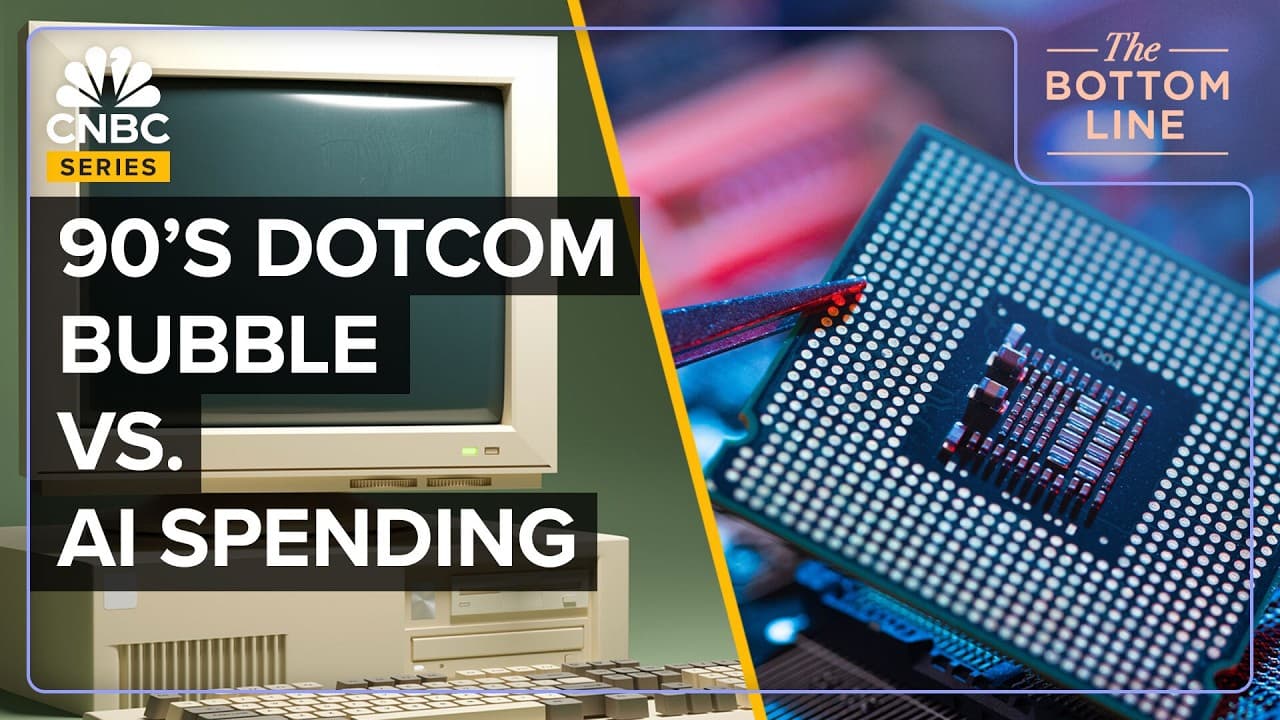
Is the AI Spending Boom an Economic Bubble?
TL;DR
AI investment may be supporting corporate earnings, stock prices, and US economic growth while concealing weakness in employment and household finances. The boom could continue as a long capital-expenditure supercycle, but high interest rates, excessive debt, weaker profits, or disappointing AI returns could sharply reduce spending and spread losses across markets and the broader economy.
Transcript
Global AI spending will top more than $330 billion in 2025 and $500 billion by the end of 2026, and by 2030, it could take about $2 trillion a year to support the infrastructure being built today. That's more than Amazon, Apple, Microsoft, meta, Nvidia and Google's parent company alphabet made combined in revenue in 2024. It's the start of t... Read More
Key Insights
- Global AI spending is projected to exceed $330 billion in 2025, reach $500 billion by the end of 2026, and potentially require about $2 trillion annually by 2030 to support the infrastructure currently being developed.
- AI investment is supporting corporate growth, stock market gains, earnings, and portions of US GDP. A September 2025 Deutsche Bank analysis argued that without AI-driven investment, the United States might already have entered a recession.
- The AI boom differs from the dot-com boom because many leading technology companies generate substantial revenue and cash. Their stronger balance sheets can support expansion, although the projected infrastructure requirements may eventually exceed the cash available for self-funded investment.
- An AI capital-expenditure supercycle is a prolonged period of accelerated investment in chips, data centers, electricity grids, and related systems. Supporters believe it could continue for five, seven, or ten years instead of ending after a typical two-to-three-year cycle.
- Continued AI spending depends on favorable borrowing costs, strong profits, investor confidence, and positive expectations among consumers and business leaders. Inflation, worsening employment, high interest rates, or declining optimism could disrupt these conditions and weaken the entire investment cycle.
- Debt financing is becoming a significant risk as companies issue bonds to fund infrastructure expansion. If profits decline, AI technology disappoints, or borrowing costs remain high, companies could face repayment problems and investors could withdraw support from expensive long-term projects.
- The US economy is K-shaped because stockholders, homeowners, and other asset owners are gaining while many people living paycheck to paycheck fall behind. Spending by high-income households can therefore make overall consumer demand appear stronger than underlying conditions suggest.
- AI adoption is expected to transform or replace some work, with about 60% of jobs in the developed world exposed to the technology according to the cited International Monetary Fund estimate. Gradual disruption could widen the divide between capital owners and labor-dependent households.
Install to Summarize YouTube Videos and Get Transcripts
Explore YouTube Video Summarizer or Get YouTube Transcript Extractor
Questions & Answers
Q: Why might the AI spending boom be an economic bubble?
The boom resembles a bubble because enormous amounts of money are flowing into technology whose long-term returns remain uncertain. AI spending is supporting earnings, stock valuations, and GDP, while some companies are beginning to finance expansion with debt. If profits weaken, borrowing becomes expensive, or AI fails to deliver sufficient returns, investment and valuations could decline together.
Q: How much could global AI infrastructure spending reach?
Global AI spending is expected to exceed $330 billion in 2025 and reach $500 billion by the end of 2026. By 2030, supporting the infrastructure being built could require about $2 trillion each year. The expansion covers multiple layers of the technology stack, including chips, data centers, electricity grids, and other supporting infrastructure.
Q: How is AI investment supporting the US economy?
AI investment is contributing to corporate earnings growth, stock market gains, and portions of US GDP. The transcript cites a September 2025 Deutsche Bank analysis arguing that the United States might already be in a recession without AI-driven investment. This concentration creates vulnerability because a slowdown in one major investment category could affect business activity, markets, and economic growth.
Q: What could cause AI infrastructure spending to slow?
AI spending could slow if inflation rises, interest rates remain high, labor market conditions deteriorate, profits weaken, or consumers and executives lose confidence in future growth. Companies also need investors to continue supporting high valuations and long-term projects. A significant deterioration in any of these connected conditions could change financing decisions and disrupt the broader capital-expenditure cycle.
Q: How does today's AI boom differ from the dot-com bubble?
Many leading AI companies differ from dot-com-era businesses because they already produce substantial revenue, hold strong balance sheets, and generate large amounts of cash. That financial strength allows them to fund considerable infrastructure investment. However, the comparison remains relevant because spending is reaching extraordinary levels, expected returns are uncertain, and increasing reliance on debt could magnify losses if the technology underperforms.
Q: What is an AI capital-expenditure supercycle?
An AI capital-expenditure supercycle is an extended period during which companies rapidly invest in the physical and digital infrastructure required for artificial intelligence. The spending includes chips, data centers, power grids, and related systems. Unlike a capital-expenditure cycle that might end after two or three years, supporters believe this expansion could continue for five, seven, or ten years.
Q: How could debt make the AI boom more fragile?
Some companies are issuing bonds to finance AI infrastructure and expect future profits to cover repayment. This becomes risky if cash generation declines, borrowing costs stay elevated, or AI investments fail to produce adequate returns. Once companies exhaust cash available for self-funding, heavier dependence on debt could mark a more precarious stage and make investors less willing to finance expansion.
Q: How could AI investment worsen economic inequality?
AI investment can disproportionately benefit people who own stocks, real estate, and other assets, while providing less immediate support to households dependent primarily on wages. Lower-income consumers are already struggling with inflation and limited savings returns. As AI adoption gradually transforms or replaces work, the gap between capital owners and labor-dependent households could widen during the transition.
Summary & Key Takeaways
-
Global AI spending is projected to exceed $330 billion in 2025, reach $500 billion by the end of 2026, and potentially require about $2 trillion annually by 2030. Supporters view this infrastructure expansion across chips, data centers, and power grids as the foundation of a new technology-driven economy.
-
The boom remains vulnerable because continued investment depends on strong corporate profits, favorable borrowing conditions, confident investors, and supportive consumer and business sentiment. As companies exhaust available cash and issue more debt, high rates or inadequate AI returns could make financing harder and expose both corporate balance sheets and economic growth.
-
AI investment is occurring within an uneven, K-shaped economy. Asset owners and high-income consumers are benefiting more, while many lower-income households face inflation pressure and limited savings returns. Hiring has slowed, employment growth is concentrated, and gradual automation could widen the divide between people who own capital and those dependent on labor.
Read in Other Languages (beta)
Share This Summary 📚
Summarize YouTube Videos and Get Video Transcripts with 1-Click
Try YouTube Summary with ChatGPT & Claude or YouTube Transcript Generator
Explore More Summaries from CNBC 📚




Summarize YouTube Videos and Get Video Transcripts with 1-Click
Try YouTube Summary with ChatGPT & Claude or YouTube Transcript Generator