How to Write Better AI Prompts with Google's Method
TL;DR
Better AI prompts define an exact task, supply relevant context and references, specify the desired persona and format, then evaluate and revise the result. For complex work, add clear constraints, divide instructions into simpler sentences, chain multiple prompts, or request several reasoning paths. Because models can hallucinate and reproduce bias, a human must verify claims and question assumptions before using the output.
Transcript
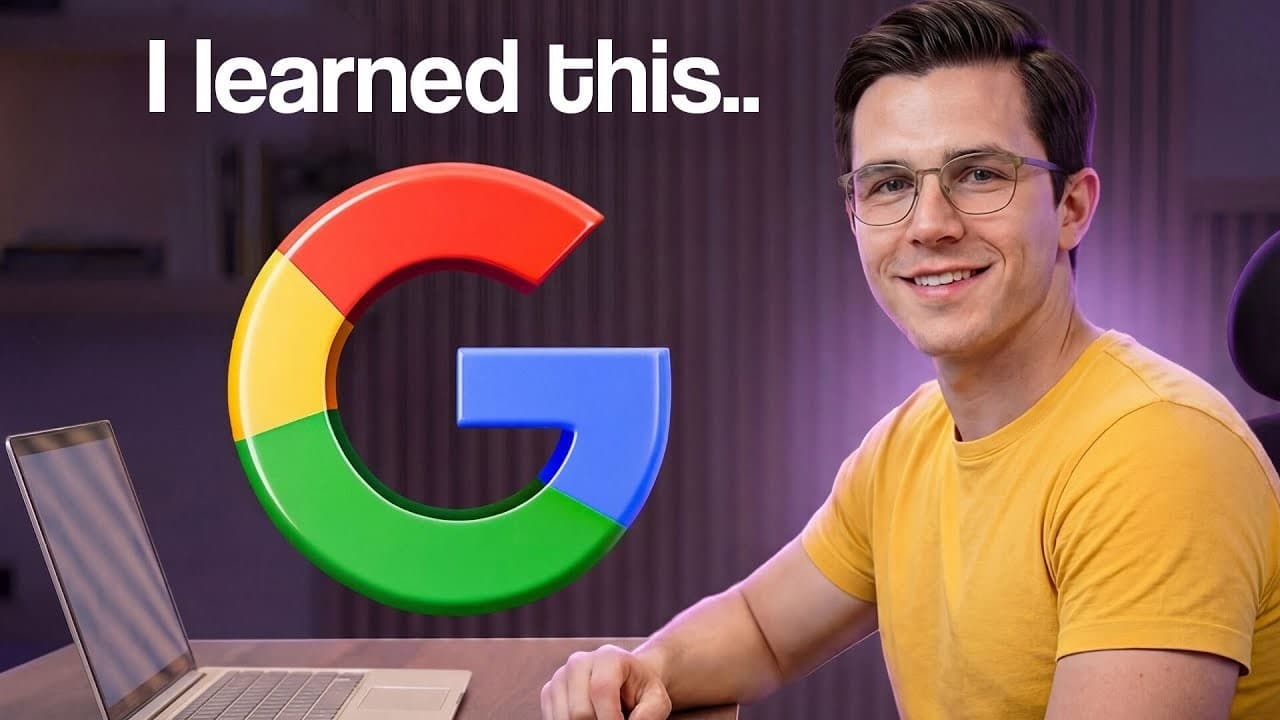
I just finished Google's six-hour prompt engineering course, and it is hands down the best AI training I have ever taken. So, I'm saving you the time, and I've packed every essential tactic Google revealed into this guide, so you can master the entire system in under 12 minutes. Of course, I can't fit every lesson from this 9-hour course into one v... Read More
Key Insights
- A strong task is an exact description of the required output, not merely a broad topic. Adding a persona gives the model a specific professional lens, while defining a format such as bullets, a table, or JSON produces a more usable deliverable.
- Context is the background information that steers an AI response toward the intended audience and purpose. Product details, user frustrations, demographic information, differentiators, and tone reduce the amount the model must guess and make the resulting content less generic.
- References are concrete examples that demonstrate the desired style or structure. Supplying successful product descriptions or high-performing social posts gives the model an observable pattern to follow instead of relying only on vague adjectives about voice, tone, or quality.
- Evaluation is the deliberate process of checking whether an output completes the assigned task, uses the intended tone, and relies on accurate information. Accepting a plausible response without systematic review can leave factual errors, stylistic mismatches, or missed requirements undetected.
- Iteration is a loop of asking, checking, adjusting, and asking again. Weak prompts can be improved by revisiting missing framework elements, splitting dense instructions into simpler sentences, reframing the request as an analogous task, or adding constraints that narrow the possible response.
- Multimodal prompting uses images, audio, or video instead of relying entirely on written descriptions. A website screenshot can support specific design feedback, while an audio file can support analysis of a piece's mood and suggestions for alternative arrangement directions.
- Prompt chaining builds complex work by using one response as the input for the next prompt. Generating options, refining selected candidates, and then creating an execution plan lets the model develop a project logically instead of handling every requirement in one oversized request.
- Human oversight is necessary because AI models can hallucinate authoritative-sounding false information and reproduce biases learned from internet data. The user remains responsible for verifying claims, questioning assumptions, reviewing reasoning, and deciding whether the final output is safe and appropriate to use.
Install to Summarize YouTube Videos and Get Transcripts
Explore YouTube Video Summarizer or Get YouTube Transcript Extractor
Questions & Answers
Q: How do you structure an effective AI prompt?
An effective AI prompt begins with the exact task or deliverable, then adds the necessary context, relevant references, and the preferred persona and output format. After the model responds, evaluate whether the answer completes the task, matches the requested tone, and uses accurate information. If it falls short, revise the prompt and repeat the process until the output meets the requirements.
Q: Why should an AI prompt include context?
Context reduces the information an AI model must guess. For landing-page copy, useful context can include what the product does, who the target users are, which problems frustrate them, how the product differs from alternatives, and what tone the writing should use. These details steer the response toward a specific audience and purpose, producing targeted copy instead of generic language.
Q: How do personas and formats improve AI responses?
A persona sets the professional lens through which the model should answer. Asking for a workout plan from the perspective of a physical therapist encourages safety guidance and anatomical focus. A format defines how the result should be organized, such as a bulleted list, table, or JSON snippet. Together, these instructions shape both the substance and usability of the response.
Q: How can reference examples improve AI-generated content?
Reference examples turn an abstract request into a concrete target. A user seeking product descriptions in a particular brand voice can provide three successful descriptions and ask the model to follow their style. Similarly, high-performing social posts can be supplied for pattern analysis before generating new posts. The model then imitates demonstrated characteristics instead of guessing what vague style labels mean.
Q: How do you fix a prompt that produces weak results?
A weak prompt can be repaired in four ways. First, check whether the original request omitted context, persona, or another framework element. Second, divide a dense paragraph into short, clear instructions. Third, reframe the request as an analogous task, such as a persuasive partnership argument instead of a business proposal. Fourth, impose specific constraints that narrow and focus the response.
Q: What is prompt chaining and when should you use it?
Prompt chaining uses the output of one prompt as the input for another, allowing a complex project to develop in stages. For a podcast launch, the model might first generate names, then create taglines for selected candidates, and finally build a four-week launch plan around the winning concept. This approach is useful when one large request contains several dependent decisions or deliverables.
Q: What is the difference between chain-of-thought and tree-of-thought prompting?
Chain-of-thought prompting asks the model to explain a decision step by step, which helps the user inspect the logic and identify flaws. Tree-of-thought prompting asks for several distinct reasoning paths or approaches at once. For an onboarding flow, those branches might emphasize speed, education, or personalization, with the experience and possible drop-off points examined for each option.
Q: Why must humans verify AI-generated answers?
Humans must verify AI output because models can invent false information that sounds authoritative and can reproduce gender, racial, or cultural biases present in their training data. The human-in-the-loop approach makes the user the final safety check. Claims should be verified, assumptions questioned, and the output reviewed for accuracy, bias, tone, and suitability before it is used in real work.
Summary & Key Takeaways
-
Google's prompting framework follows five principles: task, context, references, evaluate, and iterate. The task should name the exact deliverable, while persona and format shape the perspective and structure. Context reduces guessing by describing the audience, purpose, product, constraints, and tone needed for a targeted response.
-
References provide concrete examples of the desired voice, pattern, or structure. After receiving an answer, the user should evaluate whether it fulfills the task, matches the intended tone, and uses accurate information. Iteration improves weak results by filling missing details, simplifying instructions, changing the framing, or adding tighter constraints.
-
Advanced prompting can use images, audio, and video as direct references, connect outputs through prompt chaining, request step-by-step reasoning, or explore multiple approaches with tree-of-thought prompting. These methods support complex projects, but human oversight remains essential because models can invent plausible falsehoods and reflect biases from their training data.
Read in Other Languages (beta)
Share This Summary 📚
Summarize YouTube Videos and Get Video Transcripts with 1-Click
Try YouTube Summary with ChatGPT & Claude or YouTube Transcript Generator
Explore More Summaries from Parker Prompts 📚





Summarize YouTube Videos and Get Video Transcripts with 1-Click
Try YouTube Summary with ChatGPT & Claude or YouTube Transcript Generator