What Does the Reflection 70B Controversy Reveal About Our Perspective on LLMs?
TL;DR
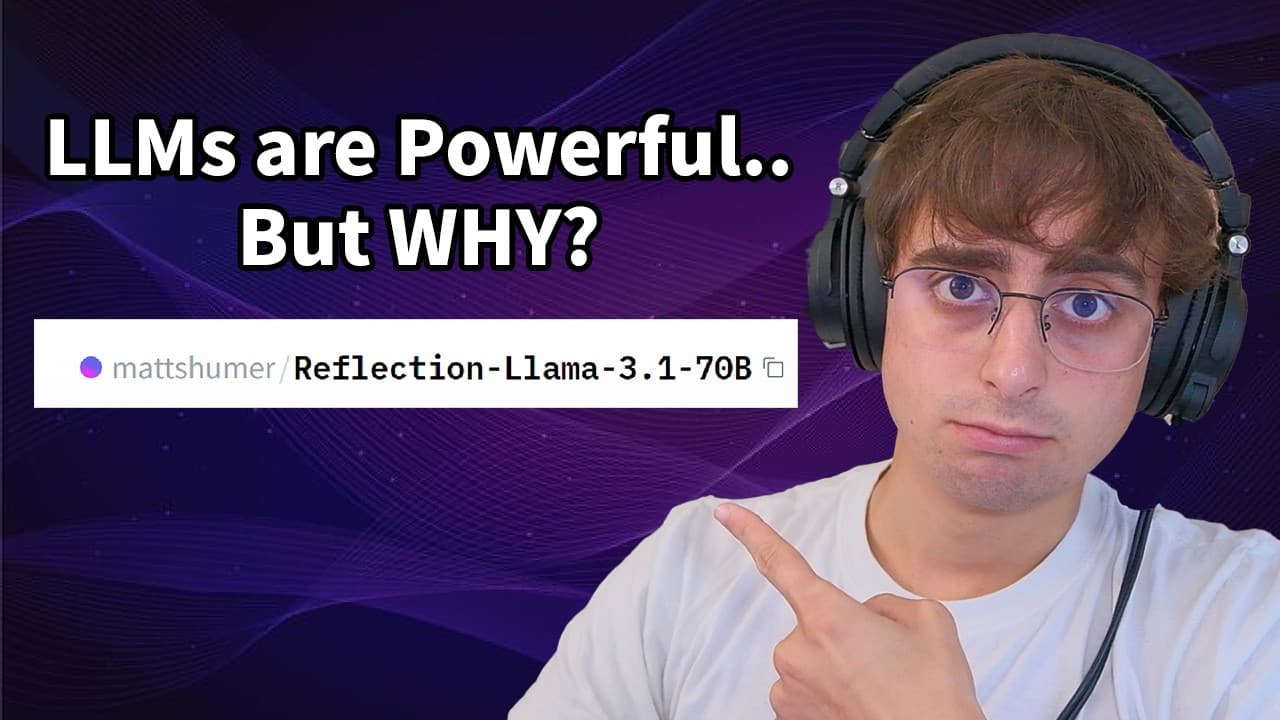
The Reflection 70B controversy suggests that strong LLM performance may depend as much on prompting as on fine-tuning. Matt Schumer presented the Llama 70B fine-tune as the world’s top open-source model, but downloaded weights severely underperformed, and its API was suspected of wrapping Claude 3.5 Sonnet with prompting techniques. Read on to understand what remains unresolved and why benchmarking deserves reconsideration.
Transcript
this whole situation has me incredibly frustrated by and large here's what's happened recently Matt Schumer who is well known in the AI space for his work on small open source large language model projects is announcing a fine tune of llama 70b called reflection 70b and is claiming that it is the world's top open- Source model and he claims that it... Read More
Key Insights
- Reflection 70B is a fine-tuned large language model developed by Matt Schumer.
- The model was initially claimed to be the top open-source model but faced performance issues.
- An API release led to suspicions it was a wrapper for Claude 3.5 Sonnet, causing community distrust.
- The model is now available for testing, showing differences in fine-tuning versus system prompting.
- Prompting techniques can significantly enhance large language model performance.
- Reflection tuning is a method where models are fine-tuned to self-correct during inference.
- The controversy emphasizes the need to rethink AI benchmarking methods.
- Matt Schumer's approach suggests potential in applying prompting techniques natively within models.
Install to Summarize YouTube Videos and Get Transcripts
Explore YouTube Video Summarizer or Get YouTube Transcript Extractor
Questions & Answers
Q: What does the Reflection 70B controversy reveal about LLM performance?
It shows how difficult it can be to separate the effects of fine-tuning from those of effective prompting. The community could not determine whether Reflection 70B was genuinely a strong model or appeared strong because it was being prompted correctly or better.
Q: What is Reflection 70B?
Reflection 70B is Matt Schumer’s fine-tune of Llama 70B. It was presented as the world’s top open-source model and trained using reflection tuning, which is intended to help LLMs fix their own mistakes during inference.
Q: Why did Reflection 70B become controversial?
People who downloaded the open-source weights found that the model severely underperformed expectations. Updated weights performed a little better, while users also concluded that the official API was apparently wrapping Claude 3.5 Sonnet with prompting techniques applied.
Q: Was the Reflection 70B API actually Claude 3.5 Sonnet?
Users on Reddit and elsewhere apparently determined that the API was a wrapper for Claude 3.5 Sonnet with prompting techniques. However, the transcript says there was still no answer or conclusion about the API situation, so no definitive judgment could be made.
Q: Is the released Reflection 70B model real?
The available model appeared to be a real 70B-sized model fine-tuned to perform reflection inference. The creator of the video had access to the real weights and had been using the model, even though questions about the separate API remained unresolved.
Q: Did replacing the Reflection 70B weights fix its performance?
Matt Schumer said the original weights had an issue and uploaded new ones. Community testing found the replacement performed a little better, but uncertainty about whether Reflection 70B was actually a very good model remained.
Q: What is reflection tuning?
Reflection tuning is described as a technique designed to enable LLMs to fix their own mistakes during inference. Reflection 70B was fine-tuned to perform this reflection process, though its advantage over applying better prompts was still unclear.
Q: Why should Reflection 70B change how AI models are benchmarked?
The controversy indicates that benchmark results may not clearly distinguish a model’s underlying capabilities from gains produced by prompting techniques. Because the community still could not separate Reflection 70B’s fine-tuning from the effects of better prompting, the situation supports reassessing how model performance is evaluated.
Summary & Key Takeaways
-
Reflection 70B, developed by Matt Schumer, is a fine-tuned model that initially underperformed, leading to controversy over its API being a wrapper for another model. Despite this, the real model is now available and exhibits differences in performance when compared to system prompting. This situation underscores the importance of reassessing AI benchmarking and the potential of prompting techniques.
-
The controversy surrounding Reflection 70B reveals significant insights into the role of prompting in large language models. While the model's initial performance issues led to community distrust, its availability has allowed for further testing. This has highlighted the need to explore the efficacy of fine-tuning versus system prompting in AI development.
-
Reflection 70B's release and subsequent controversy highlight the complexities of AI model performance and the role of prompting. The situation calls for a reassessment of AI benchmarking methods and suggests that prompting techniques could play a crucial role in enhancing model capabilities. This reflects a broader need to understand and leverage AI's potential more effectively.
Read in Other Languages (beta)
Share This Summary 📚
Summarize YouTube Videos and Get Video Transcripts with 1-Click
Try YouTube Summary with ChatGPT & Claude or YouTube Transcript Generator
Explore More Summaries from MattVidPro 📚






Summarize YouTube Videos and Get Video Transcripts with 1-Click
Try YouTube Summary with ChatGPT & Claude or YouTube Transcript Generator