How to Identify Effective Trading Strategies
TL;DR
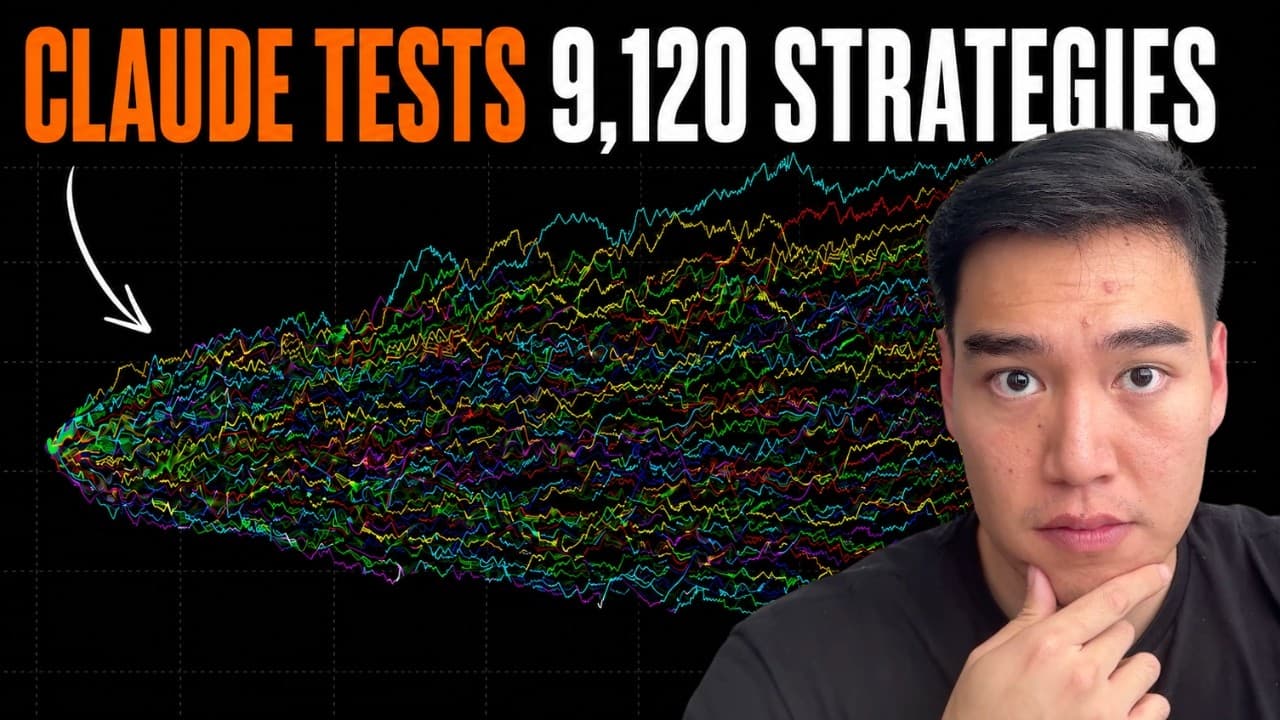
Mean reversion is the most reliable trading strategy across various market conditions over 15 years. It consistently outperforms other strategies like trend and momentum, which are more situational. By using rigorous backtesting with filters, you can identify strategies with a real edge and customize them based on personal risk tolerance and market conditions.
Transcript
I used claw to run over 9,000 back tests of trading strategies to find ones that actually work. This included every popular one that you can think of like trend following, mean reversion, momentum, breakouts, and this was across 30 different assets and 15 years of data. Now, if it's your first time on the channel, my name is Brendan. I studied math... Read More
Key Insights
- Mean reversion is the only strategy that consistently performs well across different market conditions over 15 years.
- Trend and momentum strategies can work but are highly situational, depending on the market and asset.
- Backtesting with walk forward testing helps avoid overfitting by using unseen data to validate strategies.
- A Sharpe ratio filter above 0.5 was used to eliminate 8,000 ineffective strategies from 9,000 tested.
- Robustness checks, like bootstrap reshuffling, ensure that successful trades aren't just due to luck.
- Combining uncorrelated signals can create a more robust strategy than relying on a single signal.
- Market regimes can be identified using models like Hidden Markov, optimizing strategy application based on market conditions.
- Using AI tools like Claude allows for customized backtesting, offering more control than standard platforms like Trading View.
Install to Summarize YouTube Videos and Get Transcripts
Explore YouTube Video Summarizer or Get YouTube Transcript Extractor
Questions & Answers
Q: How does mean reversion work as a trading strategy?
Mean reversion bets that when a price deviates significantly from its average, it will revert back. Traders buy when prices drop below the average, expecting a bounce, and sell when prices rise above the average, anticipating a fall. This strategy is effective across various assets and market conditions, offering a reliable edge over time.
Q: What is walk forward testing in trading?
Walk forward testing involves building and tuning a strategy on historical data, then testing it on new, unseen data. This approach helps prevent overfitting, ensuring that a strategy's success isn't just due to fitting past data but is applicable to future market conditions. It provides a more realistic assessment of a strategy's viability.
Q: Why are trend and momentum strategies considered situational?
Trend and momentum strategies rely on specific market conditions to succeed. Trend strategies bet on continued movement in one direction, while momentum strategies focus on strong assets continuing their performance. Their effectiveness varies based on the asset and market state, making them less reliable than mean reversion, which adapts more broadly.
Q: What role do robustness checks play in strategy validation?
Robustness checks, such as bootstrap reshuffling, test the consistency of a strategy by simulating different sequences of trades. This process helps determine if a strategy's success is due to genuine edge or mere chance. By reshuffling trades multiple times, traders can ensure that a strategy remains effective across various scenarios, not just a single path.
Q: How can AI tools like Claude enhance trading strategy development?
AI tools like Claude allow traders to build customized backtesting systems, offering more control over validation processes than standard platforms. Users can implement specific filters, correct for luck, and stress test strategies, ensuring a robust and reliable trading system. This customization leads to more accurate assessments and improved trading performance.
Q: What is the significance of using a Sharpe ratio filter in backtesting?
A Sharpe ratio filter measures the return of a strategy relative to its risk, with higher values indicating better risk-adjusted returns. By setting a minimum Sharpe ratio threshold, traders can eliminate strategies that don't provide sufficient returns for their risk, ensuring that only viable strategies are considered for live trading.
Q: How can market regimes be identified for strategy optimization?
Market regimes can be identified using models like Hidden Markov, which categorize the current market state as trending, choppy, or bullish. By aligning strategies with these regimes, traders can apply the most suitable strategy for each condition, such as using momentum in trending markets and mean reversion in choppy markets, optimizing performance.
Q: Why is it important to combine uncorrelated signals in trading?
Combining uncorrelated signals diversifies a trading strategy, reducing reliance on any single signal that may be weak or noisy. By integrating multiple signals that don't move together, traders can create a more robust and reliable system, increasing the chances of consistent performance across various market conditions and reducing overall risk.
Summary & Key Takeaways
-
Mean reversion stands out as the most reliable trading strategy, consistently performing well over 15 years of market data. Unlike trend and momentum strategies, which are situational, mean reversion offers a stable foundation for traders. By employing rigorous backtesting methods, traders can identify strategies with a genuine edge.
-
Backtesting using walk forward testing and Sharpe ratio filters helps eliminate ineffective strategies and prevent overfitting. Robustness checks, such as bootstrap reshuffling, ensure that successful trades are not just due to chance, providing traders with more reliable strategies.
-
AI tools like Claude enable traders to customize backtesting processes, offering greater control and validation than standard platforms. By identifying market regimes and combining uncorrelated signals, traders can optimize strategy application based on specific market conditions, enhancing the effectiveness of their trading systems.
Read in Other Languages (beta)
Share This Summary 📚
Summarize YouTube Videos and Get Video Transcripts with 1-Click
Try YouTube Summary with ChatGPT & Claude or YouTube Transcript Generator
Explore More Summaries from AI Pathways 📚


Summarize YouTube Videos and Get Video Transcripts with 1-Click
Try YouTube Summary with ChatGPT & Claude or YouTube Transcript Generator