How to Use AI for Building Trading Strategies
TL;DR
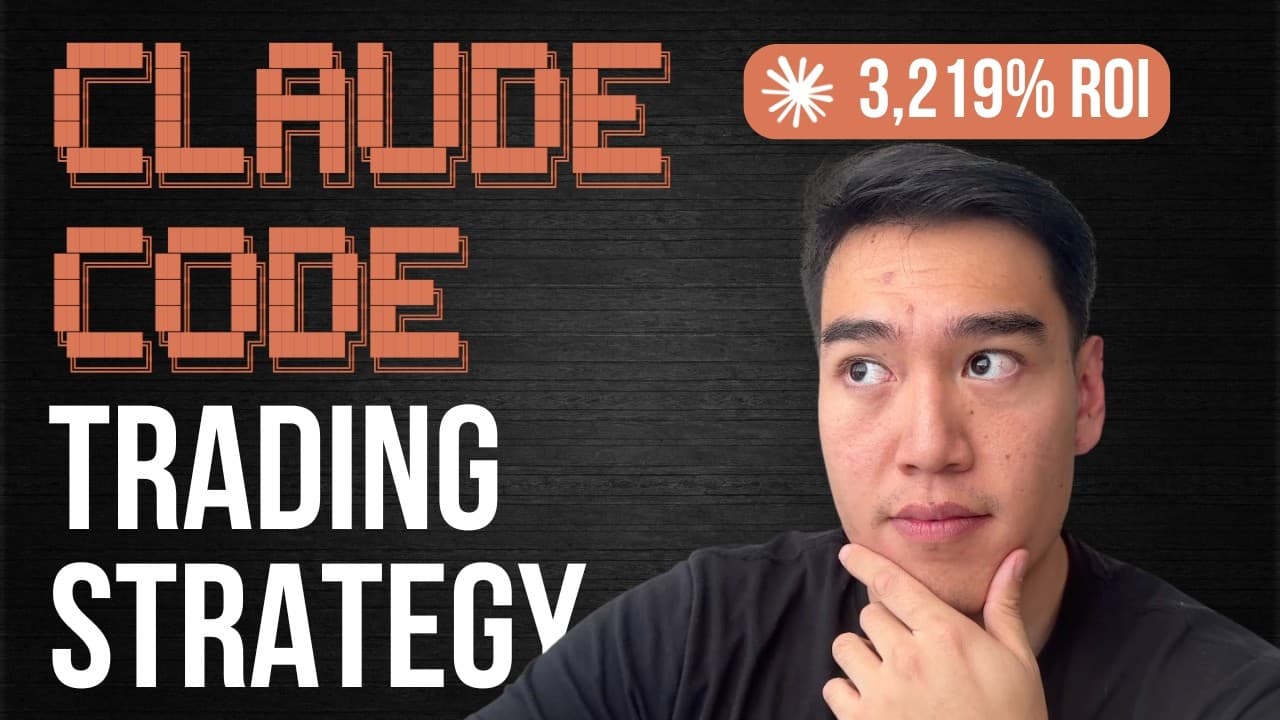
Using AI, specifically Claude Code, you can build and train a complex trading model without needing extensive coding skills. The model uses Hidden Markov Models to detect market regimes, allowing traders to adapt strategies dynamically. This approach mimics institutional trading strategies, providing a sophisticated way to manage trades based on market conditions.
Transcript
In today's video, I'm going to show you how you can copy the exact strategies used by quants and hedge funds completely with AI. Now, this is going to be super exciting because we're not just using simple Trading View strategies and indicators. We'll be building and training our own AI model to behave just like actual institutions instead of retail... Read More
Key Insights
- Hidden Markov Models (HMM) are used to predict market regimes rather than prices.
- Claude Code automates the complex coding required to implement HMMs.
- The regime terminal labels market conditions into seven states to guide trading decisions.
- Strategies can be fine-tuned using AI, adjusting leverage and entry/exit signals.
- The model can simulate historical data to evaluate strategy performance.
- AI allows for dynamic strategy adjustments to maintain profitability as markets evolve.
- The system includes risk management features like cooldown periods and leverage simulations.
- AI trading strategies are more adaptable than static scripts, offering a probabilistic approach to market changes.
Install to Summarize YouTube Videos and Get Transcripts
Explore YouTube Video Summarizer or Get YouTube Transcript Extractor
Questions & Answers
Q: How do Hidden Markov Models help in trading?
Hidden Markov Models (HMM) assist in trading by predicting market regimes instead of prices. They identify patterns such as bull runs, crashes, or choppy conditions, enabling traders to adjust their strategies accordingly. By understanding the current market state, traders can make informed decisions on entering, exiting, or holding positions, enhancing their ability to navigate complex market conditions.
Q: What role does Claude Code play in building trading models?
Claude Code simplifies the process of building trading models by automating the complex coding required for implementing Hidden Markov Models. It enables traders to create sophisticated algorithmic models without extensive programming knowledge, allowing them to focus on strategy development and optimization. Claude Code handles the heavy lifting, making advanced trading techniques accessible to a broader audience.
Q: Why are AI-driven trading strategies more adaptable?
AI-driven trading strategies are more adaptable because they use probabilistic methods to adjust to market changes dynamically. Unlike static scripts, these strategies continuously evolve, incorporating new data and insights to refine their approach. This adaptability ensures that the trading model remains effective in various market conditions, maintaining profitability by responding to shifts in market dynamics and structure.
Q: How does the regime terminal guide trading decisions?
The regime terminal guides trading decisions by labeling market conditions into seven distinct regimes, such as bull runs, crashes, or noise. Each regime provides specific guidance on whether to enter, exit, or hold positions. By understanding the current regime, traders can align their strategies with market conditions, optimizing their approach to enhance profitability and manage risk effectively.
Q: What are the benefits of simulating historical data in trading?
Simulating historical data in trading allows traders to evaluate the performance of their strategies under different market conditions. By backtesting strategies, traders can identify strengths and weaknesses, refine their approach, and gain confidence in their model's ability to perform in real-world scenarios. This process helps ensure that the trading model is robust and capable of adapting to future market changes.
Q: How can traders fine-tune their strategies using AI?
Traders can fine-tune their strategies using AI by adjusting parameters such as leverage, entry/exit signals, and risk management rules. AI models provide feedback on strategy performance, allowing traders to make data-driven adjustments to improve outcomes. This iterative process helps optimize strategies for current market conditions, ensuring that the model remains effective and profitable over time.
Q: What is the significance of risk management in AI trading models?
Risk management is crucial in AI trading models as it helps protect against significant losses and ensures long-term profitability. Features like cooldown periods, leverage simulations, and exit rules manage exposure and mitigate risks associated with volatile market conditions. Effective risk management allows traders to maintain control over their strategies, enhancing stability and confidence in their trading decisions.
Q: How does AI enhance the profitability of trading strategies?
AI enhances the profitability of trading strategies by continuously adapting to market changes and optimizing decision-making processes. By leveraging advanced algorithms and real-time data analysis, AI models can identify profitable opportunities, adjust strategies dynamically, and manage risks effectively. This adaptability ensures that trading strategies remain relevant and profitable, even as market conditions evolve.
Summary & Key Takeaways
-
Using Claude Code, traders can build AI-driven models that mimic hedge fund strategies. The model employs Hidden Markov Models to identify market regimes, allowing traders to adjust their strategies dynamically. This method offers a sophisticated way to manage trades, adapting to evolving market conditions without extensive coding skills.
-
The trading model labels market conditions into seven regimes, providing guidance on whether to enter, exit, or hold positions. By fine-tuning strategies with AI, traders can optimize leverage and entry/exit signals, ensuring the model remains profitable as markets change.
-
AI-driven trading strategies offer a more flexible approach than traditional scripts, using probabilistic methods to adapt to market shifts. The system includes risk management features, such as cooldown periods and leverage simulations, to enhance trading decisions and maintain profitability.
Read in Other Languages (beta)
Share This Summary 📚
Summarize YouTube Videos and Get Video Transcripts with 1-Click
Try YouTube Summary with ChatGPT & Claude or YouTube Transcript Generator
Explore More Summaries from AI Pathways 📚


Summarize YouTube Videos and Get Video Transcripts with 1-Click
Try YouTube Summary with ChatGPT & Claude or YouTube Transcript Generator