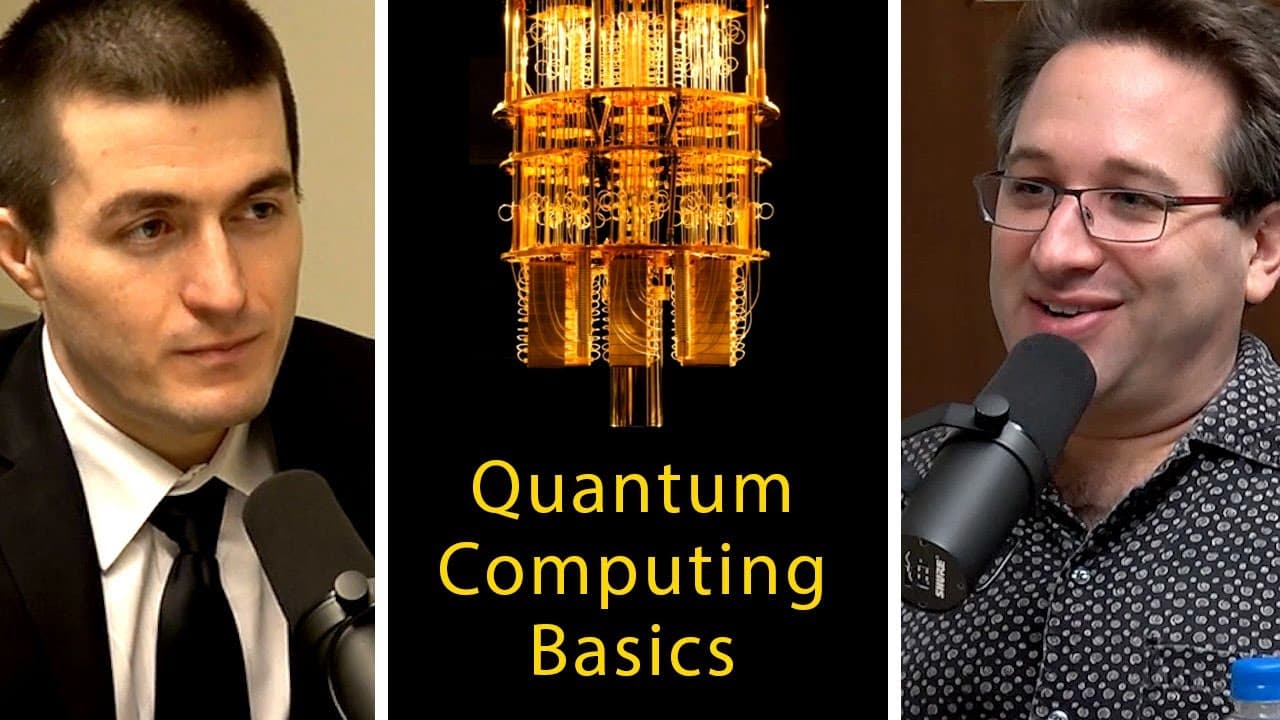
Scott Aaronson: What is a Quantum Computer? | AI Podcast Clips
TL;DR
Quantum computing is a revolutionary computational paradigm that leverages quantum mechanics principles like superposition and interference. It utilizes qubits to solve complex problems significantly faster than classical computers, though challenges like noise and decoherence must be overcome to achieve practical applications.
Transcript
as you said mono computing at least in the 1990s was a profound story at the intersection of computer science physics engineering math and philosophy so the there's this broad and deep aspect to quantum computing that represents more than just the quantum computer yes but can we start at the very basics what is quantum computing yeah so it's a prop... Read More
Key Insights
- 🏑 Quantum computing is a multidisciplinary field that combines computer science, physics, engineering, math, and philosophy.
- 🦾 The principles of quantum mechanics have been in place since 1926, but the application for computation is a recent development.
- 👻 Quantum mechanics describes the world using amplitudes, allowing for the concept of superposition and interference.
- 🖱️ Quantum computers aim to use superposition and interference to solve problems faster than classical computers.
- 😌 The challenge of building a scalable quantum computer lies in overcoming noise and decoherence.
- 🤑 Error-corrected quantum computers are the ultimate goal, where unreliable qubits can be used to simulate reliable ones.
- 💢 The current era of quantum computing is characterized by noisy intermediate-scale devices, with the potential to outperform classical computers.
- 🐎 Achieving practical quantum advantage over classical computation is a race among researchers, companies, and governments, requiring breakthroughs in engineering, physics, computer science, and investments.
- 🎙️ More videos with Scott Aaronson:
Install to Summarize YouTube Videos and Get Transcripts
Explore YouTube Video Summarizer or Get YouTube Transcript Extractor
Questions & Answers
Q: What is quantum computing?
Quantum computing is a new proposal for computation that utilizes the principles of quantum mechanics, such as superposition and interference, to solve problems faster than classical computers.
Q: How does quantum mechanics describe the world?
Quantum mechanics describes the world using amplitudes, which assign complex numbers to every possible configuration of a system, unlike probabilities in classical mechanics.
Q: How do qubits work in quantum computing?
Qubits are the basic building blocks of quantum computers. They are superpositions of 0 and 1 states, and their interactions with each other are choreographed to exploit interference and solve problems efficiently.
Q: What is the challenge of noise in quantum computing?
Noise, or decoherence, is unwanted interaction between qubits and the external environment. It causes qubits to lose their quantum state and affects the reliability of a quantum computer.
Key Insights:
- Quantum computing is a multidisciplinary field that combines computer science, physics, engineering, math, and philosophy.
- The principles of quantum mechanics have been in place since 1926, but the application for computation is a recent development.
- Quantum mechanics describes the world using amplitudes, allowing for the concept of superposition and interference.
- Quantum computers aim to use superposition and interference to solve problems faster than classical computers.
- The challenge of building a scalable quantum computer lies in overcoming noise and decoherence.
- Error-corrected quantum computers are the ultimate goal, where unreliable qubits can be used to simulate reliable ones.
- The current era of quantum computing is characterized by noisy intermediate-scale devices, with the potential to outperform classical computers.
- Achieving practical quantum advantage over classical computation is a race among researchers, companies, and governments, requiring breakthroughs in engineering, physics, computer science, and investments.
Note: The provided content is highly technical and may be difficult to digest for readers unfamiliar with quantum computing.
Summary
This video provides an introduction to quantum computing, discussing the principles of quantum mechanics, the concept of quantum bits (qubits), and the challenges facing the development of quantum computers. The speaker explains the fundamentals of quantum information and the encoding of information in qubits, as well as the problem of noise and decoherence in quantum systems. The video explores the need for error-correcting codes and the current state of quantum computing, emphasizing the progress made in recent years but also acknowledging the remaining challenges.
Questions & Answers
Q: What is quantum computing?
Quantum computing is a proposal for a new type of computation that harnesses the principles of quantum mechanics. It aims to use superposition and interference of quantum states to perform computations more efficiently than classical computers.
Q: How does quantum mechanics describe the world?
Quantum mechanics describes the world using amplitudes, which are complex numbers that represent the possibilities for the behavior of a quantum system. These amplitudes can be positive or negative, and even complex, unlike probabilities. Quantum mechanics allows for superposition, where a system can exist in multiple states simultaneously, and interference, where amplitudes can cancel each other out or reinforce each other.
Q: How does interference work in quantum mechanics?
Interference in quantum mechanics occurs when the amplitudes of different paths leading to a certain outcome interfere with each other. This interference can result in the cancellation or reinforcement of amplitudes and influences the probabilities associated with different outcomes. For example, in the double-slit experiment, interference occurs when the paths an electron can take interfere with each other, leading to a pattern of bright and dark regions on a screen.
Q: What is a quantum computer?
A quantum computer is a computer that uses superposition, interference, and other quantum phenomena to solve certain problems faster than classical computers. It is built using quantum bits or qubits, which can be in superpositions of 0 and 1 states. Multiple qubits can be used together to encode complex information and perform computations.
Q: How is information represented in quantum computing?
Information in quantum computing is represented using qubits, which are the basic unit of quantum information. A qubit can exist in a superposition of 0 and 1 states and can be manipulated to perform computations. While different physical systems can be used to implement qubits, the abstract logic and manipulation of qubits remain the same.
Q: Does the physical design of a qubit affect the higher levels of abstraction?
Currently, the physical design and implementation of qubits do affect the behavior at higher levels of abstraction. Due to the noise and decoherence present in current quantum computers, the qubits must be carefully isolated from their environment while still being manipulated. However, there are efforts to eventually decouple the logic of qubits from the hardware, allowing for greater abstraction in programming quantum computers.
Q: What is the problem of noise and decoherence in quantum computing?
Noise and decoherence refer to unwanted interactions between qubits and their environment, causing the loss of quantum state and leading to errors in computations. Maintaining qubits in isolation while also allowing controlled interactions is a significant challenge in building a scalable quantum computer. However, the theory of quantum error correction provides techniques to detect and correct errors, even with imperfect qubits.
Q: What is quantum error correction?
Quantum error correction is a theoretical framework that allows the encoding of quantum information across multiple qubits to detect and correct errors arising from noise and decoherence. By redundantly encoding information and using error correction codes, the impact of errors can be minimized, and reliable quantum computations can be achieved with imperfect qubits.
Q: How does error correction impact the scalability of quantum computers?
Error correction imposes an overhead in the number of qubits required to perform computations reliably. Each logical qubit needs to be encoded using multiple physical qubits, resulting in a significant increase in the number of qubits needed. Currently, the overhead is substantial, making it challenging to build large-scale error-corrected quantum computers. However, ongoing research aims to develop better error-correcting codes and techniques to reduce this overhead.
Q: What is the current state of quantum computing?
We are currently in the noisy intermediate scale quantum (NISQ) era, where non-error corrected quantum computers can perform computations that are hard for classical computers to simulate. While error-corrected quantum computers are the ultimate goal, we are still far from reaching that point. Progress has been made in recent years, and various organizations and research labs are continuously working towards building more capable quantum computers.
Takeaways
In summary, quantum computing represents a new way to harness the principles of quantum mechanics for computation. It relies on the properties of superposition and interference to encode and manipulate information in qubits. The challenge lies in maintaining and manipulating qubits while mitigating the impact of noise and decoherence. Error correction techniques allow for reliable quantum computations, but the overhead in the number of qubits remains a significant obstacle. The current state of quantum computing is in the NISQ era, where non-error corrected quantum computers can demonstrate computational advantages over classical computers, albeit with limited scalability. Continued research and development are necessary to overcome these challenges and achieve the full potential of quantum computing.
Summary & Key Takeaways
-
Quantum computing is a new type of computation that harnesses the principles of quantum mechanics.
-
Quantum mechanics describes the world using amplitudes, which can be positive, negative, or complex numbers.
-
A quantum computer uses qubits, or quantum bits, to exploit superposition and interference to solve certain problems faster than classical computers.
Read in Other Languages (beta)
Share This Summary 📚
Summarize YouTube Videos and Get Video Transcripts with 1-Click
Try YouTube Summary with ChatGPT & Claude or YouTube Transcript Generator
Explore More Summaries from Lex Fridman 📚


Summarize YouTube Videos and Get Video Transcripts with 1-Click
Try YouTube Summary with ChatGPT & Claude or YouTube Transcript Generator