How to Turn Confusion Into Faster Learning
TL;DR
Treat confusion as evidence that your brain is trying to organize new information, then convert that feeling into specific questions and answer them one by one. Repeating this cycle reveals knowledge gaps, directs attention toward what matters, and prevents passive reading from adding disconnected information until the subject feels overwhelming.
Transcript
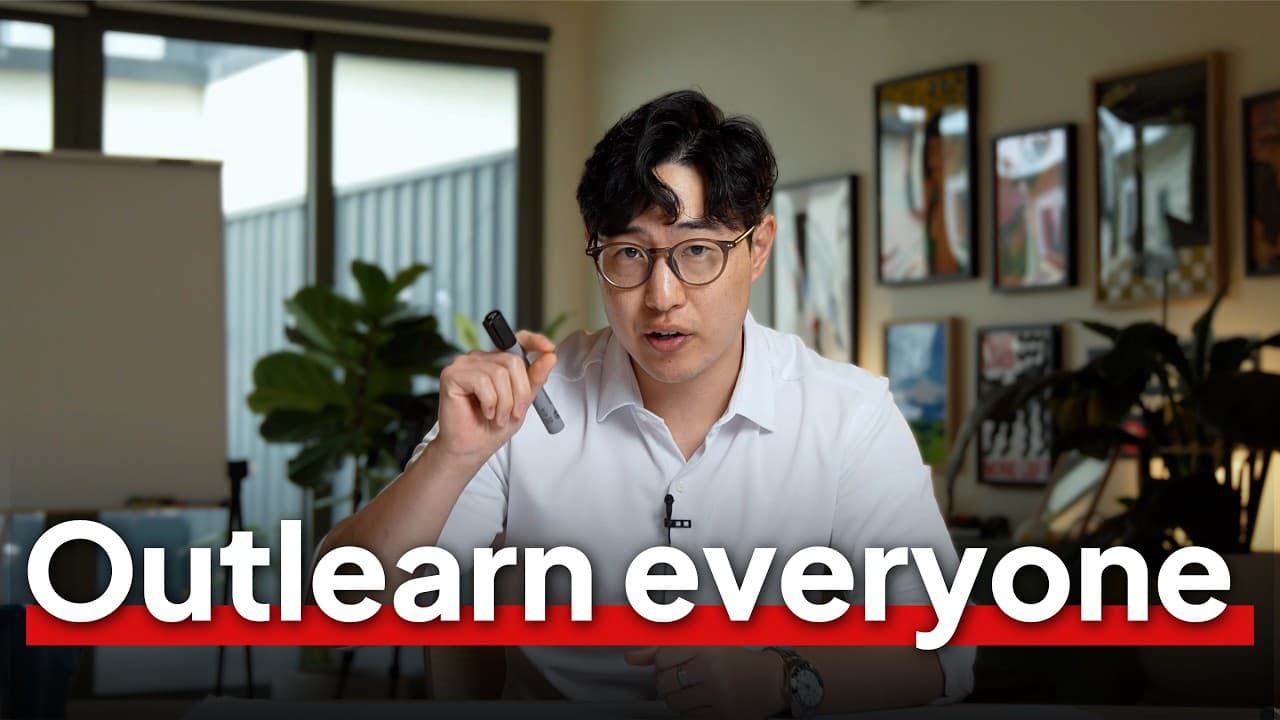
As a learning coach, there is one strategy that I see only the best learners use. In fact, it's so powerful that if I see someone using this strategy, I know that they're going to become a very efficient learner. And if someone is not using this, >> [music] >> there's almost no chance. And while I don't think there's anything as a best learning str... Read More
Key Insights
- Confusion is a symptom of learning because it arises when the brain is trying to interpret new data, decide where it belongs, and connect it with other knowledge. The feeling is therefore not automatically evidence of poor learning or inadequate ability.
- The Confusion Compass is a process of turning uncertainty into specific questions, writing those questions down, and finding their answers. Its purpose is to transform an uncomfortable but vague emotion into a targeted learning strategy that can guide immediate action.
- A lack of confusion can be a warning sign because passive exposure may occur without any attempt to connect ideas. Glazed eyes, boredom, or sleepiness while reading documentation can indicate that the learner is consuming information without actively examining what it means.
- Contextual questions can trigger productive confusion by connecting information to the reason it is being learned. Asking how knowledge affects a project, workflow, cost, implementation, or expected benefit exposes uncertainties that passive reading may leave unnoticed.
- Writing questions reveals knowledge gaps because the learner must identify exactly what remains unclear. This examination focuses attention on missing connections and produces a practical list of issues whose resolution should make the subject easier to understand.
- Learning works as a repeating cycle of confusion, questions, and answers. Answers can create further uncertainty, which leads to new questions and continued investigation. The faster a learner engages with this cycle, the faster the speaker says that person can learn.
- Passive reading can increase overwhelm because it adds more data without establishing meaningful connections. When learners hope that additional material will eventually create clarity, they may instead accumulate more disconnected points and expand the number of things they do not understand.
- Learning efficiency depends on simple strategies that reliably work, rather than an elaborate collection of perfectly connected applications. The Confusion Compass is presented as a high-value technique that can be applied to software, business, marketing, content creation, medicine, AI, and learning science.
- More videos from this channel:
- More from this channel: Justin Sung
Install to Summarize YouTube Videos and Get Transcripts
Explore YouTube Video Summarizer or Get YouTube Transcript Extractor
Questions & Answers
Q: What is the Confusion Compass learning method?
The Confusion Compass is a learning method that converts a general feeling of confusion into a list of specific questions. A learner asks which answers would make the topic less confusing, writes those questions down, and investigates them. This process exposes gaps in understanding, directs attention toward those gaps, and creates a repeatable cycle of confusion, questioning, and answering.
Q: Why can confusion be a sign of active learning?
Confusion can signal active learning because new information initially arrives as data that the brain must interpret and organize. The brain is trying to determine what the information means, where it belongs, and how it connects with other ideas. That unresolved effort creates confusion, much like a detective examining separate clues and trying to discover how they fit together.
Q: How do you turn confusion into useful study questions?
Start by noticing the specific area that feels unclear, then ask which answers would reduce that uncertainty. Write every resulting question as a concrete item and search for its answer. Useful questions may address comparisons, benefits, implementation, challenges, time, cost, complexity, use cases, or examples, depending on the subject and the reason it is being learned.
Q: What should you do when learning feels too easy?
When learning feels easy but attention is fading, introduce questions that connect the material to your actual purpose. Ask how the information helps your work, what implications it has, how it compares with alternatives, and where it fits into an existing workflow. These questions encourage the brain to examine relationships and can reveal confusion that passive reading had concealed.
Q: How can the Confusion Compass help with software documentation?
When reading documentation for a new software library, connect the material to the project where it may be used. Ask how the library compares with an existing option, what benefits it provides, how implementation works, what challenges may appear, and what time, cost, or complexity is involved. Examples and use cases can also help when the implementation is difficult to visualize.
Q: Why does passive reading make a difficult topic overwhelming?
Passive reading can create overwhelm because it keeps adding information without resolving the relationships among ideas. Instead of identifying the exact answers needed, the learner accumulates more disconnected points and more sources of uncertainty. Targeted questions encourage meaningful connections, while repeatedly reading in the hope of eventual clarity may expand confusion rather than organize it.
Q: How does the confusion and questioning cycle improve learning?
The cycle begins when new material creates uncertainty. The learner converts that uncertainty into questions, searches for answers, and then examines any new confusion produced by those answers. Repeating the process progressively clarifies the subject and keeps attention focused on current knowledge gaps. According to the speaker, faster engagement with this cycle leads to faster learning.
Q: Can the Confusion Compass be used outside academic study?
The Confusion Compass is presented as applicable to any body of knowledge, not only academic study. The speaker describes using it for business, marketing, content creation, medicine, AI, and learning science, while also illustrating its use with a software library. The same process applies across these areas: notice confusion, formulate targeted questions, answer them, and repeat.
Summary & Key Takeaways
-
Confusion is presented as a symptom of active learning because the brain must determine what new information means, where it belongs, and how it connects with existing knowledge. Feeling that material is simple can be misleading if the learner is merely consuming information without examining relationships, implications, or unresolved gaps.
-
The Confusion Compass turns a vague emotional state into an actionable process. Learners identify questions whose answers would reduce their confusion, write those questions down, and investigate them. Formulating questions forces closer examination of missing knowledge while producing a targeted research list that guides attention more efficiently than continued passive reading.
-
Learning develops through a repeating cycle of confusion, questioning, and answering. Each answer may reveal additional uncertainty and generate further questions. Moving through this cycle quickly improves learning efficiency, while simply adding more information can multiply disconnected ideas and transform manageable confusion into a broader sense of being overwhelmed.
Read in Other Languages (beta)
Share This Summary 📚
Summarize YouTube Videos and Get Video Transcripts with 1-Click
Try YouTube Summary with ChatGPT & Claude or YouTube Transcript Generator
Explore More Summaries from Justin Sung 📚


Summarize YouTube Videos and Get Video Transcripts with 1-Click
Try YouTube Summary with ChatGPT & Claude or YouTube Transcript Generator