How Can Technology Prevent Western Wildfires?
TL;DR
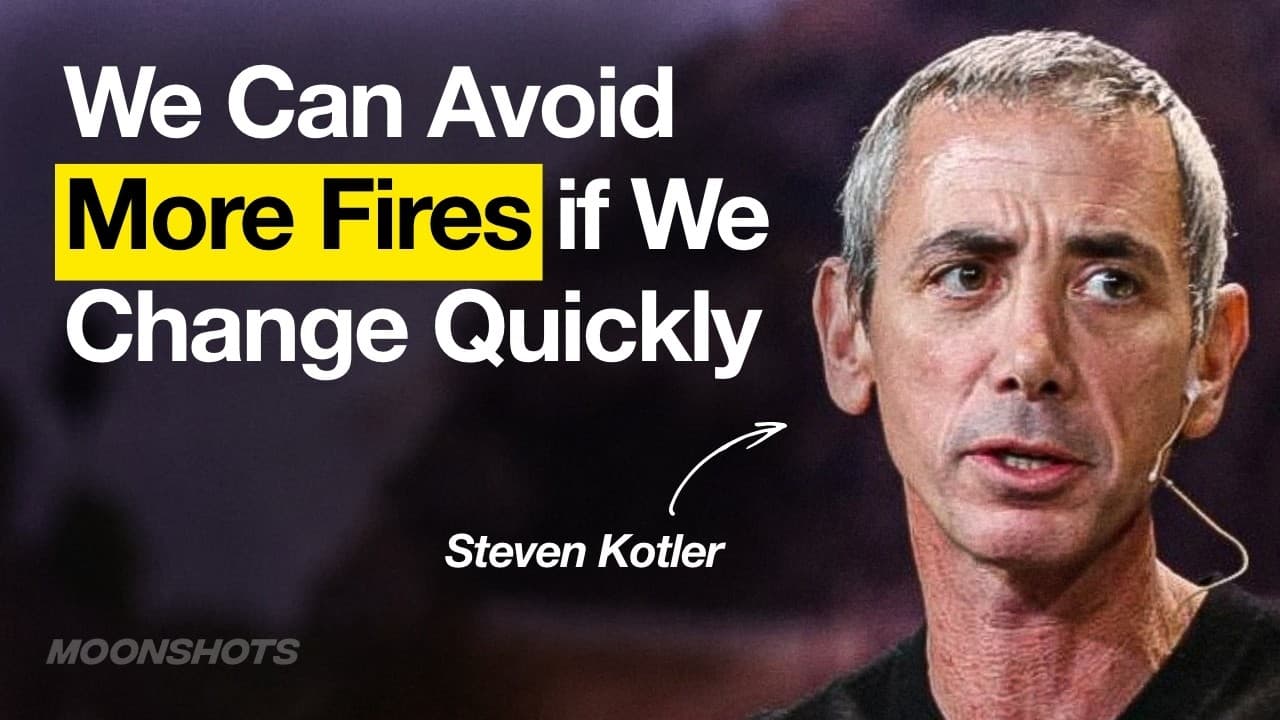
Reducing dry woody biomass below the stated 59 percent threshold could keep forest fires from becoming explosive, while faster detection and response technologies could stop ignitions earlier. Steven Kotler argues that entrepreneurs already have promising tools, but government barriers, fragmented stakeholders, limited funding, and inadequate monitoring of toxic pollution are preventing those solutions from being deployed at the required scale.
Transcript
most experts believe that almost all the forests in the American West are going to burn over the next 10 to 20 years this is not the first fire this is just the canary and the coal mine the downstream Health consequences are really really severe here I am every day working out being healthy what watching what I eat you know my sleep all of those th... Read More
Key Insights
- • Wildfire risk is described as a regional crisis, not an isolated Los Angeles event. Kotler says most experts he consulted expect almost all forests in the American West to burn within 10 to 20 years, with the main disagreement concerning the timing.
- • Excess woody biomass is presented as the central source of extreme fire behavior. Kotler says fires can extinguish themselves when continental forest biomass falls below 59 percent, while fuel loads across the American West are generally above 60 percent.
- • Lake Tahoe is described as containing 248 million bone-dry tons of wood that must be removed before the surrounding forest is considered safe. This figure illustrates the immense processing and transportation challenge involved in reducing hazardous forest fuel at regional scale.
- • Cataclysmic fires are said to persist across multiple seasons until available fuel is consumed. Kotler reports that studies indicate such fire cycles can continue for more than a decade, which is why experts view recent California fires as the beginning of a wider crisis.
- • California recorded 12 of its largest wildfires during the five years discussed in the conversation. Kotler also says two fires crossed the Sierra Nevada in 2020, contradicting a long-standing expert belief that such crossings were impossible.
- • Early fire detection is presented as a solvable technological challenge. Diamandis says repeated evacuations motivated the creation of the $1 million Wildfire XPRIZE, although obtaining funding for the prize took five years despite the scale and urgency of the problem.
- • Standard air-quality readings are described as incomplete after urban fires. The hosts say systems focused on 2.5-micron and 10-micron particles may miss nickel, lithium, volatile chemicals, and other pollutants released when cars, televisions, electronics, and buildings burn.
- • Wildfire consequences extend beyond visible property destruction. The discussion connects smoke exposure with serious respiratory risks, cites Kotler's experience with double pneumonia, and highlights continuing mental-health stress, insurance complications, potentially contaminated air and water, and substantial economic damage.
Install to Summarize YouTube Videos and Get Transcripts
Explore YouTube Video Summarizer or Get YouTube Transcript Extractor
Questions & Answers
Q: How can technology help prevent catastrophic wildfires?
Technology can help by detecting ignitions earlier, supporting faster response, monitoring hazardous conditions, and improving the removal and processing of accumulated forest biomass. Peter Diamandis describes early detection as a solvable problem and points to the $1 million Wildfire XPRIZE. Steven Kotler argues that entrepreneurs possess promising solutions, but government barriers, fragmented stakeholders, and inadequate support slow implementation.
Q: Why does excess woody biomass increase wildfire danger?
Woody biomass consists of dry forest material located among healthy trees, and the conversation identifies it as the fuel that allows fires to grow and spread explosively. Kotler says fires can put themselves out when continental forest biomass is below 59 percent. He reports that western fuel loads are generally above 60 percent, leaving much of the region dangerously combustible.
Q: How much forest material must be removed around Lake Tahoe?
Steven Kotler says the Lake Tahoe area contains 248 million bone-dry tons of wood that must be removed before the forest can be considered safe. The figure demonstrates that prevention requires more than cutting vegetation. Communities also need ways to collect, transport, process, and use an enormous volume of biomass, which makes the problem operationally and economically difficult.
Q: Why are recent Los Angeles fires considered an early warning?
The hosts characterize the Los Angeles fires as a warning because Kotler says experts expect a much broader period of burning throughout the American West and into parts of Canada. He reports that the principal disagreement is whether this unfolds over 10 or 20 years. Recent fires therefore represent an early stage of a regional fuel and prevention crisis.
Q: What pollutants can urban wildfires release into the air?
The conversation says burning homes, cars, televisions, and other electronics can release nickel, lithium, volatile chemicals, metals, and additional toxic substances. The hosts warn that ordinary air-quality systems may emphasize 2.5-micron and 10-micron particles without detecting all these compounds. Consequently, blue skies or reassuring particle readings may not establish that post-fire air is free from harmful chemicals.
Q: What health effects can continue after a wildfire ends?
Wildfire health consequences can continue because people may inhale smoke, fine particles, and chemicals released from destroyed structures and electronics. Kotler recounts developing double pneumonia after prolonged exposure during Nevada fires, followed by a complicated case of COVID. The discussion also identifies mental-health strain and stress among people who lose homes, evacuate repeatedly, or remain uncertain about environmental contamination.
Q: What evidence suggests western wildfires are becoming more severe?
Kotler says California experienced 12 of its largest recorded wildfires during the five years discussed. He also reports that two fires crossed the Sierra Nevada in 2020, even though experts had long believed such a crossing was impossible. He adds that once cataclysmic burning begins, studies indicate it may continue for more than a decade until available fuel is consumed.
Q: Why have wildfire solutions been difficult to deploy?
Kotler describes wildfire management as a hard problem involving many stakeholders. He says his team spent three years pursuing initiatives in Los Angeles, Nevada, and Utah but could not gain meaningful traction despite repeated meetings. Diamandis adds that funding the Wildfire XPRIZE required five years. They argue that government barriers and insufficient support prevent entrepreneurs and technologies from reaching effective scale.
Summary & Key Takeaways
-
Steven Kotler describes the American West as a growing wildfire powder keg. He says experts expect extensive forests across western states and parts of Canada to burn within 10 to 20 years because cataclysmic fires can continue until accumulated fuel is consumed. Recent California fires are presented as an early warning.
-
The proposed prevention strategy combines forest management, rapid detection, technology, entrepreneurship, and coordinated response. Kotler identifies excessive woody biomass as a central problem and says forests become safer below a 59 percent fuel-load threshold. Peter Diamandis highlights the $1 million Wildfire XPRIZE as an effort to improve early intervention.
-
Wildfire damage continues after flames are extinguished. The conversation highlights destroyed homes, vehicles, televisions, and electronics as sources of metals and volatile chemicals that ordinary air-quality systems may not measure. The hosts also emphasize respiratory illness, mental-health stress, insurance complications, water contamination concerns, and large economic losses.
Read in Other Languages (beta)
Share This Summary 📚
Summarize YouTube Videos and Get Video Transcripts with 1-Click
Try YouTube Summary with ChatGPT & Claude or YouTube Transcript Generator
Explore More Summaries from Peter H. Diamandis 📚




Summarize YouTube Videos and Get Video Transcripts with 1-Click
Try YouTube Summary with ChatGPT & Claude or YouTube Transcript Generator