How Did Inversion Fair Value Gaps Signal Forex and NQ Moves? | 2025 Lecture Series Review 02/05/2025
TL;DR
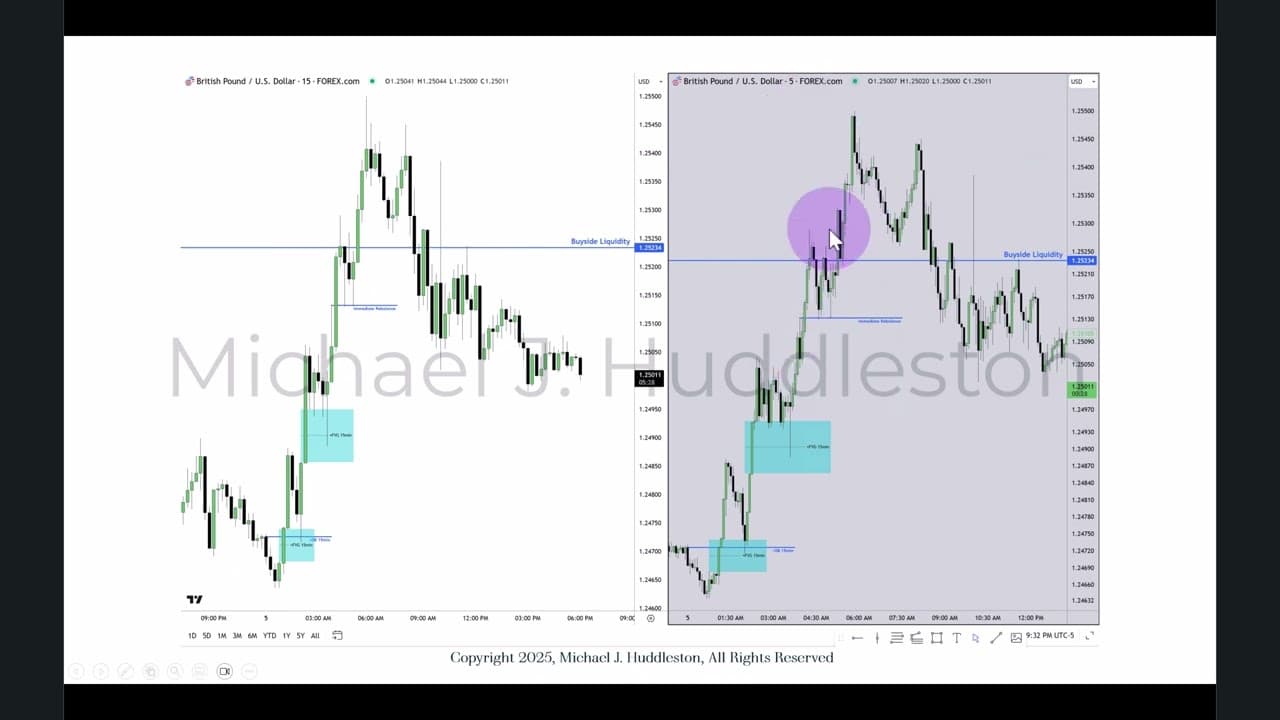
The February 5, 2025 Forex and NQ review shows how inversion fair value gaps, relative strength, and a three-market Triad can frame market expectations. Pound dollar reached its buy-side liquidity target before euro dollar, while the dollar index remained inside its expected gap. Whipsawing, overlapping ranges call for larger stops, less leverage, and patience. Read on for the specific entry logic and market clues.
Transcript
e hey folks welcome back today's Wednesday February 5th 2025 it's going to be a really short Forex and NASDAQ review before we get into it just note that it's important that you watch the February 4th 2025 market review so I covered some and some of these levels that you're going to look at here I'm taking a great deal of Liberty and thinking that ... Read More
Key Insights
- An inversion fair value gap is a former sell-side efficiency the trader watches to behave in reverse; when price displaces lower from its consequent encroachment level, the first lower-timeframe fair value gap becomes a short entry.
- The Forex Triad requires confirming a bullish currency pair against a closely correlated pair and a bearish dollar index, so looking at only one pair fails to capture everything impacting price delivery.
- High resistance liquidity run conditions show as whipsawing price that overlaps previous ranges and overshoots inefficiencies, meaning stop losses must be generous rather than a half pip or one pip tight.
- Relative strength analysis explained why cable was the upside leader over euro dollar, which is why the trader targeted pound dollar's buy-side liquidity pool and was not interested in euro dollar.
- Watching the prior February 4th 2025 market review first is essential, otherwise the levels shown look like hindsight rather than pre-planned analysis on the charts.
- Both pound dollar and euro dollar hit their buy-side liquidity pool targets, so the trader lost interest in whether the dollar index reached its expected inversion fair value gap since it was only a catalyst.
- Trade Wars, tariffs, and saber rattling between companies drive interest-rate markets, commodities, and currencies erratically, which then rolls over into equities markets and worsens liquidity conditions.
- Ranges anchored on a weekly timeframe do not align to the right candlestick wicks on a daily chart, which is intentional when moving from a higher to a lower timeframe rather than a charting mistake.
Install to Summarize YouTube Videos and Get Transcripts
Explore YouTube Video Summarizer or Get YouTube Transcript Extractor
Questions & Answers
Q: What is an inversion fair value gap, and how does the trader use it?
It is a prior sell-side efficiency that the trader expects may behave in reverse. He watches for price to reach the gap’s low, move outside it, and then remain at or below its consequent encroachment level. If price displaces lower from there, the first lower-timeframe fair value gap can provide a short opportunity.
Q: What happened to the dollar index on February 5, 2025?
The dollar index traded lower as expected but did not move outside the low of the anticipated inversion fair value gap. On the five-minute chart, price continued moving back and forth within the gap’s upper half.
Q: Why should Forex traders analyze a three-market Triad instead of one currency pair?
A single currency pair does not show every factor affecting price delivery. For a bullish currency-pair idea, the trader looks for strength in a closely correlated pair such as pound dollar and confirmation from a bearish dollar index.
Q: Why did pound dollar reach its target before euro dollar?
Relative strength analysis indicated that pound dollar, also called cable, was the stronger upside market. Euro dollar lagged before eventually trading in sympathy with pound dollar, and both ultimately reached their buy-side liquidity pools.
Q: What is a high resistance liquidity run condition?
It appears as whipsawing price action that repeatedly overlaps earlier ranges. Inefficiencies look less crisp, and price may overshoot them instead of stopping precisely. The five-minute Forex charts in the review displayed these characteristics.
Q: How should traders manage risk during high resistance liquidity runs?
The trader recommends more generous stop losses, less leverage, and greater patience. He says half-pip or one-pip stops are highly unlikely to keep a position open in the conditions shown.
Q: Why did the trader lose interest in the dollar index completing its expected move?
The dollar index served as a catalyst within the three-market Triad rather than as the primary objective. Once pound dollar and euro dollar both reached their buy-side liquidity targets, the trader considered the Forex expectations complete for the week.
Q: Why should viewers watch the February 4, 2025 market review first?
That earlier review established the relevant levels before the February 5 price action, preventing the analysis from appearing to rely on hindsight. It also explains that a displayed range was anchored on the weekly timeframe, which is why it does not align with the daily chart’s right-side candlestick wicks.
Summary & Key Takeaways
-
The review builds on the February 4th 2025 market review, where levels were noted so today's analysis is not hindsight. The dollar index was expected to behave as an inversion fair value gap and move below short-term sell-side liquidity, and it traded lower but stayed inside the expected gap.
-
Euro dollar lagged while pound dollar led on the upside, explained by relative strength analysis. Both pairs eventually hit their buy-side liquidity pool targets. Because the correlated pairs met the trader's weekly objective, interest in the dollar index reaching its inversion fair value gap disappeared since it served only as a Triad catalyst.
-
Markets show high resistance liquidity run conditions with whipsawing, overlapping ranges and overshot inefficiencies, requiring generous stops, less leverage, and patience. The trader got stopped out on NASDAQ, emphasizes specializing in one market across multiple timeframes, and argues the markets are manipulated and algorithmically driven, provable by execution and logic.
Read in Other Languages (beta)
Share This Summary 📚
Summarize YouTube Videos and Get Video Transcripts with 1-Click
Try YouTube Summary with ChatGPT & Claude or YouTube Transcript Generator
Explore More Summaries from The Inner Circle Trader 📚

Summarize YouTube Videos and Get Video Transcripts with 1-Click
Try YouTube Summary with ChatGPT & Claude or YouTube Transcript Generator