IT Certificates or Degrees for Remote IT Jobs
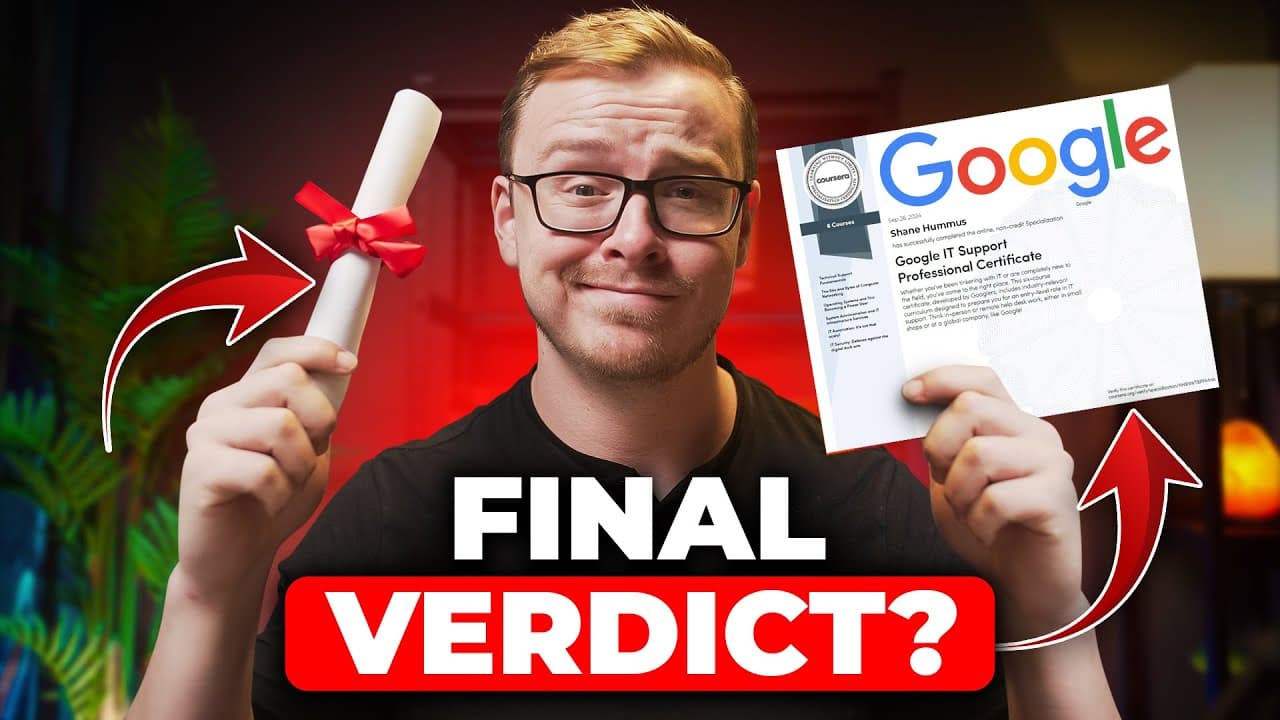
TL;DR
IT certificates are presented as the faster, less expensive route for beginners, career switchers, and working professionals seeking practical skills for entry-level technology roles. College degrees offer broader education, networking, structured learning, institutional resources, and access to employers that require or prefer degrees, so the better choice depends on career goals, finances, available time, and preferred learning style.
Transcript
so I've talked a lot on this channel about it certificates and I've also talked a lot on this channel about college degrees but the question is which one is actually better in order to land an it related job and by the end of this video you're going to know exactly which one is better for your particular situation and we're going to go over topics ... Read More
Key Insights
- IT certificates are designed for people who want to enter the technology industry quickly, affordably, and flexibly, including high school graduates, career switchers, holders of unrelated degrees, and current technology workers who want to validate their experience or pursue advancement.
- College degrees are suited to learners who value a comprehensive education, a broad academic foundation, and a structured learning environment. They may also be necessary for applicants targeting companies that require degrees or useful when employers give degree holders preference during hiring.
- Entry-level IT opportunities include help desk, IT support, technical support, and network support positions, while systems administration is another potential path. The certificate route is presented as a way to build practical skills relevant to these jobs without completing another degree.
- Professional certificate programs are more affordable and require less time than traditional college degrees according to the transcript. Their flexible online format can be especially helpful for learners balancing education with work, family responsibilities, or an existing career.
- Industry-created certificates focus on current, job-ready skills because companies developed them in response to gaps between academic instruction and workplace needs. College programs may include theoretical, unrelated, or outdated material alongside the practical knowledge they provide.
- Certificate coursework is a low-commitment way to test whether an IT career is genuinely appealing. Learners encounter skills resembling workplace tasks early, allowing them to change direction before investing the extensive time and money associated with a degree.
- College education provides networking opportunities with classmates, professors, and employers visiting campus. It can also provide access to libraries, journals, research facilities, career services, extracurricular activities, and faculty expertise, although students may not always use these resources fully.
- The Google IT Support Professional Certificate and Microsoft IT Support Specialist Professional Certificate are presented as useful options on Coursera. The Microsoft program may be particularly recognizable because many companies use Microsoft products, while both programs aim to develop hands-on support skills.
Install to Summarize YouTube Videos and Get Transcripts
Explore YouTube Video Summarizer or Get YouTube Transcript Extractor
Questions & Answers
Q: How do I choose between an IT certificate and a college degree?
Choose according to your career goal, budget, schedule, and preferred learning environment. An IT certificate is presented as a strong fit when you want practical skills, flexible study, minimal prerequisites, and a quicker path into technology work. A college degree may fit better when you want broad academic study, structured instruction, campus networking, institutional resources, or access to employers that require or prefer degree holders.
Q: Who should pursue an IT professional certificate?
An IT professional certificate can suit a high school graduate without a college degree, someone whose existing degree is not helping with employment, or a worker changing careers. It can also help people who need flexible learning because of family or work commitments. Current technology professionals may use certificates to learn additional skills, validate existing experience, or strengthen their case for a promotion or raise.
Q: Who benefits most from earning a college degree for IT?
A college degree can benefit someone who wants a comprehensive education, enjoys structured classroom learning, and values studying subjects beyond the immediate requirements of an IT role. It may also help students seeking campus friendships, professional connections, faculty guidance, career services, and research resources. Most importantly, it can preserve access to companies that require a degree or give degree holders preference.
Q: What IT jobs can professional certificates help applicants pursue?
The transcript identifies IT support specialist, help desk technician, technical support specialist, network support specialist, and systems administrator as possible roles. Help desk work is described as one of the easiest areas to enter. A certificate does not guarantee employment, but it can help applicants develop relevant skills and display an industry-recognized credential on a resume or LinkedIn profile.
Q: Why can IT certificates be faster than college degrees?
IT certificates concentrate on skills connected to workplace responsibilities instead of requiring broad academic coursework across unrelated subjects. This focused structure lets learners encounter practical IT material early and complete training with a shorter commitment. The transcript also notes that learners can study online and adjust the pace, making certificates more compatible with employment, family obligations, and career changes.
Q: What are the main advantages of a college degree for an IT career?
A college degree offers a broad education, a recognized credential, structured learning, and opportunities to build relationships with classmates, professors, and visiting employers. Colleges may also provide libraries, paid journals, research facilities, career services, extracurricular activities, and direct access to faculty. A degree can remain valuable when a target employer requires one or uses educational background as a hiring preference.
Q: How can an IT certificate help someone test a new career?
A certificate introduces job-related skills early, giving learners a practical preview of the work before they make a larger educational commitment. If the material feels uninteresting or unsuitable, they can move to another certificate and explore a different career direction. The transcript contrasts this flexibility with discovering dissatisfaction only after spending substantial time completing college and entering the associated profession.
Q: Which beginner IT certificate programs are recommended?
The transcript highlights the Google IT Support Professional Certificate and the Microsoft IT Support Specialist Professional Certificate, both hosted on Coursera. They are presented as programs that develop hands-on skills and provide recognizable credentials for beginning an IT career. The Microsoft option may look relevant to employers because many organizations use products such as Excel and Microsoft Word. The creator also discloses an affiliate partnership with Coursera.
Summary & Key Takeaways
-
Professional IT certificates suit high school graduates, career switchers, degree holders seeking more useful skills, and technology workers pursuing advancement. Their minimal prerequisites, flexible schedules, practical coursework, and relatively low cost make them accessible to people who need to study around employment, family responsibilities, or other commitments.
-
College degrees provide a broad academic foundation, structured instruction, networking opportunities, recognized credentials, and access to libraries, journals, research facilities, career services, professors, and extracurricular activities. Their disadvantages include high costs, long time commitments, theoretical or outdated material, and coursework that may not relate directly to an IT career.
-
Certificates can prepare learners for roles such as help desk technician, IT support specialist, technical support specialist, network support specialist, and systems administrator. The Google IT Support Professional Certificate and Microsoft IT Support Specialist Professional Certificate are highlighted as beginner-oriented options offering practical skills and credentials that can strengthen a resume or LinkedIn profile.
Read in Other Languages (beta)
Share This Summary 📚
Summarize YouTube Videos and Get Video Transcripts with 1-Click
Try YouTube Summary with ChatGPT & Claude or YouTube Transcript Generator
Explore More Summaries from Shane Hummus 📚





Summarize YouTube Videos and Get Video Transcripts with 1-Click
Try YouTube Summary with ChatGPT & Claude or YouTube Transcript Generator