How to Build Better AI Presentations in 5 Steps
TL;DR
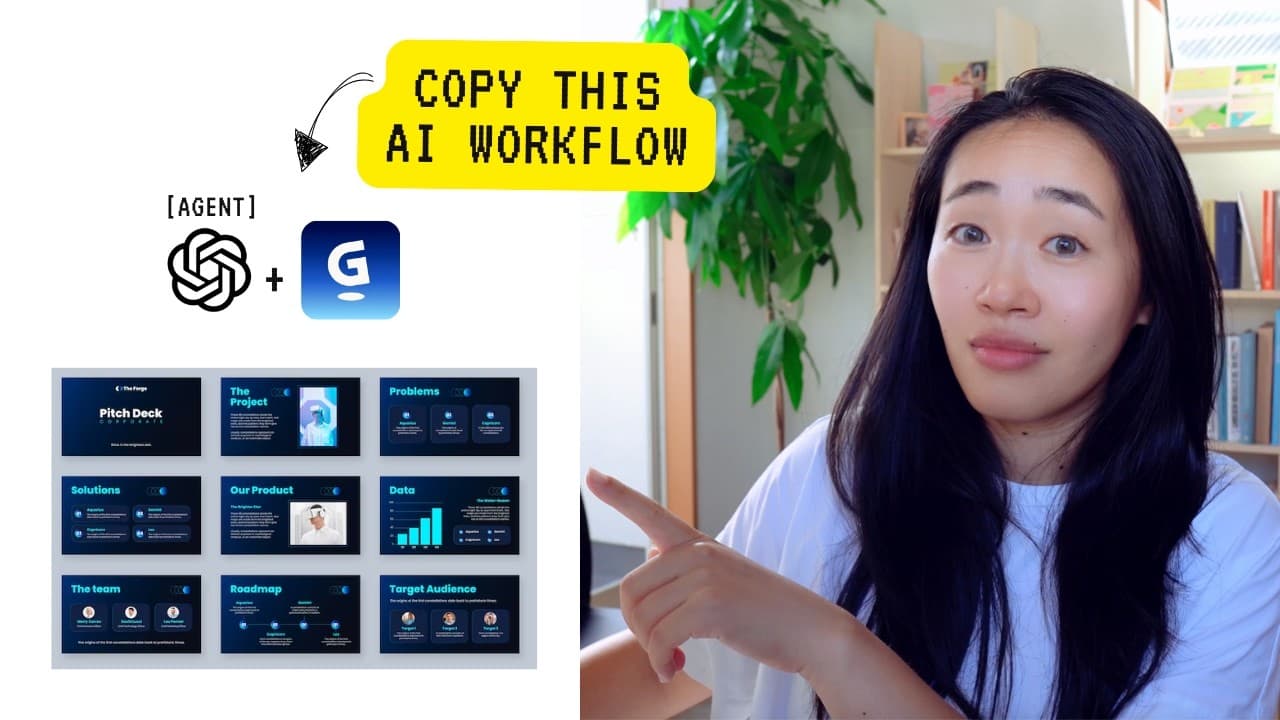
Start by forming a human-led hypothesis from your context, goal, existing insights, quick research, and proprietary information. Then use AI for deep research, investigate promising findings, organize the argument with a framework-driven outline, generate the slides, and polish them in Gamma. This staged input, processing, output, and feedback loop produces more useful results than requesting a complete presentation in one prompt.
Transcript
Real professional stuff. This is where 99% of knowledge workers get so frustrated and they're flipping tables because, yes, the boss is saying, "Hey, we got to use AI. We got to increase productivity. AI is amazing." But when you actually use it, it gives you vague things that are sometimes wrong and that has insights that honestly are not wo... Read More
Key Insights
- AI performance has an uneven capability frontier, so its usefulness depends on whether a task falls within the areas where it has sufficient skill, knowledge, and data. Applying AI outside that frontier can reduce accuracy instead of improving the work.
- Consultants using AI completed 12.2% more tasks, finished tasks 25.1% faster, and produced results rated more than 40% higher in quality in the cited study. However, those benefits did not apply equally to every type of knowledge-work task.
- Consultants working on tasks outside AI’s capability frontier were 19 percentage points less likely to produce correct solutions than consultants working without AI. Productivity gains therefore do not eliminate the need to judge whether a model is suited to the assignment.
- The first step is to create a hypothesis, which is an educated guess about the likely answer or direction. That hypothesis should combine the organization’s context, the presentation’s goal, existing insights, initial research, and the human worker’s understanding of relevant capabilities and constraints.
- A 20–30 minute initial search is enough to begin building a nuanced hypothesis. The purpose is not to complete the research, but to connect market information with company knowledge and identify a promising direction that AI can investigate more deeply.
- Proprietary data is an important source of presentation quality because ChatGPT cannot access information that remains inside a paid database or organization unless the user retrieves and supplies it. Human access to such evidence can materially improve the research input.
- The recommended workflow has five stages: form a hypothesis, conduct AI deep research, investigate specific insights, build a framework-driven outline, and generate the presentation. Gamma can then be used to make the resulting slide deck look more polished.
- An effective AI workflow uses an input, processing, output, and feedback loop rather than a single prompt. Dividing presentation development into simple stages lets the user inspect evidence, refine reasoning, and increase the probability of obtaining useful and presentable results.
Install to Summarize YouTube Videos and Get Transcripts
Explore YouTube Video Summarizer or Get YouTube Transcript Extractor
Questions & Answers
Q: Why do beginner AI presentations often produce vague results?
Beginner AI presentations often produce vague results because the user provides a broad topic or collection of files and asks the model to create a perfect deck immediately. The model may lack the organization’s context, the exact decision goal, existing human insights, and proprietary evidence. A stronger process separates input, analysis, output, and feedback into focused stages.
Q: What are the five steps for creating a better AI presentation?
The five steps are to form a hypothesis, use AI for deep research, investigate particular insights more closely, create a framework-driven outline, and generate the presentation. After slide generation, Gamma can be used to improve the visual polish. Each stage gives the user an opportunity to refine the evidence and reasoning before producing the final deck.
Q: How should you form a hypothesis for an AI presentation?
Form a hypothesis by combining what you already know about the organization, the specific goal of the presentation, and any early insights that suggest a direction. Spend 20–30 minutes reviewing relevant public sources and proprietary information. Then state an educated guess about the likely answer, such as which market best matches the company’s products, capabilities, and geographic presence.
Q: Why is human context necessary when using AI for presentations?
Human context is necessary because AI does not automatically know the company’s history, capabilities, goals, internal discussions, geographic presence, or strategic priorities. A person can connect new evidence with that organizational knowledge and recognize why a finding matters. That initial judgment supplies a useful hypothesis and directs subsequent AI research toward a relevant business decision.
Q: What does the uneven capability frontier mean for AI work?
The uneven capability frontier means that AI performs well on some tasks but poorly on others, even as its overall capabilities expand. The cited study found strong productivity and quality improvements within suitable tasks, but consultants were 19 percentage points less likely to reach correct solutions on tasks outside the frontier. Users must therefore match AI use to the assignment.
Q: What productivity gains did the cited AI study report?
The cited study reported that consultants using AI completed 12.2% more tasks on average and finished their tasks 25.1% more quickly. Their results were also rated more than 40% higher in quality than those of the control group. These gains require context, because performance became worse when consultants applied AI to tasks outside its capability frontier.
Q: Why should proprietary data be included in AI research?
Proprietary data can contain relevant details that are unavailable through ordinary public searches and inaccessible to ChatGPT on its own. If an organization subscribes to a paid database, the user may need to retrieve the information and provide it as research input. Combining that evidence with company context can make the hypothesis and subsequent presentation more specific and credible.
Q: Which ChatGPT setup is recommended for deep research?
The recommended setup is to open ChatGPT’s tools, select deep research, and use a reasoning model identified by a name beginning with the letter O. Agent mode can also perform deep research, but the presenter prefers the dedicated deep research option after comparing them. The reasoning model is selected because the task requires analysis of the collected information.
Summary & Key Takeaways
-
AI presentations often fail because users ask a model to transform raw inputs directly into polished slides. The recommended alternative is an input, processing, output, and feedback loop. Breaking the work into five focused stages improves the probability that the final presentation contains relevant evidence, nuanced reasoning, and actionable insights.
-
The first stage is a human-led hypothesis based on organizational context, the decision goal, existing insights, quick public research, and any available proprietary data. A 20–30 minute review can reveal a plausible direction, such as prioritizing a market that matches the company’s products, capabilities, spending expectations, and geographic presence.
-
After establishing a hypothesis, the workflow uses AI deep research, targeted investigation of specific insights, a framework-driven outline, and slide generation followed by visual polishing in Gamma. ChatGPT’s deep research and a reasoning model are recommended for analysis, while the overall process is designed to compress presentation development from roughly a week into under an hour.
Read in Other Languages (beta)
Share This Summary 📚
Summarize YouTube Videos and Get Video Transcripts with 1-Click
Try YouTube Summary with ChatGPT & Claude or YouTube Transcript Generator
Explore More Summaries from Vicky Zhao 📚

Summarize YouTube Videos and Get Video Transcripts with 1-Click
Try YouTube Summary with ChatGPT & Claude or YouTube Transcript Generator