How Did Money Evolve from Debt to Paper?
TL;DR
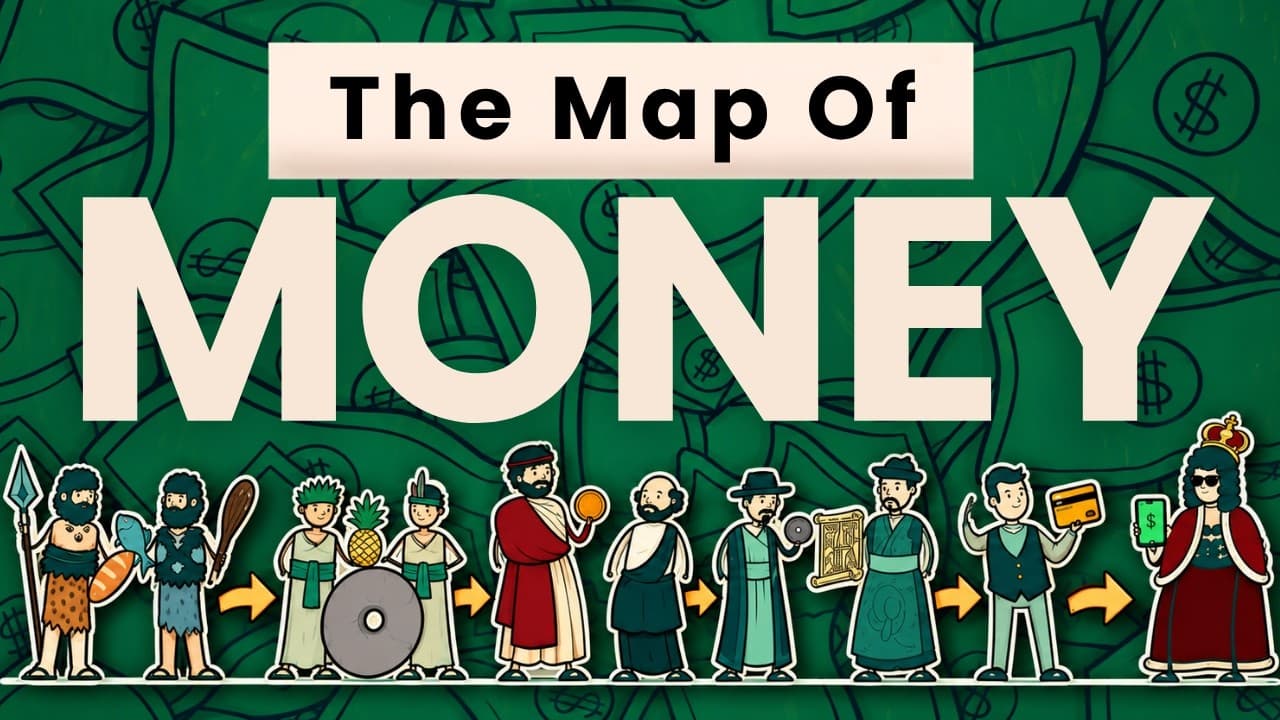
Money derives its usefulness from shared agreement, not from the material used to represent it. Recorded debts preceded coins by thousands of years, while paper receipts made trade safer and easier but also enabled banks and governments to issue more claims than their reserves could support, weakening money as a stable measure of value.
Transcript
Nobody teaches you the truth about money. I studied at an economics faculty for 6 years and still didn't understand it. 9 years ago, I started reading every serious finance and money book I could find and summarizing them on YouTube. What I found contradicted almost everything I was taught. So, one day I went back to the professor I trusted most an... Read More
Key Insights
- Money is a shared agreement about ownership and obligation, as illustrated by Yap's enormous stone discs. The stones did not need to move during purchases, and even a stone lost beneath the ocean continued circulating because the island community recognized that it existed and belonged to a particular family.
- The conventional barter origin story is presented as a logical argument rather than documented history. Adam Smith wrote the story in 1776, but the transcript says anthropologist Caroline Humphrey found no described example of a barter economy in any culture or era.
- Barter is described as an emergency response to monetary collapse, not the original economic system. The transcript cites Russia in the 1990s and Argentina in 2002 as cases where people directly exchanged goods after their currency systems stopped functioning effectively.
- Recorded debt existed more than 5,000 years ago in Mesopotamia. Clay tablets documented borrowed tools, repayment promises tied to harvests, and merchants' accounts, showing that civilizations could organize exchange through written obligations without relying on coins as the initial form of money.
- Coins appeared 2,700 years after the earliest debt records, according to the transcript. This sequence supports the argument that promises and accounting came before physical currency, with cities, workers, merchants, and entire civilizations operating through recorded claims for more than 2,000 years.
- Paper receipts emerged as practical substitutes for heavy or vulnerable metal. In Song Dynasty Sichuan, merchants deposited iron with trusted shops and traded the resulting receipts, while 17th-century Londoners similarly exchanged claims on gold stored securely in goldsmiths' vaults.
- Fractional lending creates useful investment and serious risk at the same time. The London goldsmith could lend idle deposited gold to merchants who built businesses and created jobs, but depositors unknowingly carried the risk while the goldsmith retained the interest and could issue unsupported receipts.
- Central banking institutionalized the issuance of paper claims through the Bank of England in 1694. Merchants lent the crown 1.2 million pounds and received authority to issue bank notes backed by the king's repayment promise, establishing a model that other countries later copied.
Install to Summarize YouTube Videos and Get Transcripts
Explore YouTube Video Summarizer or Get YouTube Transcript Extractor
Questions & Answers
Q: What gives money its value?
Money receives its value from a shared agreement about ownership, debts, and acceptable payment rather than from the physical object itself. On Yap, huge limestone discs functioned as money without moving between owners. Even a disc lost beneath the ocean retained value because everyone accepted that it existed and belonged to a specific family.
Q: Did money develop because barter was inefficient?
The transcript argues that money did not develop from a widespread barter economy. Adam Smith presented barter as a logical origin story in 1776, but anthropologist Caroline Humphrey reportedly found no documented example of an economy based entirely on barter. Instead, early communities tracked favors and obligations, while barter appeared when established monetary systems collapsed.
Q: What existed before coins were invented?
Debt records and repayment promises existed before coins. More than 5,000 years ago, Mesopotamian people used clay tablets to record borrowed tools, obligations to repay after harvests, and amounts owed to merchants. Coins appeared 2,700 years later, so cities and commercial systems operated through recorded promises for more than 2,000 years before coinage.
Q: How did paper money begin in Song Dynasty China?
Paper money began as a practical response to the burden of transporting heavy iron currency in Sichuan. Merchants deposited their iron with trusted local shops and received receipts that could be traded more safely and conveniently. The government later standardized the practice with official paper money, but excessive printing during expensive wars eventually damaged public trust.
Q: Why did people accept paper instead of metal money?
People accepted paper because it solved immediate problems. Iron was heavy to carry across a vast empire, while gold stored at home faced theft, war, and fire. Depositing metal with a trusted custodian and transferring a receipt produced the same commercial result with less effort and danger, making paper claims attractive before their risks became apparent.
Q: How did goldsmiths create additional money?
Goldsmiths noticed that only a minority of depositors collected their gold on a typical day because most people traded paper receipts instead. A goldsmith could therefore lend deposited gold or issue extra receipts and charge borrowers interest. If 100 pieces of gold supported 150 receipts, the additional 50 claims had no matching gold behind them.
Q: Why can issuing too much paper money cause problems?
Issuing additional paper creates more claims without adding the physical assets that originally supported them. The transcript describes rising prices when goldsmiths printed receipts beyond their gold holdings and collapsing trust when Chinese authorities repeatedly expanded paper issuance. In both cases, the measuring tool changed because the issuer benefited from creating more units.
Q: How did the Bank of England change money creation?
The Bank of England made official a practice similar to the goldsmiths' issuance of paper claims. In 1694, merchants lent King William III's crown 1.2 million pounds for war funding. In return, they received authority to issue bank notes backed by the king's promise to repay rather than by an equivalent quantity of gold in a vault.
Summary & Key Takeaways
-
Money began as a system of remembered and recorded obligations rather than as a solution to barter. Evidence presented from Mesopotamian clay tablets shows that people documented debts more than 5,000 years ago. Coins appeared 2,700 years later, demonstrating that complex cities, employment, and commerce could operate through promises long before metal currency existed.
-
The stone money of Yap illustrates that monetary value depends on collective recognition. Ownership of enormous limestone discs could change even when the stones never moved, and one submerged disc remained usable because the community accepted its existence and ownership. The physical object mattered less than the trusted social record attached to it.
-
Paper money developed because metal was inconvenient and dangerous to transport. Merchants in Song Dynasty Sichuan exchanged receipts representing deposited iron, while Londoners traded goldsmith receipts instead of moving stored gold. These useful systems became vulnerable when authorities or custodians issued additional paper claims, causing the monetary measure to lose reliability.
Read in Other Languages (beta)
Share This Summary 📚
Summarize YouTube Videos and Get Video Transcripts with 1-Click
Try YouTube Summary with ChatGPT & Claude or YouTube Transcript Generator
Explore More Summaries from LITTLE BIT BETTER 📚






Summarize YouTube Videos and Get Video Transcripts with 1-Click
Try YouTube Summary with ChatGPT & Claude or YouTube Transcript Generator