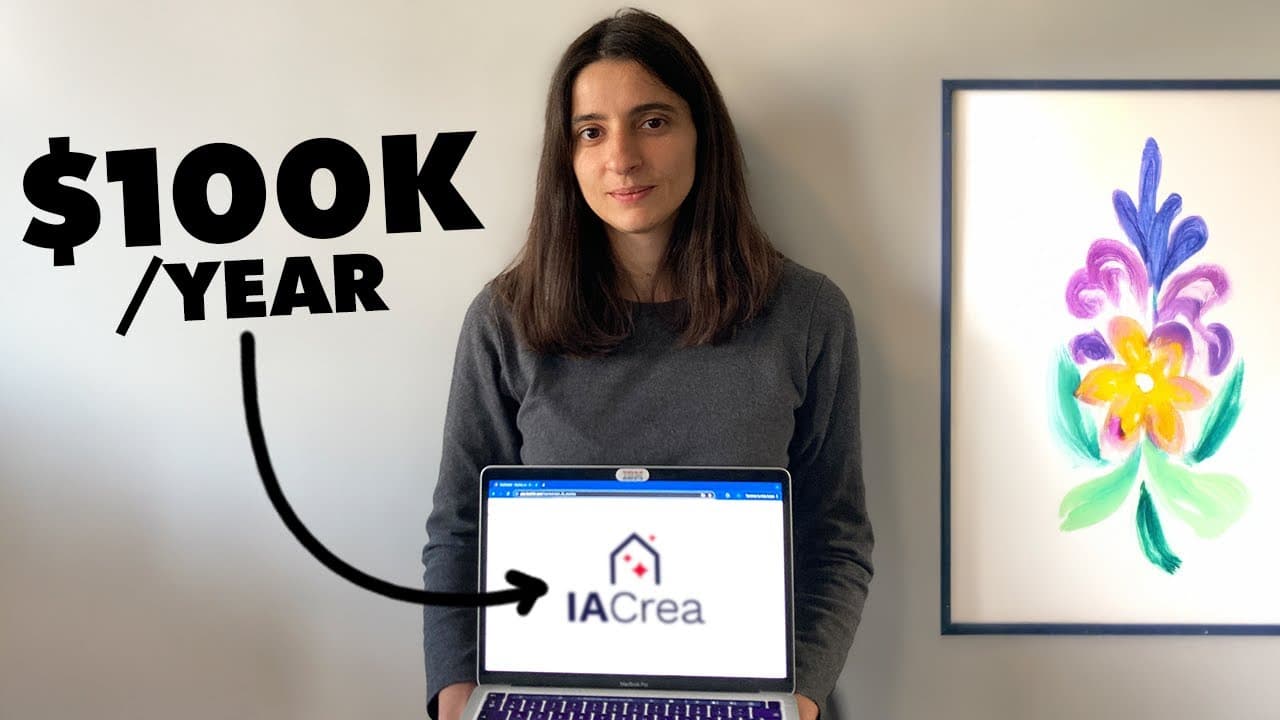
How Pauline Built AI Crea to $8,000 a Month While Working at IBM
TL;DR
Pauline built AI Crea into an AI home-renovation service making around $8,000 per month by solving a recurring customer problem, shipping a simple MVP, and validating it through payments from real estate agents. She found customers through Facebook and physical events, then supported retention with free trials, improved images, yearly plans, and easy cancellation. Read on for her practical framework for choosing ideas, finding customers, and reducing churn.
Transcript
when I started AI career which is at 8,000 Mr currently I was still an employee at IBM how did this girl build a $100,000 Pere AI app while working a full-time job well it's because of how she's growing it to find customers online uh you have to think about where your clients are Pauline spent her first few years as a part-time Indie hacker buildin... Read More
Key Insights
- A viable product idea begins with a recurring problem that the founder understands. Pauline evaluates whether she can improve the situation, monetize a solution, and reach likely customers before deciding to invest time in building it.
- Early payment is stronger validation than general enthusiasm. Pauline presented AI Crea's MVP to real estate agents found online and through her personal network, then treated their willingness to purchase the initial product as evidence of genuine demand.
- A useful MVP can be simple and imperfect. AI Crea initially offered basic features and weak image quality, but releasing it created opportunities to learn what customers actually wanted and improve the service through sustained work.
- Customer acquisition works by identifying where intended users already gather. Pauline recommends searching social networks and communities for the relevant profession or audience, then selecting channels according to the behavior and relationships of those prospective customers.
- Marketing channels should match the product's audience. Facebook and physical events worked well for reaching real estate agents, while Twitter suited a separate directory product because Pauline's audience there included developers and people interested in indie hacking.
- Pricing shapes both customer expectations and operational demands. Pauline notes that lower prices can create a low-cost image, while higher prices may attract fewer customers and reduce the amount of support the business must provide.
- Flexible billing can build customer trust. Pauline offers subscriptions and one-time payments because some customers dislike recurring charges, and she makes cancellation clear and easy instead of relying on a difficult cancellation process to retain users.
- Retention improves when customers understand the product and receive valuable results. Pauline reduced churn by adding a yearly plan, offering a free trial, and improving generated images until they looked much more like photographs.
Install to Summarize YouTube Videos and Get Transcripts
Explore YouTube Video Summarizer or Get YouTube Transcript Extractor
Questions & Answers
Q: How did Pauline build AI Crea while working full-time at IBM?
Pauline worked on AI Crea during nights and weekends while she was still employed at IBM. The service eventually reached more than 8,000 users and around $8,000 in monthly revenue, giving her the confidence to leave IBM and become a full-time founder.
Q: What does the AI Crea home-renovation service do?
AI Crea lets users upload a photograph of a home, choose a design style, and receive an AI-generated renovation concept within a few seconds. For example, a user can see a kitchen redesigned in a modern or Scandinavian style.
Q: How should a founder choose a problem for an AI product?
Pauline starts with a problem experienced by herself or someone she knows, then asks how frequently it occurs. She also evaluates whether she can build a better solution, monetize it, and reach potential customers before investing time in the idea.
Q: How do you validate an AI SaaS idea before expanding it?
Build a simple MVP, show it to people who experience the target problem, and ask them to pay. Pauline presented AI Crea to real estate agents she found online and through her personal network; their actual purchases, rather than praise alone, validated the idea.
Q: Why should an AI founder launch an imperfect MVP quickly?
An early release reveals what customers actually want instead of relying on the founder’s assumptions. AI Crea’s first version had simple features and poor image quality and took about a month to build, followed by roughly a year of improvement.
Q: How can a new SaaS founder find the first customers?
Identify where the intended customers already gather, then search relevant professions and communities on channels such as Facebook, LinkedIn, and Reddit. Pauline found that Facebook and physical events worked particularly well for reaching real estate agents because their work is strongly relationship-driven.
Q: How should marketing channels differ between SaaS products?
The marketing channel should match the audience for each product. Pauline used Facebook and physical events for AI Crea’s real estate customers, while Twitter suited her directory product because her audience there included developers and people interested in indie hacking.
Q: How can an AI SaaS reduce customer churn?
Pauline reduced churn by introducing a yearly plan, offering a free trial, and improving generated images until they looked much more like photographs. She also offers subscription and one-time payment options and makes cancellation clear and easy, helping customers choose terms that suit them.
Summary & Key Takeaways
-
Pauline developed AI Crea while employed at IBM, working during nights and weekends before becoming a full-time founder. The service lets users upload a home photo, select a design style, and receive an AI-generated renovation concept. Its revenue eventually gave her the confidence to leave her job.
-
Her product-development process begins with a problem experienced by herself or someone she knows. She evaluates its frequency, whether she can create a better solution, whether customers can be reached, and whether the idea can make money. She then releases an imperfect MVP and seeks payment and feedback from real prospects.
-
Growth depends on matching each product with the channels used by its intended customers. Pauline reaches real estate professionals through Facebook and physical events, while developer-focused products fit her Twitter audience. She combines targeted distribution with flexible payment options, free trials, improved image quality, yearly plans, and straightforward cancellation.
-
Key Insights
Read in Other Languages (beta)
Share This Summary 📚
Summarize YouTube Videos and Get Video Transcripts with 1-Click
Try YouTube Summary with ChatGPT & Claude or YouTube Transcript Generator
Explore More Summaries from Starter Story 📚




Summarize YouTube Videos and Get Video Transcripts with 1-Click
Try YouTube Summary with ChatGPT & Claude or YouTube Transcript Generator