Has the AI Hard Takeoff Started? Recursive Self-Improvement Explained
TL;DR
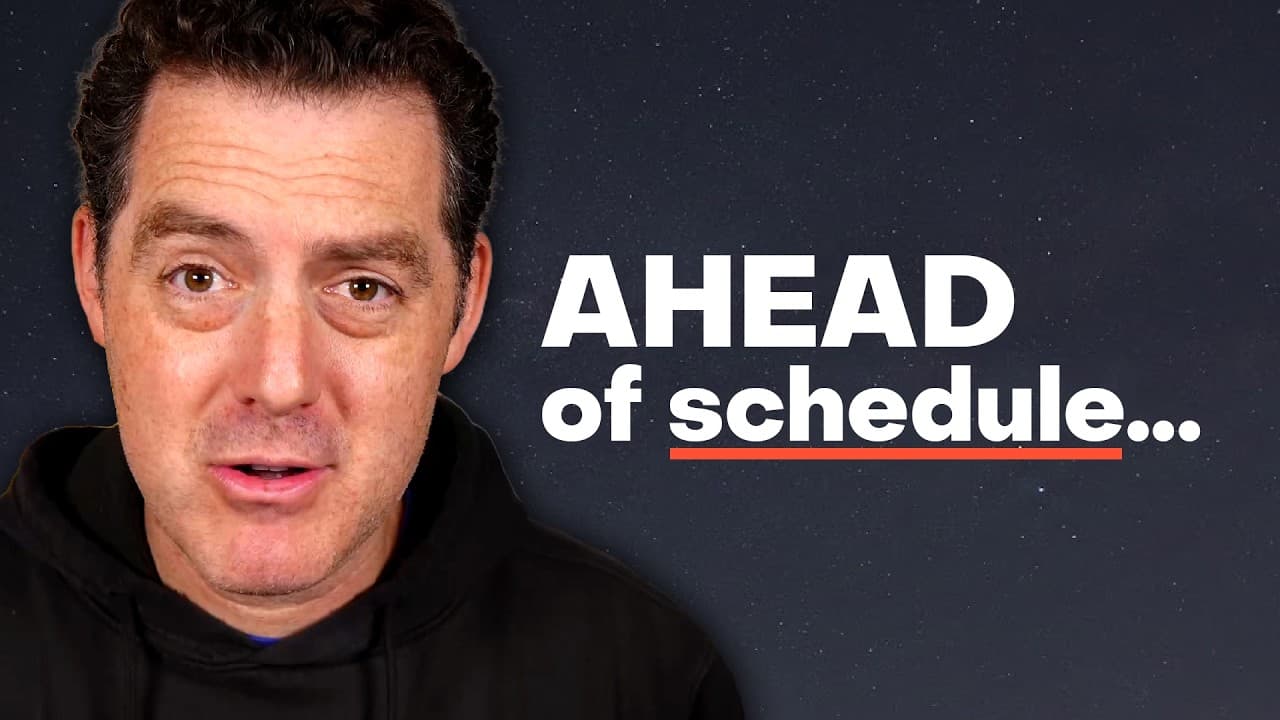
Recursive self-improvement is the process in which an AI helps develop its next version, and the examples presented suggest that this process has begun. MiniMax says M2.7 handles 30 to 50% of its research workflow and achieved a 30% improvement on internal evaluation sets, while OpenAI says GPT-5.3-Codex helped create itself. Read on to see how these human-AI research loops work and why they may accelerate model development.
Transcript
I don't know if you noticed it, but we have officially crossed into the recursive self-improvement phase of artificial intelligence. We've been talking about this for a long time on this channel, but we're there now. And I don't think people are talking about it enough. And I'm going to show you multiple examples from which it is going to become ab... Read More
Key Insights
- Recursive self-improvement means one AI agent helps build the next version of itself, removing humans as the bottleneck on research speed. Once that loop closes, the stated limit on progress becomes how much compute can be thrown at it rather than how many human AI researchers are available.
- MiniMax is a Chinese frontier AI lab that releases open-source models, and it indicated it would open-weight M2.7 within a couple of weeks of the release discussed. The company framed self-evolution of both the model and the organization as the natural next step after human productivity was fully unleashed.
- M2.7 discovered concrete optimizations for the models by systematically searching for optimal combinations of sampling parameters including temperature, frequency penalty, and presence penalty, designing more specific workflow guidelines, and adding loop detection to the scaffold's agent loop, achieving a 30% performance improvement on internal evaluation sets.
- The MiniMax research loop starts with a researcher discussing an experimental idea with the agent, which helps with literature review, tracks a preset experiment spec, pipelines data and other artifacts, and launches experiments. This accelerates problem discovery and experimentation, delivering models faster.
- GPT-5.3-Codex is described by OpenAI as its first model that was instrumental in creating itself. Early checkpoints of the model helped optimize later checkpoints of the same model, meaning the self-improvement happened within a single model's training run, not only across model generations.
- Sam Altman set two dated internal goals in an October 2025 post: an automated AI research intern by September 2026 running on hundreds of thousands of GPUs, and a true automated AI researcher by March 2028. Altman noted March 2028 falls almost five years to the month after the GPT-4 launch.
- Anthropic's focus on coding serves a flywheel: coding is where the revenue is today, and that revenue funds hiring, GPUs, and the next model. Coding and deep research agents also build the tooling and infrastructure that make training, deploying, and serving the next model faster.
- Anthropic described autonomous loops in a July 24, 2025 article on how it uses Claude Code internally, where Claude Code writes the code for a new feature, runs tests, and iterates continuously. Engineers give Claude abstract problems, let it work autonomously, then review solutions before final refinements.
Install to Summarize YouTube Videos and Get Transcripts
Explore YouTube Video Summarizer or Get YouTube Transcript Extractor
Questions & Answers
Q: What is recursive self-improvement in AI?
Recursive self-improvement means an AI agent helps build or optimize the next version of itself. The described loop compounds improvements by letting AI design, run, and analyze research experiments while humans steer the work and review its direction.
Q: Why does the video claim that the AI hard takeoff has started?
The claim is based on multiple AI models already contributing to their own development. MiniMax says M2.7 deeply participated in its evolution, while OpenAI described GPT-5.3-Codex as its first model instrumental in creating itself.
Q: How does MiniMax M2.7 improve itself?
During development, M2.7 updated its own memory and built dozens of complex skills in its harness for reinforcement learning experiments. It then improved its learning process and harness using the experimental results, creating what MiniMax called a cycle of model self-evolution.
Q: How much of the research workflow can MiniMax M2.7 handle?
MiniMax says M2.7 can handle 30 to 50% of the overall research workflow. Humans still configure the harness, steer the agent, and review experiment direction, while the AI writes and runs code, analyzes results, and reports its findings.
Q: How does the MiniMax M2 iteration system work?
A researcher discusses an experimental idea with the agent, which supports literature review, follows a preset experiment specification, pipelines data and artifacts, and launches experiments. The AI writes and runs the experimental code, analyzes the results, and reports back before the human and AI review the findings and repeat the loop.
Q: What performance improvement did M2.7 achieve through self-optimization?
M2.7 achieved a 30% performance improvement on internal evaluation sets. Its optimizations included searching combinations of temperature, frequency penalty, and presence penalty, developing more specific workflow guidelines, and adding loop detection to the agent scaffold.
Q: Did OpenAI say GPT-5.3-Codex helped create itself?
Yes. OpenAI described GPT-5.3-Codex as its first model instrumental in creating itself, with early versions helping debug its training, manage deployment, and diagnose test results and evaluations. Early checkpoints also helped optimize later checkpoints within the same training run.
Q: How is Anthropic using Claude Code for autonomous development?
Anthropic described Claude Code writing code for new features, running tests, and iterating continuously in autonomous loops. Engineers provide abstract problems, review the resulting solutions, and make final refinements, while the tooling helps accelerate development of later models and infrastructure.
Summary & Key Takeaways
-
MiniMax, a Chinese frontier AI lab that publishes open-weight models, described M2.7 as its first model deeply participating in its own evolution. During development the team let the model update its own memory, build dozens of complex skills in its harness for reinforcement learning experiments, and then improve its own learning process and harness based on those experiment results.
-
The M2 iteration system keeps a human in the loop for configuring the harness, steering the agent, and reviewing experiment direction, while the agent harness supplies skills, memory, guardrails, and evaluation infrastructure. The agent designs experiments with the human, writes and runs the code, analyzes and reports results, and the cycle repeats. AI now handles 30 to 50% of that workflow.
-
OpenAI stated GPT-5.3-Codex was its first model instrumental in creating itself, with the Codex team using early versions to debug its own training, manage deployment, and diagnose test results. Sam Altman's October 2025 post set internal goals of an automated AI research intern by September 2026 on hundreds of thousands of GPUs, and a true automated AI researcher by March 2028.
Read in Other Languages (beta)
Share This Summary 📚
Summarize YouTube Videos and Get Video Transcripts with 1-Click
Try YouTube Summary with ChatGPT & Claude or YouTube Transcript Generator
Explore More Summaries from Matthew Berman 📚



Summarize YouTube Videos and Get Video Transcripts with 1-Click
Try YouTube Summary with ChatGPT & Claude or YouTube Transcript Generator