What Is Supervised Learning in Machine Learning?
TL;DR
Supervised learning predicts outcomes using labeled training data, suitable for continuous or discrete variables. It includes methods like linear regression for continuous data and logistic regression for classification tasks. Though powerful, challenges like overfitting and underfitting require careful management.
Transcript
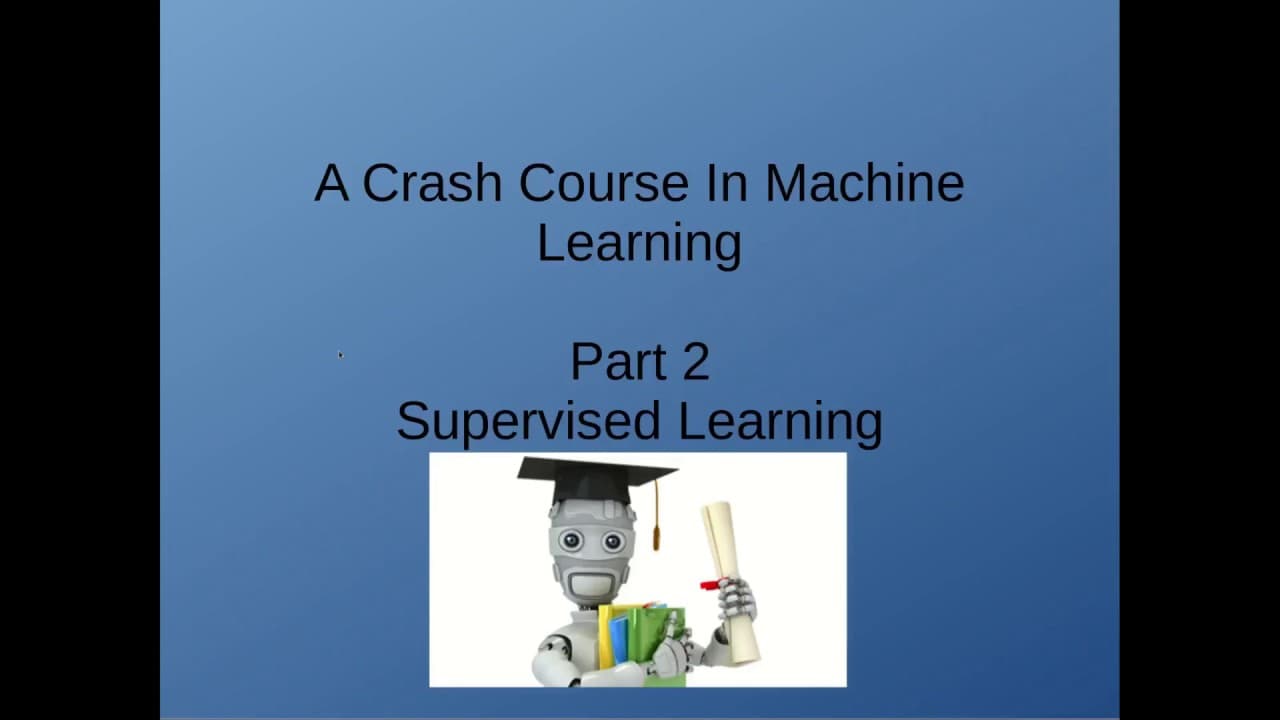
everybody welcome back to part two of a crash course in machine learning today we're going to talk about supervised learning as you learned in part one supervised learning is perfect when you know the ground truth labels for some set of training data this can be used for continuous or discrete variables so for instance if you want to predict home p... Read More
Key Insights
- ❓ Supervised learning is effective when there is known training data.
- ❓ Linear regression is used for predicting continuous variables, while logistic regression is used for predicting discrete variables.
- ✊ Neural networks are powerful tools that can be used in various applications, but they require significant computational power.
- ❓ Overfitting and underfitting are common challenges in supervised learning that can be addressed through techniques like regularization.
- 👶 Supervised learning has limitations, as models that perform well on the training data may not generalize well to new, unseen cases.
Install to Summarize YouTube Videos and Get Transcripts
Explore YouTube Video Summarizer or Get YouTube Transcript Extractor
Questions & Answers
Q: What is supervised learning?
Supervised learning is a machine learning technique where known training data is used to predict continuous or discrete variables.
Q: How does linear regression work?
Linear regression is used to predict continuous variables. It involves finding the best fit line that minimizes the sum of the squares of the deviation between the model's predictions and the actual data points.
Q: How does logistic regression differ from linear regression?
Logistic regression is used to predict discrete variables with known classes. It uses the sigmoid function to map the output to a value between 0 and 1, representing the probability of belonging to a certain class.
Q: What are neural networks and how do they work?
Neural networks are mathematical models inspired by how neurons in the brain work. They consist of layers of interconnected units, where each unit applies an activation function, such as the sigmoid function, to its inputs. The output of one layer becomes the input for the next layer, and this process continues until the final output is obtained.
Summary & Key Takeaways
-
Supervised learning is used when you have known training data and want to predict continuous or discrete variables.
-
Linear regression is used for predicting continuous variables, while logistic regression is used for predicting discrete variables.
-
Neural networks are a powerful tool that can be used for a wide range of applications, but they require significant computational power.
Read in Other Languages (beta)
Share This Summary 📚
Summarize YouTube Videos and Get Video Transcripts with 1-Click
Try YouTube Summary with ChatGPT & Claude or YouTube Transcript Generator
Explore More Summaries from Machine Learning with Phil 📚


Summarize YouTube Videos and Get Video Transcripts with 1-Click
Try YouTube Summary with ChatGPT & Claude or YouTube Transcript Generator