How does MVFP4 make 4-bit AI training work?
TL;DR
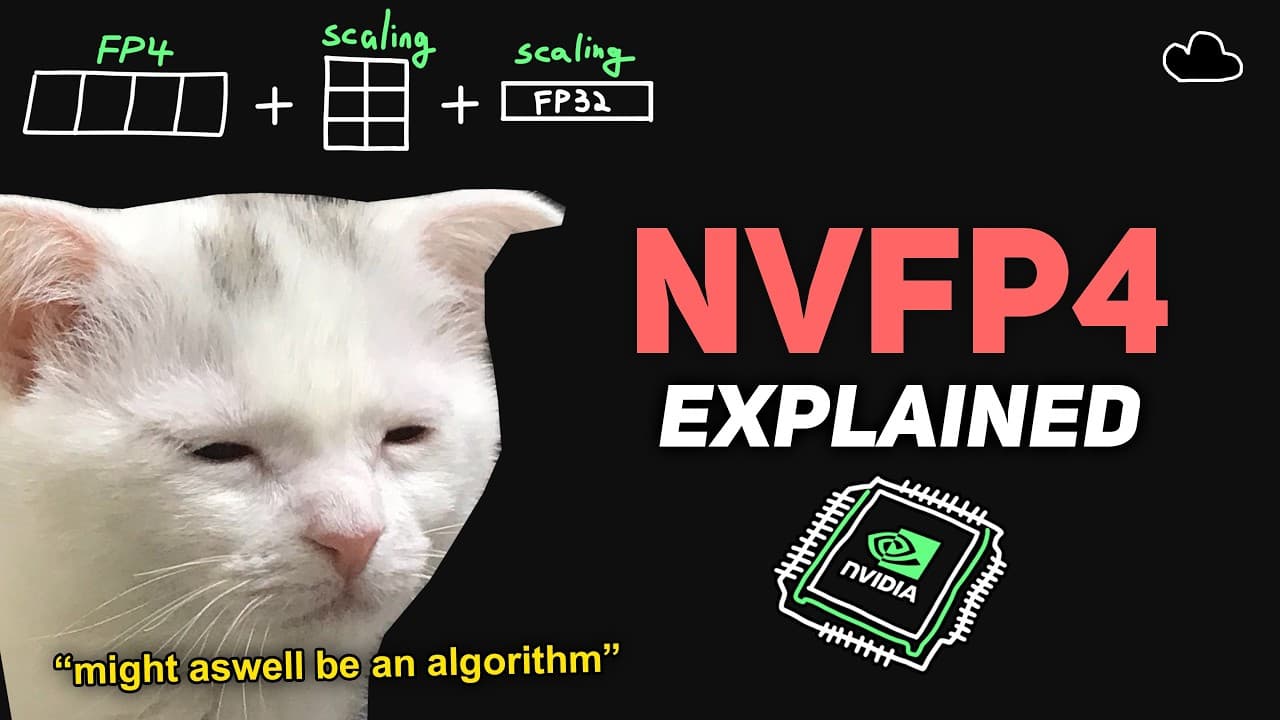
MVFP4 uses a mixed approach with FP8 local scales and a FP32 global scale to quantize weights and activations while keeping training stable. It keeps some layers in higher precision, and applies 2D block scaling for weights so forward and backward passes remain faithful. Inference can be cheaper, but training remains complex.
Transcript
With the anticipated Nvidia GPU architecture Vera Rubin, I think many of us have seen the term MVFP4 being tossed around a lot more. Something like, oh, it is able to achieve 50 pedaflops of compute at MVFP4 precision. Very cool. A lot of numbers with a lot of fancy terms, but probably 90% of the Nvidia stockholders don't even know what this senten... Read More
Key Insights
- MVFP4 uses 16 value blocks with a single scale to reduce disparity and improve local accuracy.
- MVFP4 replaces power-of-two scaling with an FP8 scale (E4 M3) to gain richer, non-binary scaling values.
- An FP32 tensor scale is added on top of FP8 block scales to manage the overall dynamic range.
- Training stability relies on keeping sensitive layers in higher precision and not quantizing them to FP4.
- 2D block scaling for weights ensures consistency between forward and backward passes through the same weight matrix.
- Quantization errors are more tolerable during inference than during training, where learning signals must stay precise.
- Attention to weight distribution across layers prevents divergence during training with MVFP4.
- The design aims to enable cheaper inference while maintaining viable training recipes for LMS models.
Install to Summarize YouTube Videos and Get Transcripts
Explore YouTube Video Summarizer or Get YouTube Transcript Extractor
Questions & Answers
Q: A real search query question about the video (e.g. 'How to...', 'What is...', 'Why does...', 'When should...'). Question 1
MVFP4 is a 4-bit floating point approach that Nvidia develops to make training large language models feasible with very low precision. It combines an FP8 block scale with an FP32 global scale and introduces 2D block scaling for weights to keep the forward and backward passes aligned. The goal is to reduce memory and compute while preserving enough numerical fidelity for learning signals to remain stable.
Q: Question 2
The key difference between MXFP4 and MVFP4 is the block size and the scale scheme. MVFP4 uses 16-value blocks instead of 32, and adopts an FP8 scale in place of a strict power-of-two scale, with an FP32 tensor scale on top to extend the overall range. This improves local precision while maintaining a broad dynamic range.
Q: Question 3
Why does Nvidia keep some layers in higher precision during MVFP4 training? Because quantizing all layers to FP4 can cause divergence in training, and the final layers require more dynamic range and precision for stable learning signals. The approach preserves accuracy where it matters most for optimization.
Q: Question 4
What is the purpose of the FP32 tensor scale in MVFP4? It provides a broad global range to represent very large or very small values, which the FP8 block scales alone cannot capture. This top-level scale helps maintain stability across the entire network before local refinements by FP8 blocks.
Q: Question 5
How does 2D block scaling help training with MVFP4? It ensures that the same weight matrix is quantized consistently in both forward and backward passes, preventing mismatches that could bias gradients. This alignment reduces the risk of learning signals becoming unstable across different directions.
Q: Question 6
What is the trade-off when using FP4 for training? While FP4 can drastically reduce memory and compute, it introduces sensitivity to rounding errors in weights, activations, and gradients. To mitigate this, the training recipe keeps some layers in higher precision and uses careful scaling strategies.
Q: Question 7
How does MVFP4 impact inference versus training? Inference can benefit from cheaper, lower-precision computation, but training requires a full recipe to maintain stability. The design aims to balance cheap forward passes with a practical approach to training where precision is preserved where needed.
Q: Question 8
What does the term MVFP4 stand for and why is it significant? MVFP4 stands for mixed-precision FP4 with micro scaling, representing Nvidia’s method to quantize models to 4-bit precision while using local scales and supplemental FP32 scaling. This approach seeks to enable feasible training of large AI models without prohibitive resource use.
Summary & Key Takeaways
-
MVFP4 builds on micro scaling by using smaller blocks of 16 values with a shared scale factor, improving local accuracy versus MXFP4.
-
The system adds an FP32 tensor scale on top of FP8 scales to handle large global ranges before local refinements, enabling better stability.
-
Training requires maintaining higher precision in sensitive layers and using 2D block scaling to align forward and backward passes for consistent gradients.
Read in Other Languages (beta)
Share This Summary 📚
Summarize YouTube Videos and Get Video Transcripts with 1-Click
Try YouTube Summary with ChatGPT & Claude or YouTube Transcript Generator
Explore More Summaries from bycloud 📚




Summarize YouTube Videos and Get Video Transcripts with 1-Click
Try YouTube Summary with ChatGPT & Claude or YouTube Transcript Generator