How to Analyze Customer Calls Using Python and AI
TL;DR
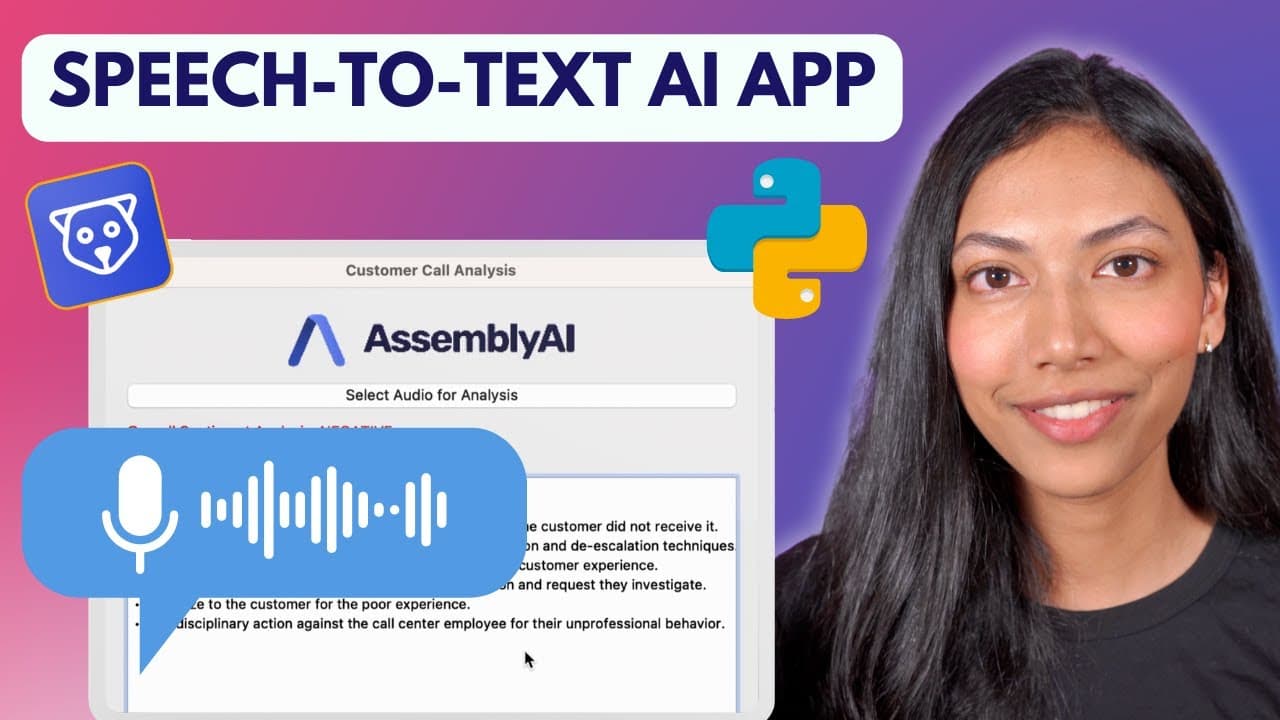
To analyze customer calls using Python, leverage Assembly AI's speech-to-text API for transcription and utilize the Lemur framework for sentiment analysis and action item extraction. Start by coding in Google Colab, set up your API key, and implement functions to handle audio file uploads, analyze sentiments, and generate actionable insights from the calls.
Transcript
hello everyone in this video we're going to be building a very simple python application which makes use of machine learning to analyze customer calls to do this we're going to be making use of assembly ai's powerful speech to text API as well as their llm framework lemur to start off let's take a look at what our end result will look like here is ... Read More
Key Insights
- 😯 Assembly AI's speech to text API and Lemur framework enable advanced customer call analysis.
- 👨💻 Google Colab simplifies the coding process for machine learning applications.
- ❓ Sentiment analysis and action item extraction are essential components of customer call analysis.
- 😒 The application demonstrates real-world use cases of machine learning in customer service.
- ❓ Integration of AI technology enhances efficiency in analyzing customer interactions.
- ❓ Emphasis on context and data processing for accurate sentiment and action item generation.
- ♻️ Utilization of virtual environments and Python libraries streamlines application development.
Install to Summarize YouTube Videos and Get Transcripts
Explore YouTube Video Summarizer or Get YouTube Transcript Extractor
Questions & Answers
Q: How are customer calls analyzed using machine learning in this video?
In the video, customer calls are analyzed by transcribing audio files using Assembly AI's speech to text API, performing sentiment analysis, and extracting action items using the Lemur framework.
Q: What role does Lemur framework play in generating action items from customer calls?
The Lemur framework is used to retrieve action items by processing the transcript of the customer call and providing relevant follow-up actions based on the call content.
Q: How is the sentiment analysis of customer calls conducted in this application?
Sentiment analysis is performed by counting positive and negative instances in the call content to determine the overall sentiment, which is crucial for understanding customer satisfaction levels.
Q: What are the key steps involved in building the Python application for customer call analysis?
The key steps include transcribing audio files, conducting sentiment analysis, and extracting action items by integrating Assembly AI's APIs and the Lemur framework for effective customer call analysis.
Summary & Key Takeaways
-
Utilizing Assembly AI's speech to text API and Lemur framework for customer call analysis.
-
Coding logic in Google Colab for easy implementation.
-
Generating sentiment analysis and action items for customer calls using Python.
Read in Other Languages (beta)
Share This Summary 📚
Summarize YouTube Videos and Get Video Transcripts with 1-Click
Try YouTube Summary with ChatGPT & Claude or YouTube Transcript Generator
Explore More Summaries from AssemblyAI 📚




Summarize YouTube Videos and Get Video Transcripts with 1-Click
Try YouTube Summary with ChatGPT & Claude or YouTube Transcript Generator