How to Choose and Understand Camera Lenses
TL;DR
Choose a lens that matches your camera mount, sensor format, desired field of view, and shooting needs. Focal length controls framing, compression, and distortion, while aperture controls incoming light and depth of field. Prime lenses prioritize sharpness and wide apertures, whereas zoom lenses provide faster, more flexible composition.
Transcript
so camera lenses can be super confusing at first like what do all of these numbers mean on the lens what's the best lens for beginners which one should you choose if you're a photographer or you're into video there's lots of questions so in this video let's break down everything there is to know about lenses for beginners you got to just press reco... Read More
Key Insights
- A camera lens is an optical system that passes light through multiple glass elements, bends it, and focuses it onto a specific area of the camera sensor. Without a compatible lens, a DSLR or mirrorless camera is practically unable to create a usable image.
- A lens mount is the physical connection standard between a lens and camera body. Sony E-mount cameras require E-mount lenses, while Canon uses EF mounts for older DSLRs and RF mounts for newer mirrorless cameras, so compatibility must be checked before purchasing.
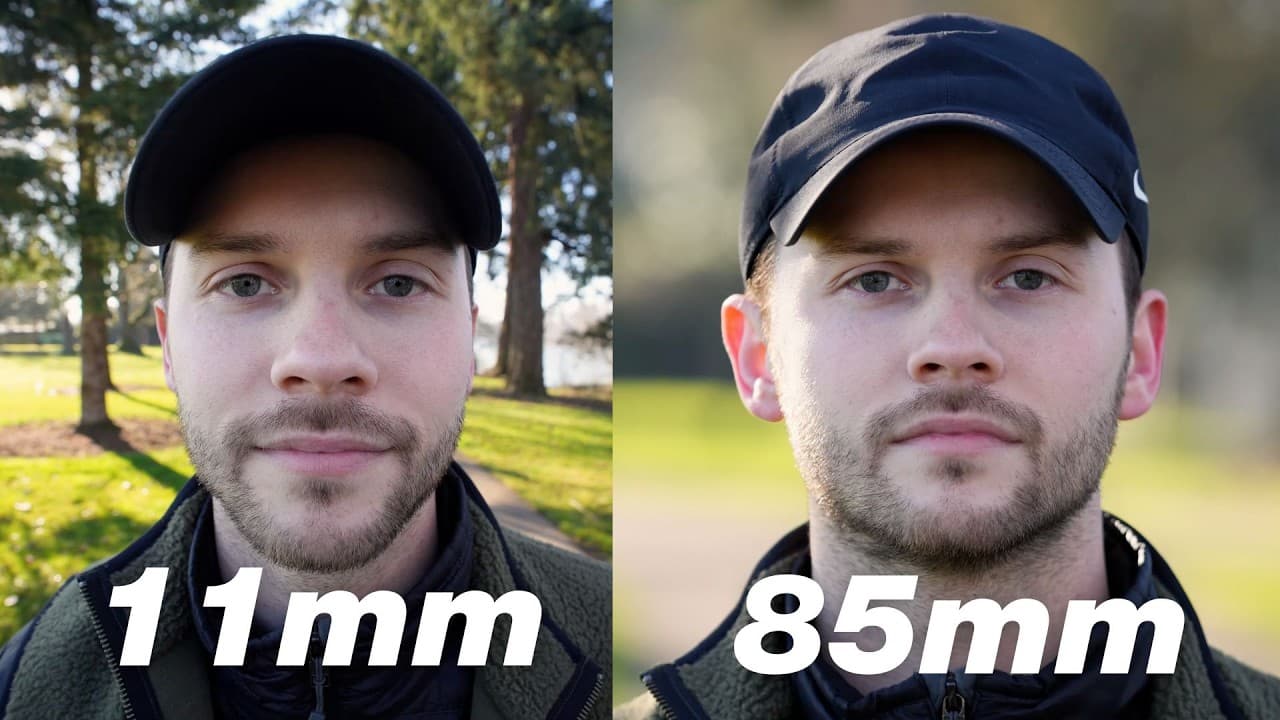
- Focal length is a measurement in millimeters that determines how wide or tight the captured field of view appears. Examples such as 11 mm, 16 mm, and 20 mm suit wide scenes, while 85 mm, 105 mm, and 200 mm suit distant subjects.
- Longer focal lengths create stronger visual compression by narrowing the field of view and magnifying distant objects. This makes the background appear larger and closer to the subject than it would with a wide-angle lens, producing a more compressed-looking image.
- Wide focal lengths tend to create more visible distortion, making a scene appear stretched or expanded and sometimes causing straight architectural lines to look curved. Tighter focal lengths generally minimize this distortion, preserve straighter lines, and produce a more natural-looking perspective.
- Prime lenses have one fixed focal length, often use fewer internal elements, and can provide sharper images and wider maximum apertures. Zoom lenses cover a range of focal lengths, making them more versatile when photographers or filmmakers must quickly capture wide, medium, and tight compositions.
- Aperture is the lens opening that controls incoming light and depth of field. A low value such as f/1.8 admits more light and produces a shallow focused area, while a high value such as f/16 admits less light and keeps more of the scene focused.
- APS-C cameras change the effective field of view through crop factor, regardless of whether the attached lens was designed for full-frame or APS-C use. A 20 mm lens produces a 30 mm equivalent field of view on cameras using the stated 1.5x multiplier.
Install to Summarize YouTube Videos and Get Transcripts
Explore YouTube Video Summarizer or Get YouTube Transcript Extractor
Questions & Answers
Q: How does a camera lens create an image?
A camera lens allows light to travel through multiple pieces of glass called lens elements. Those elements bend and direct the light so it reaches a particular area of the camera sensor in focus, producing the image. This optical process makes the lens essential, since a DSLR or mirrorless camera is practically useless without one.
Q: How do I know whether a lens fits my camera?
Check the mounting system used by both the lens and the camera body. A Sony E-mount camera requires a lens made for E-mount, whether the lens comes from Sony or a third-party manufacturer. Compatibility can also vary within one brand, as older Canon DSLRs use EF mounts while newer Canon mirrorless cameras use RF mounts.
Q: What does focal length mean on a camera lens?
Focal length is the value shown in millimeters on a lens, such as 20 mm, 50 mm, or 70–200 mm. It determines the captured field of view, including how wide or tight the composition appears. It also affects background compression and distortion, making it one of the most important factors when selecting a lens.
Q: Which focal lengths work for different types of photography?
Wide focal lengths such as 11 mm, 16 mm, and 20 mm are useful for landscapes, buildings, and small studio spaces. Medium choices such as 35 mm, 50 mm, and 70 mm cover many everyday situations. Tighter telephoto options such as 85 mm, 105 mm, and 200 mm suit wildlife, sports, concerts, and other distant subjects.
Q: What is the difference between prime and zoom lenses?
A prime lens has one fixed focal length, so changing the framing requires physically moving the camera. It usually contains fewer elements, can produce sharper images, and often offers a wider aperture. A zoom lens changes focal length internally, providing greater flexibility for capturing wide, medium, and tight shots without repositioning the camera.
Q: How does aperture affect light and depth of field?
Aperture controls how much light enters through the lens and how much of the scene remains focused. A low f-stop such as f/1.8 creates a wide opening, admits substantial light, and produces a shallow depth of field with a blurred background. A high value such as f/16 reduces light and increases the focused area.
Q: What is the difference between constant and variable aperture lenses?
A constant-aperture lens maintains the same aperture value while its focal length changes. Prime lenses and more expensive zoom lenses can provide this behavior. A variable-aperture lens stops down while zooming tighter. For example, the described 18–55 mm kit lens changes from f/3.5 to f/5.6, reducing the light reaching the sensor.
Q: How does an APS-C sensor change a lens's field of view?
An APS-C sensor applies a crop factor that makes a lens produce a tighter effective field of view than it does on a full-frame camera. The stated multiplier is 1.5x for Sony, Nikon, Fuji, and most other brands, and 1.6x for Canon. Therefore, a 20 mm lens becomes a 30 mm equivalent view at 1.5x.
Summary & Key Takeaways
-
A camera lens uses glass elements to bend incoming light and focus it onto the camera sensor, creating an image. Because manufacturers use specific mounting systems, buyers must confirm that a lens matches the camera body. Even one manufacturer may use different mounts across DSLR and mirrorless product lines.
-
Focal length, measured in millimeters, determines field of view, compression, and distortion. Wide focal lengths capture expansive scenes but can stretch subjects and curve straight lines. Longer focal lengths capture tighter views, magnify distant objects, make backgrounds appear closer, and generally produce a more natural-looking image with less distortion.
-
Aperture controls both incoming light and depth of field. Low f-stop values create wide openings, brighter exposure, and blurred backgrounds, while high values reduce light and keep more of the scene focused. Sensor size also changes effective field of view through the crop factor applied by APS-C cameras.
Read in Other Languages (beta)
Share This Summary 📚
Summarize YouTube Videos and Get Video Transcripts with 1-Click
Try YouTube Summary with ChatGPT & Claude or YouTube Transcript Generator
Explore More Summaries from Think Media 📚






Summarize YouTube Videos and Get Video Transcripts with 1-Click
Try YouTube Summary with ChatGPT & Claude or YouTube Transcript Generator