What Is GPT-5 and How Does It Improve AI?
TL;DR
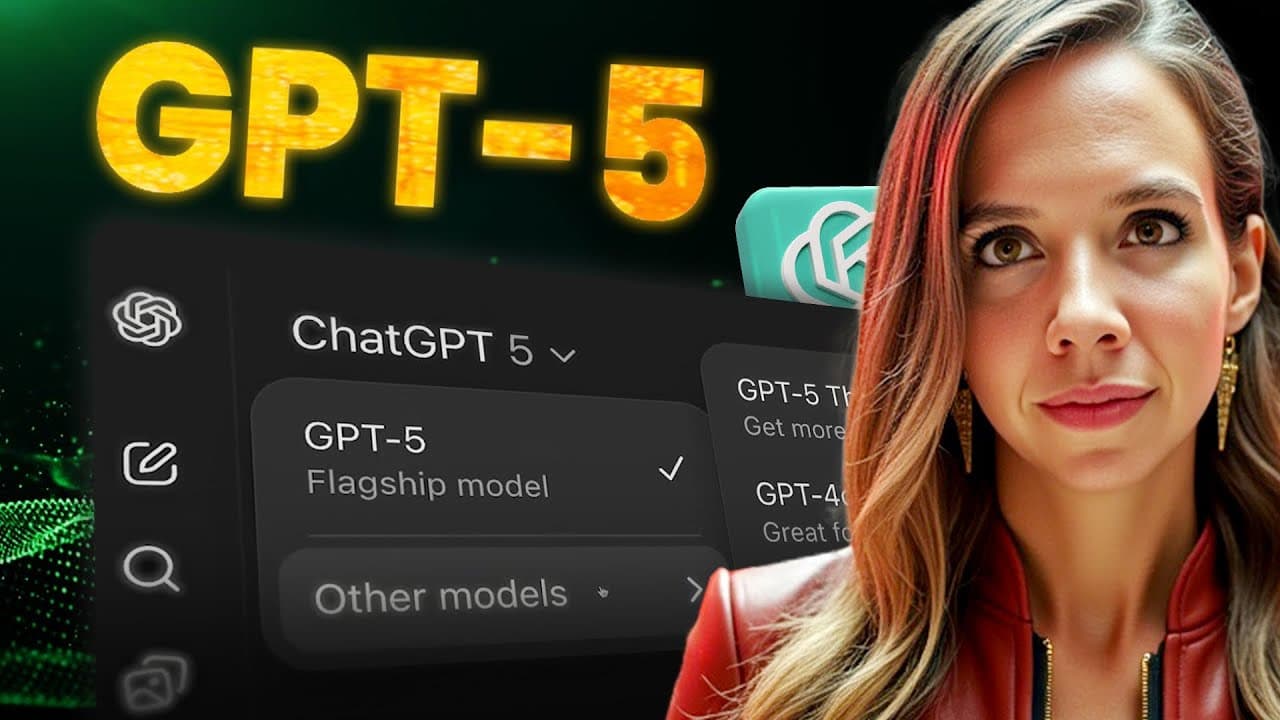
GPT-5 improves AI by automatically giving simple questions quick responses and applying deeper reasoning to complex problems. The family includes GPT-5, GPT-5 Mini, and GPT-5 Nano, while reported advances include a 74.9% SWE-bench score, a hallucination rate below 1%, and a 400K-token API context window. Read on for the model differences, coding demonstrations, safety approach, developer features, and access tiers.
Transcript
We just watched history unfold live. After 32 months since chat GPT's launch, OpenAI just dropped GPT5. And Sam Alman wasn't exaggerating when he said this would be like having a team of PhD level experts in your pocket. I've been analyzing every detail from OpenAI's live stream while you were sleeping. Real Julia has ran some tests, too. What they... Read More
Key Insights
- GPT-5 is a three-model family consisting of GPT-5, GPT-5 Mini, and GPT-5 Nano. The flagship targets demanding expert-level work, Mini is positioned as a faster everyday model, and Nano prioritizes low cost and speed for applications operating under tighter resource constraints.
- Automatic reasoning adjustment is a central GPT-5 capability. The system reportedly gives immediate responses to straightforward questions and activates deeper analytical processing for complex problems, reducing the need for users to select separate fast and reasoning-focused models manually.
- GPT-5 coding performance is illustrated through complete interactive applications built within minutes. Demonstrations included an adjustable Bernoulli-effect physics visualization and a French learning platform containing flashcards, quizzes, progress tracking, pronunciation practice, and an educational snake game.
- Reported benchmark performance includes 74.9% on SWE-bench, compared with 69.1% for o3, and 97% on Tau-squared, where the transcript says no model had exceeded 49% two months earlier. GPT-5 also reportedly reached an LM Arena score of 1,481.
- The reported hallucination rate is below 1% for GPT-5, compared with 5% to 7% for o3. The presentation connects this reduction with improved attention and a 400K-token context window, arguing that the combination makes the model more dependable for complex work.
- Enterprise applications are presented across pharmaceuticals, banking, and health care. Amgen reportedly used GPT-5 to support drug-design research, BBVA reduced certain financial analyses from three weeks to a few hours, and Oscar Health identified it as its strongest model for clinical reasoning.
- Safe completions are designed to maximize useful assistance within safety restrictions. Instead of treating every sensitive request as a choice between full compliance and refusal, GPT-5 may provide limited information, clarify its boundaries, and suggest safer alternatives that still address the user's underlying need.
- GPT-5 access extends across free, Plus, and Pro usage tiers. Free users receive GPT-5 subject to limits and then fall back to GPT-5 Mini, Plus users receive higher usage limits, and Pro users receive unlimited GPT-5 access together with extended thinking for more detailed responses.
Install to Summarize YouTube Videos and Get Transcripts
Explore YouTube Video Summarizer or Get YouTube Transcript Extractor
Questions & Answers
Q: What is GPT-5, and how does it improve AI?
GPT-5 is presented as a family of models that can think, reason, and create at expert human levels across many domains. Its central improvement is automatic reasoning adjustment: simple questions receive fast responses, while complex problems trigger deeper analytical work.
Q: What are the differences between GPT-5, GPT-5 Mini, and GPT-5 Nano?
GPT-5 is the flagship model for demanding, expert-level tasks. GPT-5 Mini is a faster, more cost-effective model for high-volume everyday work, while GPT-5 Nano prioritizes speed and efficiency and is described as 25 times more affordable than GPT-5.
Q: How well does GPT-5 perform on coding and agentic benchmarks?
The transcript reports a 74.9% score on SWE-bench, compared with 69.1% for o3. It also reports a 97% Tau-squared score for complex agentic tool-calling scenarios and says that no model had exceeded 49% two months earlier.
Q: What did GPT-5 build in the coding demonstrations?
GPT-5 reportedly wrote 400 lines of working code in 2 minutes and created an interactive Bernoulli-effect visualization with adjustable air speed, angles of attack, and real-time pressure calculations. It also built a French learning platform with flashcards, quizzes, progress tracking, pronunciation practice, and an educational snake game.
Q: What does the transcript report about GPT-5 hallucinations and context length?
The transcript states that GPT-5 has a hallucination rate below 1%, compared with 5% to 7% for o3. It also describes a 400K-token API context window and better attention mechanisms, presenting these features as improvements for complex work.
Q: How can GPT-5 help people understand medical information?
In the cancer journey described, ChatGPT translated a medical report into plain language before the patient spoke with her doctor 3 hours later. GPT-5 went further by providing context about pending results, anticipating related concerns, and suggesting questions to ask the doctor.
Q: How do GPT-5 safe completions work?
Safe completions are designed to maximize helpfulness within safety constraints instead of treating every sensitive request as a choice between full compliance and refusal. GPT-5 may provide a partial answer, explain its limitations, and offer safer alternatives that still address the underlying need.
Q: Who can access GPT-5, and what happens when usage limits are reached?
GPT-5 access is described across free, Plus, and Pro tiers. Free users receive limited GPT-5 access before falling back to GPT-5 Mini, Plus users receive higher limits, and Pro users receive unlimited GPT-5 access with extended thinking.
Summary & Key Takeaways
-
GPT-5 is presented as a model family comprising the flagship GPT-5, the faster and more cost-effective GPT-5 Mini, and GPT-5 Nano, which is described as 25 times more affordable than the flagship. Automatic reasoning adjustment allows the system to allocate more analytical effort when a request becomes difficult.
-
Coding demonstrations showed GPT-5 rapidly producing interactive software, including a physics visualization and a French learning platform. The transcript also reports a 74.9% SWE-bench score, a 97% Tau-squared score, and an LM Arena score of 1,481, alongside a reported hallucination rate below 1%.
-
The broader product includes voice conversations, adaptive learning, safe completions, and developer controls such as structured outputs, verbosity settings, custom tools, and a 400K-token API context window. Free users receive limited GPT-5 access before falling back to GPT-5 Mini, while Pro users receive unlimited GPT-5 and extended thinking.
Read in Other Languages (beta)
Share This Summary 📚
Summarize YouTube Videos and Get Video Transcripts with 1-Click
Try YouTube Summary with ChatGPT & Claude or YouTube Transcript Generator
Explore More Summaries from Julia McCoy 📚





Summarize YouTube Videos and Get Video Transcripts with 1-Click
Try YouTube Summary with ChatGPT & Claude or YouTube Transcript Generator