How to Draw Realistic Muscles Quickly and Easily
TL;DR
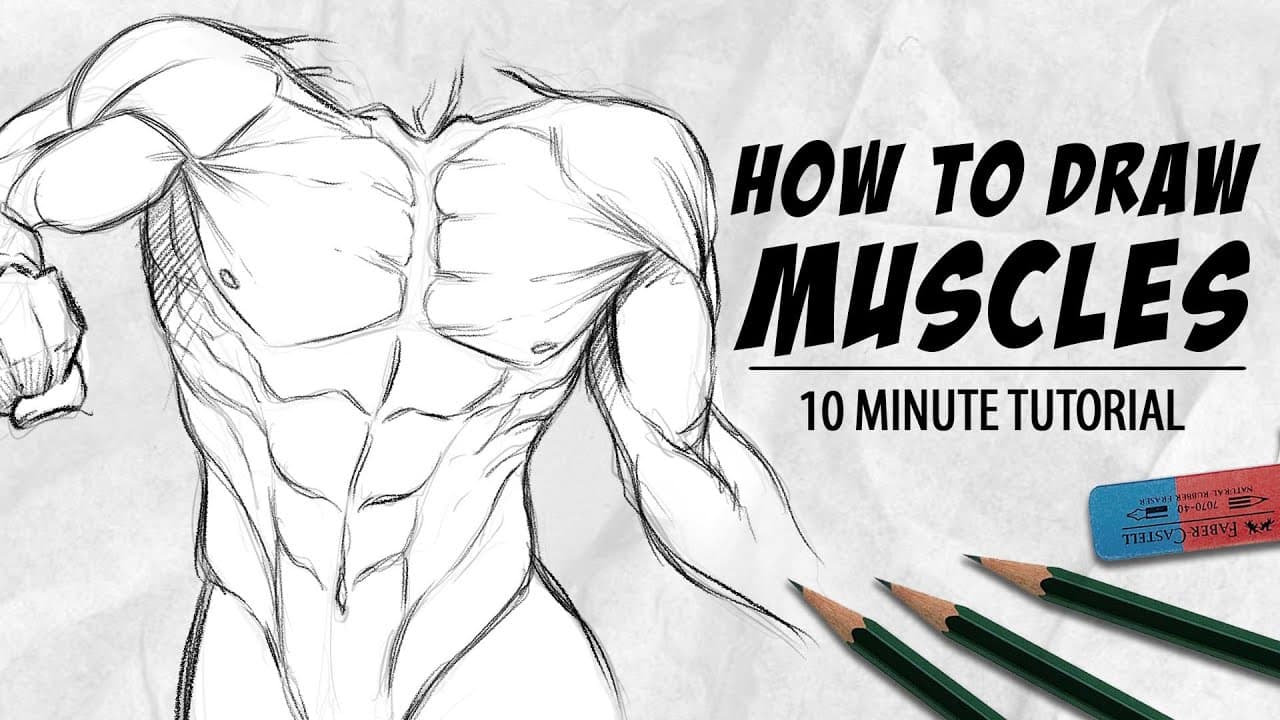
To draw realistic muscles, break them down into basic shapes, focusing on the outlines and beginnings of the muscles for detail. Avoid unrealistic representations by considering anatomy and incorporating shading techniques to add depth. Using references like 3D models can significantly improve accuracy in your muscle drawings.
Transcript
[music] Hi guys. My name is Marcel and today, we're getting manly because you're gonna learn how to draw some serious muscle like a Sir. In today's video, I'll show you how to draw some certain muscle groups, but don't worry, you'll be able to draw any kind of muscles with these methods. Everything you'll need is a piece of paper and a pen. Don't w... Read More
Key Insights
- 💪 Breaking muscles down into basic shapes simplifies the drawing process and aids in understanding anatomy.
- 💪 Detail at the beginning of muscles is essential for creating a muscular appearance without merely inflating their size.
- 💪 Observing and understanding muscle anatomy can prevent flat-looking drawings and improve accurately representing muscle groups.
- 💪 Shading adds depth and dimension, making muscle drawings appear more lifelike and natural.
- 💨 Utilizing references, like 3D models, is not cheating but a way to enhance artistic understanding and accuracy.
- 🅰️ The typical body types—like lean and bulky—require different drawing approaches to reflect their unique characteristics accurately.
- 🥺 Artists should avoid overdoing muscle mass in drawings, as subtlety often leads to more realistic representations.
Install to Summarize YouTube Videos and Get Transcripts
Explore YouTube Video Summarizer or Get YouTube Transcript Extractor
Questions & Answers
Q: What basic shapes should I use when starting to draw muscles?
In the video, Marcel emphasizes breaking down the arm into basic shapes: a circle for the shoulder (deltoid), an oval for the bicep, and a triangle for the lower arm muscles. This simplification allows artists to understand the muscle's structure and proportions better, making it easier to build their drawings around these foundational forms.
Q: How can I make my muscle drawings look more realistic?
To create realistic muscle representations, begin by detailing the starting parts of muscles rather than just enlarging their overall size. As demonstrated in the video, attention to the initial outlines and incorporating realistic shading techniques can give the muscles depth and prevent appearing flat or simplistic, leading to more lifelike renditions.
Q: What are some common mistakes when drawing muscles?
One common mistake mentioned in the video is simply drawing muscles as larger shapes without understanding their anatomy. This can lead to unrealistic proportions, like the "Lego brick" effect. Another is drawing abs as straight lines rather than in the triangular shape they actually form, which can result in an incorrect depiction of the human figure.
Q: Is shading important in muscle drawing, and why?
Yes, shading is crucial as it adds depth and dimension to drawings. Marcel highlights that using realistic shading techniques can make muscles appear more three-dimensional. By creating smooth transitions rather than flat outlines, the final artwork looks more dynamic and visually appealing, enhancing the overall impression of strength and realism.
Summary & Key Takeaways
-
The tutorial focuses on breaking down the anatomy of muscles into simple shapes, enabling artists to reproduce any muscle group effectively.
-
Essential techniques include enhancing muscle outlines and understanding the anatomy to avoid unrealistic representations such as "Lego brick" arms.
-
The video concludes with shading methods to add depth and realism to muscle drawings, emphasizing the importance of using references for accuracy.
Read in Other Languages (beta)
Share This Summary 📚
Summarize YouTube Videos and Get Video Transcripts with 1-Click
Try YouTube Summary with ChatGPT & Claude or YouTube Transcript Generator
Explore More Summaries from Draw like a Sir 📚

Summarize YouTube Videos and Get Video Transcripts with 1-Click
Try YouTube Summary with ChatGPT & Claude or YouTube Transcript Generator