How to Build a Real-Time Voice Command Model with TensorFlow
TL;DR
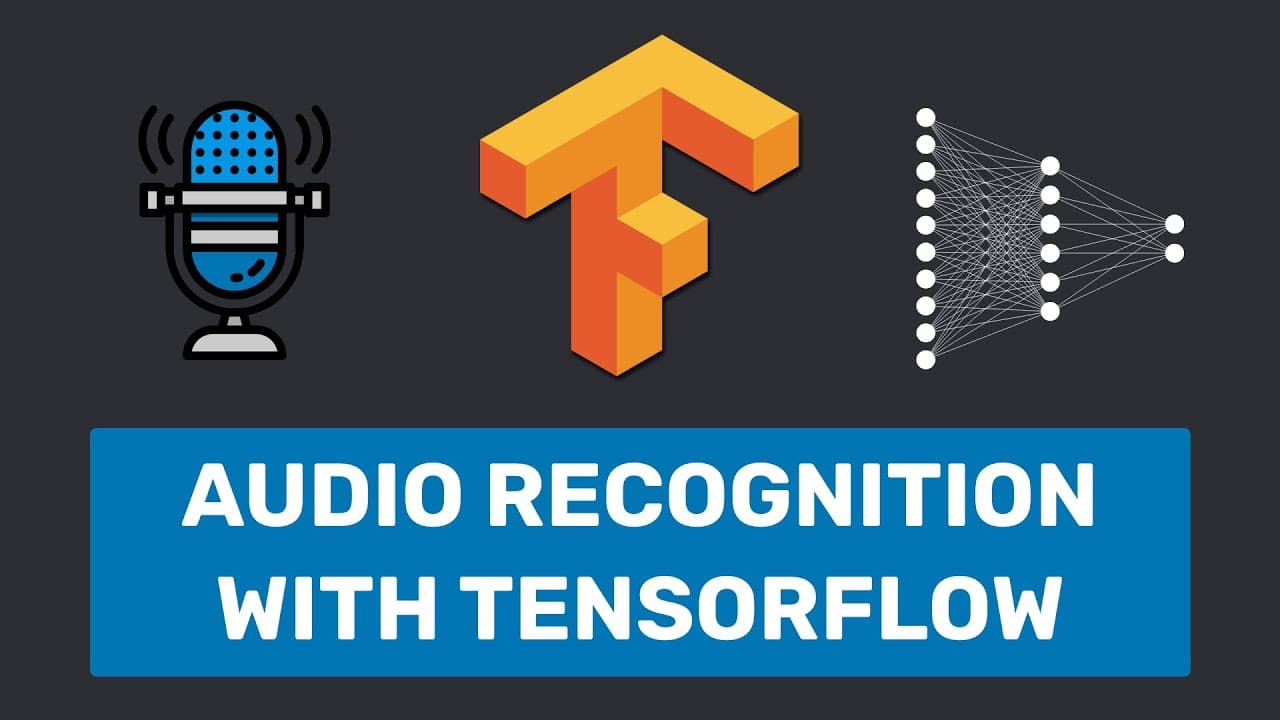
To build a real-time voice command recognition model using TensorFlow, start by training on the speech commands dataset and then adapt the model to process microphone input. The model, built with convolutional layers, achieves 85% accuracy and can control applications like a turtle graphics program, enabling voice commands to perform actions in real-time.
Transcript
welcome everyone in today's video we create a speech recognition model with tensorflow that can recognize keywords and then we turn this into an actual project that can listen to real-time data from your microphone and can then classify this so you could use this for example for a home automation project or whatever you want in our case we built a ... Read More
Key Insights
- 😯 Utilizes TensorFlow's speech commands dataset for keyword recognition.
- ❓ Model architecture comprises downsampling, normalization, convolutional layers, and dense layers.
- 😫 Achieves 85% accuracy on the test set for classification.
- ⌛ Adapts the model pipeline for real-time input from the microphone.
- 🪈 Provides helper functions for recording audio and preprocessing the input.
- 🐢 Integrates a turtle control system for real-time application demonstration.
- 🎰 Saves and downloads the model for deployment on local machines.
Install to Summarize YouTube Videos and Get Transcripts
Explore YouTube Video Summarizer or Get YouTube Transcript Extractor
Questions & Answers
Q: What is the TensorFlow model used in the project?
The TensorFlow model is based on the speech commands dataset for recognizing keywords like up, down, left, right, and more.
Q: How is the model architecture structured?
The model architecture includes layers for downsampling, normalization, convolutional layers, max-pooling, and dense layers for classification.
Q: What is the process for training and testing the model?
The model is trained on the speech commands dataset, split into training, validation, and testing sets, achieving 85% accuracy on the test set. Confusion matrix is used for evaluation.
Q: How is real-time input from a microphone integrated into the model?
The model pipeline is adapted to receive a numpy array input from the microphone, which is then processed and converted to a tensor for prediction.
Summary & Key Takeaways
-
TensorFlow model recognizes keywords, converted to real-time control using microphone input.
-
Utilizes TensorFlow speech commands dataset for training and testing.
-
Model built with convolutional neural network to classify spectrograms.
Read in Other Languages (beta)
Share This Summary 📚
Summarize YouTube Videos and Get Video Transcripts with 1-Click
Try YouTube Summary with ChatGPT & Claude or YouTube Transcript Generator
Explore More Summaries from AssemblyAI 📚




Summarize YouTube Videos and Get Video Transcripts with 1-Click
Try YouTube Summary with ChatGPT & Claude or YouTube Transcript Generator