How Do Network Protocols Control Communication?
TL;DR
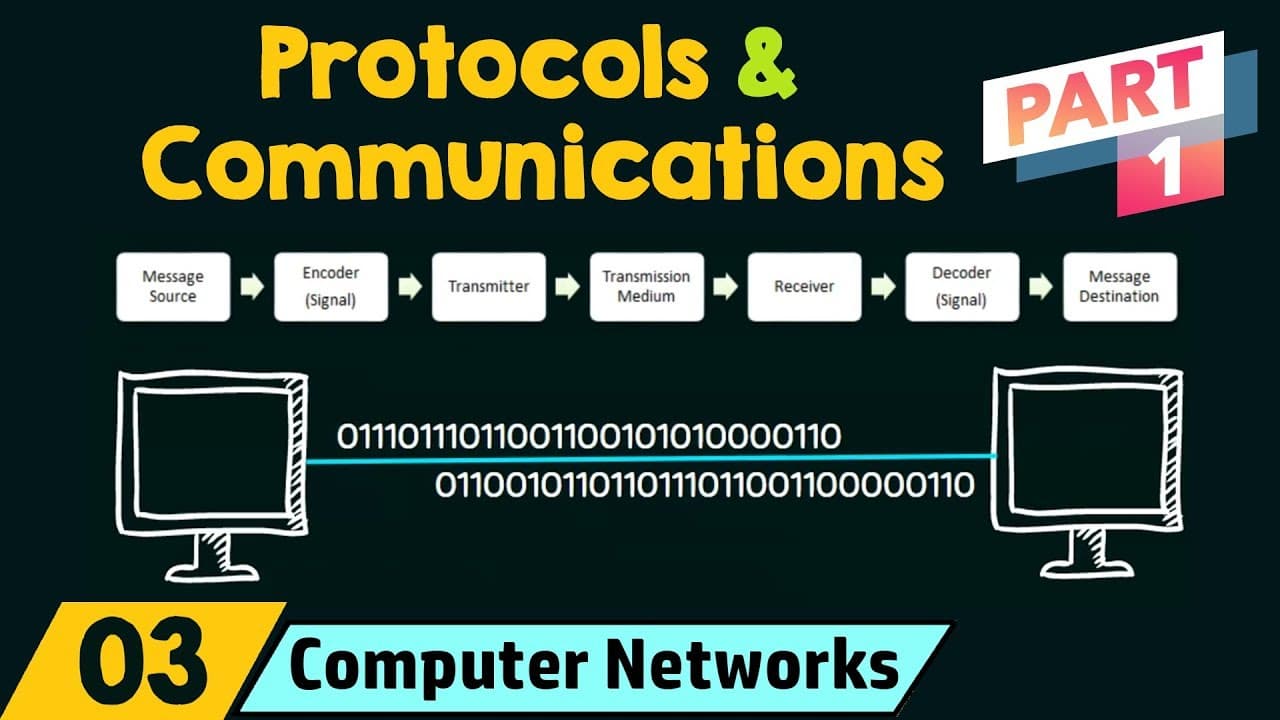
Network protocols make data communication effective by defining what is communicated, how it is communicated, and when it is communicated. They govern encoding, formatting and encapsulation, message size, timing, and delivery options, while data can flow through simplex, half-duplex, or full-duplex communication depending on whether transmission occurs in one direction, alternates directions, or happens simultaneously.
Transcript
Hello everyone, welcome back to the course on computer networks. Today we shall see network protocols and communication. Before we step into the topic, we shall understand what are the things we are going to learn today. Today we will be learning about data communication, data flow what is the importance of protocol in computer network. Understand ... Read More
Key Insights
- Data communication is the exchange of data between two nodes through a link or transmission medium. One node acts as the source, another as the destination, and the connecting cable or other medium provides the channel through which the data travels.
- Simplex communication is a unidirectional data flow in which one node transmits and another receives. A keyboard sending data to a CPU and a traditional monitor receiving information from a CPU illustrate communication that does not return data in the opposite direction.
- Half-duplex communication is a bidirectional flow that does not permit simultaneous sending and receiving. Each device can perform both roles, but only one direction is active at a time, as demonstrated by people taking turns speaking and listening through a walkie-talkie.
- Full-duplex communication is a bidirectional flow in which sending and receiving occur simultaneously. A telephone line illustrates this mode because participants can talk and listen at the same time, unlike half-duplex communication, which requires the direction of transmission to alternate.
- A network protocol is a set of rules that governs data communication. It determines what is communicated, how communication takes place, and when it occurs so that senders and receivers can coordinate language, speed, timing, responses, and other communication requirements.
- Message encoding is the conversion of source data into a transmissible form. Data is converted into signals for a wired medium or waves for a wireless medium, transmitted through the channel, received at the destination, and decoded so the destination can understand it.
- Message formatting and encapsulation are protocol functions that make transmitted data identifiable and understandable. The sender and receiver agree on a format, while information such as source and destination details is added to the data so the correct communication participants can be recognized.
- Message timing and sizing are protocol controls that adapt communication to receiver and link limitations. Large messages are divided into smaller units, flow control prevents a fast sender from overwhelming a slow receiver, and response timeouts determine when unacknowledged data should be retransmitted.
- Message delivery options are unicast, multicast, and broadcast. Unicast sends data from one sender to exactly one receiver, multicast sends it to a selected set of receivers rather than everyone, and broadcast sends it to all participants in the network.
Install to Summarize YouTube Videos and Get Transcripts
Explore YouTube Video Summarizer or Get YouTube Transcript Extractor
Questions & Answers
Q: What is data communication in a computer network?
Data communication is the exchange of data between two nodes through a link or transmission medium. A communication arrangement includes a source or sender, a destination or receiver, and a channel or medium connecting them. The source creates and sends the data, the medium carries it, and the destination receives and interprets it.
Q: What is the difference between simplex, half duplex, and full duplex?
Simplex allows data to travel in only one direction, with one device transmitting and the other receiving. Half duplex allows communication in both directions, but sending and receiving cannot occur at the same time. Full duplex also supports both directions, but it permits devices to send and receive simultaneously.
Q: How does simplex communication work?
Simplex communication works through a permanently unidirectional flow. One node sends data and another node receives it, with no return transmission in the same communication arrangement. A keyboard sends information to a CPU without receiving information back, while a traditional monitor receives CPU output without sending information back to the CPU.
Q: Why is a walkie-talkie an example of half-duplex communication?
A walkie-talkie is an example of half-duplex communication because users can both talk and listen, but they cannot perform those actions simultaneously. When one device is transmitting, the other receives. The direction can later reverse, but communication must alternate instead of allowing both participants to send and receive at the same time.
Q: Why are protocols necessary in network communication?
Protocols are necessary because communication becomes ineffective when participants do not share rules. A sender might transmit faster than a receiver can handle, use a representation the receiver cannot understand, or leave no opportunity for a response. Protocols establish mutual rules covering the content, method, timing, and coordination of data communication.
Q: What are the main elements of a network protocol?
The protocol elements described are message encoding, message formatting and encapsulation, message sizing, message timing, and message delivery options. Together, they define how data is represented for transmission, organized with identifying information, divided into manageable units, regulated according to timing requirements, and directed to the intended network recipients.
Q: How do message timing and flow control support reliable communication?
Message timing includes flow control and response timeout. Flow control regulates a fast sender so that a slower receiver is not given data faster than it can handle. A receiver can acknowledge successful delivery. If the sender does not receive that acknowledgment within the protocol's waiting period, it retransmits the same data to support guaranteed delivery.
Q: What is message formatting and encapsulation?
Message formatting means that the sender and receiver mutually agree on the organization of transmitted data. Encapsulation adds information to the data rather than sending the data alone. Source and destination information can be included so the receiver can determine who sent the message and ensure that the intended sender and receiver are correctly identified.
Q: What is the purpose of message sizing in a protocol?
Message sizing handles situations in which the data is too large for the capacity of the transmission link. The sending computer breaks a large message into smaller units that the medium can carry. This resembles dividing a large piece of human communication into smaller parts or sentences that can be delivered and understood more easily.
Q: What are unicast, multicast, and broadcast delivery?
Unicast is delivery from one sender to exactly one receiver in the network. Multicast is delivery from one sender to a selected set of receivers, but not to every participant. Broadcast is delivery from one sender to all participants in the network. These options specify which destinations should receive a transmitted message.
Summary & Key Takeaways
-
Data communication is the exchange of data between two nodes through a link or transmission medium. Its direction is described by three flow modes. Simplex permits transmission in one direction, half duplex permits both directions at different times, and full duplex permits simultaneous sending and receiving in both directions.
-
A protocol is a set of mutually agreed rules governing data communication. It determines what information is communicated, how it is represented and transmitted, and when communication occurs. Without shared rules for language, speed, timing, responses, and acknowledgments, the sender and receiver may be unable to exchange information effectively.
-
Protocol elements include message encoding, formatting and encapsulation, sizing, timing, and delivery options. Data is encoded for its transmission medium, supplemented with source and destination information, divided when necessary, and regulated through flow control and response timeouts. Delivery may target one receiver, a selected group, or everyone.
Read in Other Languages (beta)
Share This Summary 📚
Summarize YouTube Videos and Get Video Transcripts with 1-Click
Try YouTube Summary with ChatGPT & Claude or YouTube Transcript Generator
Explore More Summaries from Neso Academy 📚





Summarize YouTube Videos and Get Video Transcripts with 1-Click
Try YouTube Summary with ChatGPT & Claude or YouTube Transcript Generator