How Did Scientists Predict a Supernova in SP1149?
TL;DR
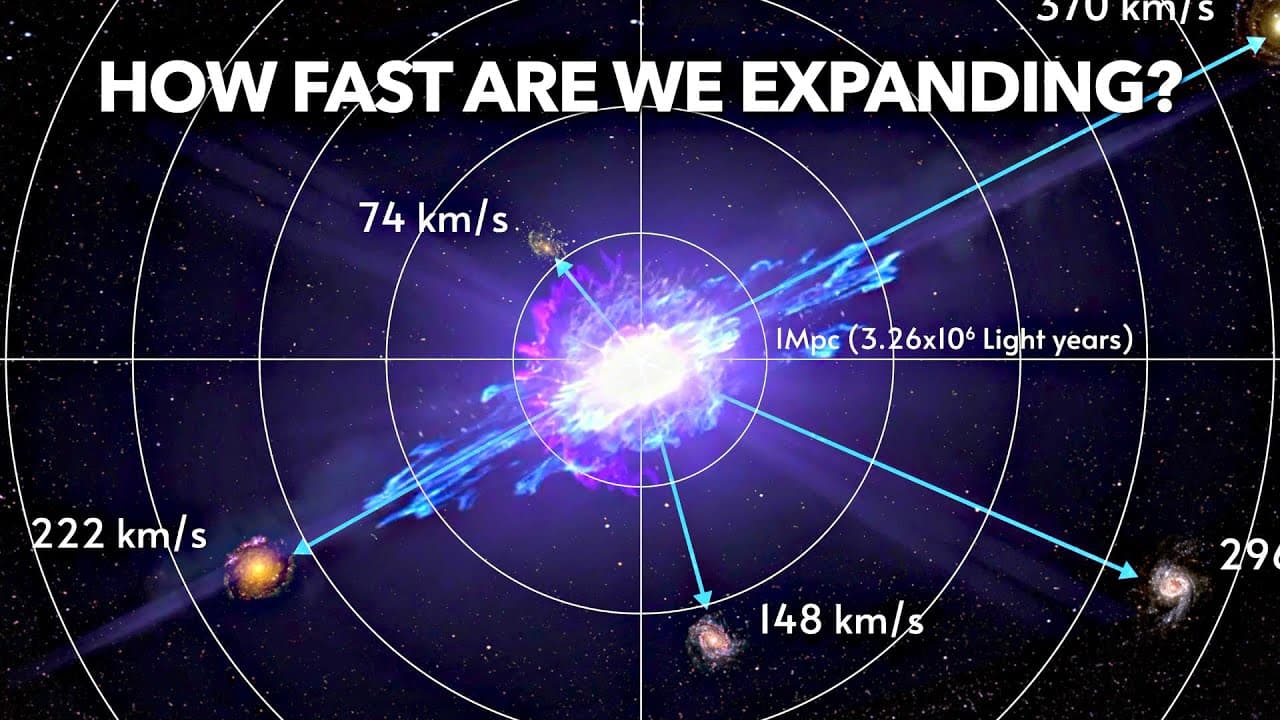
Scientists predicted the supernova in the galaxy SP1149 by analyzing gravitational lensing, which created multiple images of the exploding star. This breakthrough allowed them to measure time delays between images, leading to calculations of the Hubble constant, a key factor in understanding the universe’s expansion. This method provides a new, independent means of measuring cosmic distances.
Transcript
This video was sponsored by Fasthosts, who are offering UK viewers the chance to win a 5,000 pound tech bundle if you can answer my Techie Test question later in the show. On May 1st, 2015 a group of scientists predicted that the following November, we would see a star go supernova billions of light years away in a spiral galaxy designated SP1149. ... Read More
Key Insights
- 🤩 Supernovae are rare and unpredictable events that mark the end of a star's life cycle.
- 👻 Gravitational lensing can create multiple images of distant objects, allowing scientists to study them in more detail.
- ☠️ The time delay between the appearance of lensed images can be used to measure the Hubble constant and determine the rate of the universe's expansion.
Install to Summarize YouTube Videos and Get Transcripts
Explore YouTube Video Summarizer or Get YouTube Transcript Extractor
Questions & Answers
Q: How did scientists successfully predict the occurrence of a supernova?
Scientists were able to predict the supernova by observing its lensed images, which appeared in multiple locations due to gravitational lensing caused by a cluster of galaxies.
Q: What is gravitational lensing?
Gravitational lensing is a phenomenon where the path of light is bent by the gravity of a massive object, causing the light to follow a curved trajectory and creating multiple images of the same object.
Q: How did scientists calculate the Hubble constant using the lensed supernova images?
By measuring the time delay between the appearance of the multiple images of the supernova, scientists were able to calculate the Hubble constant, which indicates the rate of the universe's expansion.
Q: What implications does the successful prediction of the supernova have?
The prediction of the supernova using gravitational lensing provides confirmation of our understanding of light and gravity on a cosmic scale. It also offers an alternative method to measure the Hubble constant.
Summary & Key Takeaways
-
Scientists successfully predicted a supernova in a distant galaxy designated SP1149 using the Hubble Space Telescope.
-
Gravitational lensing, caused by a large amount of ordinary matter and dark matter, created multiple images of the supernova.
-
The time delay between the appearance of the multiple images allowed scientists to calculate the Hubble constant, which measures the rate of the universe's expansion.
Read in Other Languages (beta)
Share This Summary 📚
Summarize YouTube Videos and Get Video Transcripts with 1-Click
Try YouTube Summary with ChatGPT & Claude or YouTube Transcript Generator
Explore More Summaries from Veritasium 📚


Summarize YouTube Videos and Get Video Transcripts with 1-Click
Try YouTube Summary with ChatGPT & Claude or YouTube Transcript Generator