Can We Terraform the Sahara to Stop Climate Change?
TL;DR
Exploring afforestation in deserts to mitigate climate change.
Transcript
We have been hearing it for years. Climate change is happening. What I am about to present to you is fact. These are reliable measurements with multiple peer reviewed papers confirming the information. Atmospheric carbon dioxide levels are the highest they have been in over 400 thousand years, confirmed by our analysis of hundreds of samples of arc... Read More
Key Insights
- Atmospheric carbon dioxide levels are at a historical high, confirmed by extensive scientific research, emphasizing the urgency of addressing climate change.
- Global temperatures have risen significantly since the industrial revolution, with predictions of more extreme weather and economic impacts if trends continue.
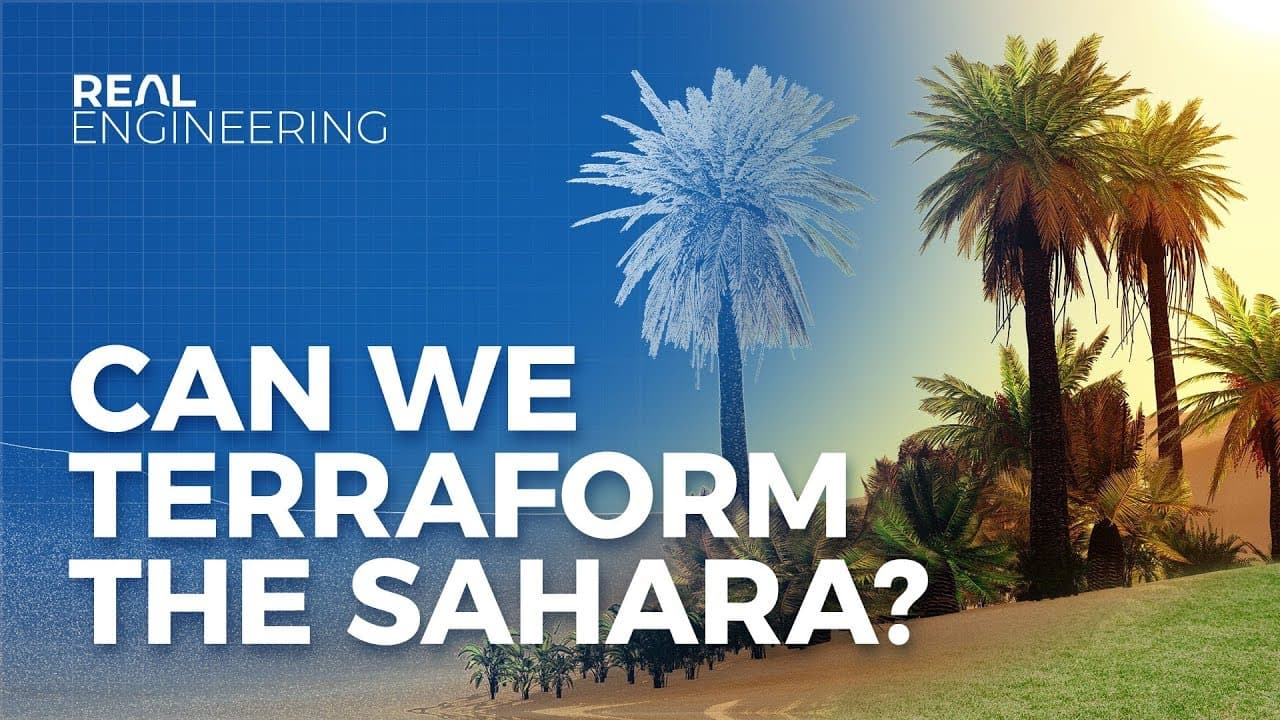
- Afforestation in deserts like the Sahara and Australian outback is proposed as a geoengineering solution to sequester carbon and combat climate change.
- Desalination technology advancements make large-scale irrigation in deserts feasible, but the energy and financial costs are substantial.
- Afforestation could potentially capture a significant percentage of annual carbon emissions, but the feasibility and environmental impact are complex and uncertain.
- The project would require international cooperation and funding, possibly through carbon taxes, but raises ethical concerns about resource usage.
- Climate models suggest that afforestation may alter local and global temperatures, with potential negative effects on Earth's albedo and ocean temperatures.
- The overall effectiveness of afforestation as a climate solution is debated, with some studies suggesting it might increase global temperatures slightly by 2100.
Install to Summarize YouTube Videos and Get Transcripts
Explore YouTube Video Summarizer or Get YouTube Transcript Extractor
Questions & Answers
Q: What is the main goal of the proposed afforestation project in deserts?
The main goal of the proposed afforestation project in deserts like the Sahara and Australian outback is to sequester atmospheric carbon dioxide by planting forests. This initiative aims to capture a significant portion of annual carbon emissions, thus mitigating climate change and its associated effects on global temperatures and weather patterns.
Q: What are the potential challenges of implementing afforestation in deserts?
Implementing afforestation in deserts faces several challenges, including sourcing and managing the vast amounts of water required for irrigation, the financial and energy costs associated with desalination and water distribution, and the potential negative environmental impacts such as changes in Earth's albedo and local ecosystems. Additionally, ethical considerations arise from using non-renewable groundwater resources.
Q: How could afforestation affect global and local temperatures?
Afforestation could affect global and local temperatures by altering Earth's albedo and increasing local precipitation through evaporative cooling. While forests absorb solar radiation and reduce albedo, potentially increasing temperatures, the cloud cover generated might counteract this effect. Climate models provide mixed results, with some suggesting a slight increase in global temperatures by 2100.
Q: What role does desalination technology play in the afforestation project?
Desalination technology is crucial for providing the vast quantities of water needed to irrigate the proposed forests in deserts. With advancements in desalination, it is possible to convert seawater into freshwater for irrigation, though this comes with significant energy requirements and associated carbon emissions. The project's viability depends on balancing these factors with sustainable energy sources like solar power.
Q: What are the ethical concerns associated with using groundwater for afforestation?
Using groundwater for afforestation raises ethical concerns because it involves tapping into non-renewable resources that are vital for local populations. Draining these aquifers could deplete essential water supplies for communities in the Sahara region, posing risks to their livelihoods and ecosystems. This highlights the need for careful consideration of resource management and sustainability.
Q: How might afforestation impact the global carbon cycle?
Afforestation could impact the global carbon cycle by sequestering large amounts of carbon dioxide in the biomass of the newly planted forests, potentially capturing 16.3% to 32.6% of annual emissions. However, it may also disrupt natural processes like the fertilization effect of Sahara dust on the Amazon and Atlantic, potentially offsetting some of the carbon sequestration benefits.
Q: What financial mechanisms could support the afforestation project?
The afforestation project could be supported financially through international cooperation and carbon taxes. Countries could contribute to funding the project by implementing carbon taxes on fossil fuels, allowing them to offset their emissions. This approach would require significant global collaboration and commitment to addressing climate change through innovative and large-scale solutions.
Q: Why is decreasing carbon emissions still considered the best solution for climate change?
Decreasing carbon emissions is considered the best solution for climate change because it directly addresses the root cause of global warming. Renewable energy sources like solar and wind power offer sustainable, low-carbon alternatives to fossil fuels. By reducing emissions, we can mitigate climate change more effectively and avoid the complex and uncertain outcomes associated with large-scale geoengineering projects like afforestation.
Summary & Key Takeaways
-
The video discusses the potential of afforestation in deserts like the Sahara and Australian outback as a method to combat climate change by sequestering carbon dioxide. It highlights the challenges, including water supply, energy costs, and environmental impacts, and suggests international cooperation through carbon taxes.
-
Afforestation could increase the global tree population by 33%, capturing 16.3% to 32.6% of annual emissions. However, the project's feasibility is hindered by high costs, ethical concerns, and potential negative impacts on Earth's albedo and ocean temperatures.
-
The video concludes that while afforestation is an intriguing idea, decreasing carbon emissions through renewable energy remains the most effective tool against climate change. It encourages viewers to learn about solar energy through an online course, promoting action and awareness.
Read in Other Languages (beta)
Share This Summary 📚
Summarize YouTube Videos and Get Video Transcripts with 1-Click
Try YouTube Summary with ChatGPT & Claude or YouTube Transcript Generator
Explore More Summaries from Real Engineering 📚





Summarize YouTube Videos and Get Video Transcripts with 1-Click
Try YouTube Summary with ChatGPT & Claude or YouTube Transcript Generator