How Can Rubber Bands Be Used in Refrigeration?
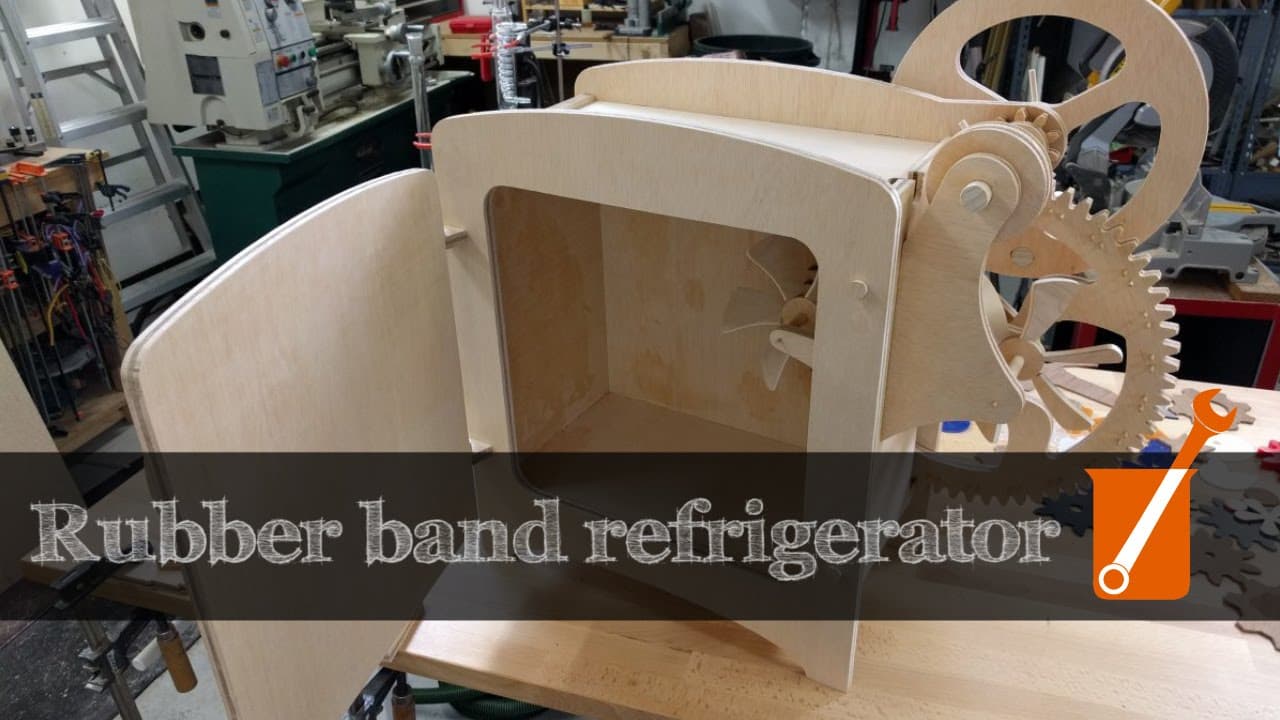
TL;DR
Rubber bands can be utilized in refrigeration by taking advantage of their thermal properties—warming when stretched and cooling upon contraction. This phenomenon demonstrates fundamental thermodynamic principles and can be incorporated into a mechanism mimicking a heat engine, suggesting innovative applications for cooling systems.
Transcript
today on Applied Science I'd like to show you an unusual property of rubber bands and also demonstrate a mechanism that I built that makes use of this property so here's what you can do you can try this at home just go to your office drawer and pick out a couple of regular rubber bands the bigger the better this one is a size 64 and what you want t... Read More
Key Insights
- 🤕 Rubber bands exhibit an unconventional thermal property of warming when stretched and cooling upon contraction.
- 🤕 The rubber band thermodynamic demonstration showcases the role of entropy and disorder in energy transformations.
- 🤕 The heat engine mechanism built with rubber bands offers insights into potential applications in energy conversion and refrigeration technology.
- 🤕 The concept of a rubber band refrigerator hints at innovative approaches to cooling systems with implications for energy efficiency.
- 🤕 Understanding the principles of thermodynamics and entropy helps explain the counterintuitive behavior of rubber bands in heating and cooling.
- 🤕 The application of rubber bands in a heat engine showcases the potential for unconventional materials in engineering solutions.
- 🤕 Exploring the thermodynamic properties of rubber bands provides a practical demonstration of fundamental scientific concepts in action.
Install to Summarize YouTube Videos and Get Transcripts
Explore YouTube Video Summarizer or Get YouTube Transcript Extractor
Questions & Answers
Q: Why do rubber bands warm up when stretched and cool down upon contraction?
Rubber bands exhibit this thermal behavior due to the principles of thermodynamics and entropy. When stretched, the molecules become more ordered, analogous to compressing gas in a spray can, leading to warming. Upon contraction, the molecules return to a disordered state, akin to gas expansion, causing cooling.
Q: How does the rubber band heat engine mechanism work?
The mechanism uses rubber bands as spokes in a wheel configuration, which change shape when exposed to light. By harnessing the rubber bands' thermal properties, the wheel can create motion, demonstrating a heat engine principle based on varying temperatures.
Q: What is the significance of the rubber band refrigerator concept?
The rubber band refrigerator concept explores the potential of using rubber bands in cooling systems. By leveraging the unique thermal behavior of rubber bands, it offers a novel approach to refrigeration, with implications for energy efficiency and environmental sustainability.
Q: How does the rubber band demonstration relate to entropy and disorder?
The rubber band demonstration highlights the role of entropy in thermodynamic processes. When the rubber band contracts, it returns to a more disordered state, releasing energy and cooling down, reflecting the universal tendency towards entropy increase.
Summary & Key Takeaways
-
Rubber bands exhibit a unique property of warming when stretched and cooling upon contraction, contrary to typical thermodynamic expectations.
-
This property is akin to gases cooling upon expansion, highlighting the role of entropy and disorder in the thermodynamic process.
-
The demonstration showcases a heat engine mechanism built with rubber bands, hinting at potential applications in refrigeration.
Read in Other Languages (beta)
Share This Summary 📚
Summarize YouTube Videos and Get Video Transcripts with 1-Click
Try YouTube Summary with ChatGPT & Claude or YouTube Transcript Generator
Explore More Summaries from Applied Science 📚



Summarize YouTube Videos and Get Video Transcripts with 1-Click
Try YouTube Summary with ChatGPT & Claude or YouTube Transcript Generator