THE BEHAVIORAL INVESTOR (BY DANIEL CROSBY)
TL;DR
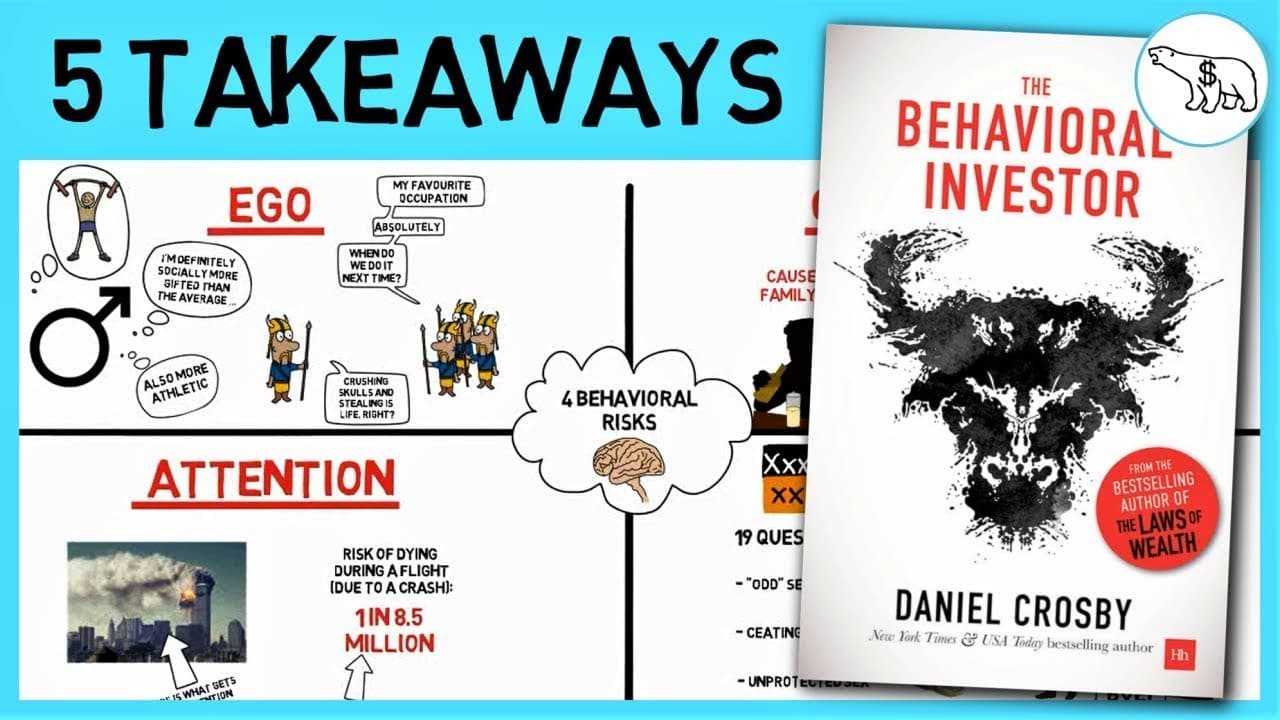
Protect your ego, suppress emotions, and ask "why not?" in investing. Manage behavioral risks through strategies like spreading wealth and playing the odds.
Transcript
You were born to fit in, but investing requires you to stand out. You are wired to protect your ego, but to succeed in the markets, you must suppress it. You are programmed to ask why, but in investing, you must learn to ask: why not? This is The Swedish investor. And this video is a top five takeaways from the book "The Behavioral Investor". By Da... Read More
Key Insights
- 🪡 Ego, conservatism, attention, and emotion are behavioral risks that investors need to manage.
- 🖐️ Spreading wealth, questioning assumptions, and playing the odds can help mitigate these risks.
- ❓ Value investing and momentum investing are two strategies that have empirical, theoretical, and psychological support.
- ⚾ A rule-based system for investing can help navigate behavioral risks and improve overall investment performance.
- 🧘 Emotions can be controlled through meditation and recognizing emotional states.
- 😉 Designing a winning rule-based system requires empirical and theoretical support, as well as psychological difficulty to maintain its profitability.
- 📈 Value investing involves buying undervalued stocks, while momentum investing focuses on stocks with upward or downward trends.
- 🥺 Overcoming behavioral risks can be challenging, but awareness and implementing strategies can lead to better investment decision-making.
Install to Summarize YouTube Videos and Get Transcripts
Explore YouTube Video Summarizer or Get YouTube Transcript Extractor
Questions & Answers
Q: How does ego affect investment decisions?
Ego leads investors to seek information that confirms their own beliefs and avoid questioning them, which can be detrimental to decision-making. This bias prevents objective analysis and can result in poor investment choices.
Q: How can conservatism impact investment strategies?
Conservatism causes individuals to stick to familiar options, leading them to hold onto losing positions in investments. Overcoming this bias requires avoiding the default option and taking time to consider alternative choices.
Q: Why does attention play a significant role in investing?
Investors tend to focus on stories rather than relying on statistical and mathematical analysis. During market downturns, media coverage exacerbates fear and panic, causing investors to overlook long-term trends and make irrational decisions.
Q: How do emotions affect investment decisions?
Strong emotions can lead to the abandonment of rational investment strategies. Just as emotions can influence decision-making in unrelated areas, they can impair judgment and cause individuals to deviate from their usual investment rules.
Summary & Key Takeaways
-
The content discusses four behavioral risks that can harm investment returns: ego, conservatism, attention, and emotion.
-
It provides strategies to manage these risks, such as spreading wealth, questioning assumptions, and not being swayed by stories.
-
The importance of designing a rule-based system for investing is emphasized, with focus on empirical and theoretical support, and psychological difficulty.
Read in Other Languages (beta)
Share This Summary 📚
Summarize YouTube Videos and Get Video Transcripts with 1-Click
Try YouTube Summary with ChatGPT & Claude or YouTube Transcript Generator
Explore More Summaries from The Swedish Investor 📚





Summarize YouTube Videos and Get Video Transcripts with 1-Click
Try YouTube Summary with ChatGPT & Claude or YouTube Transcript Generator