Why AGI Will Take a Decade: Andrej Karpathy's Insights
TL;DR
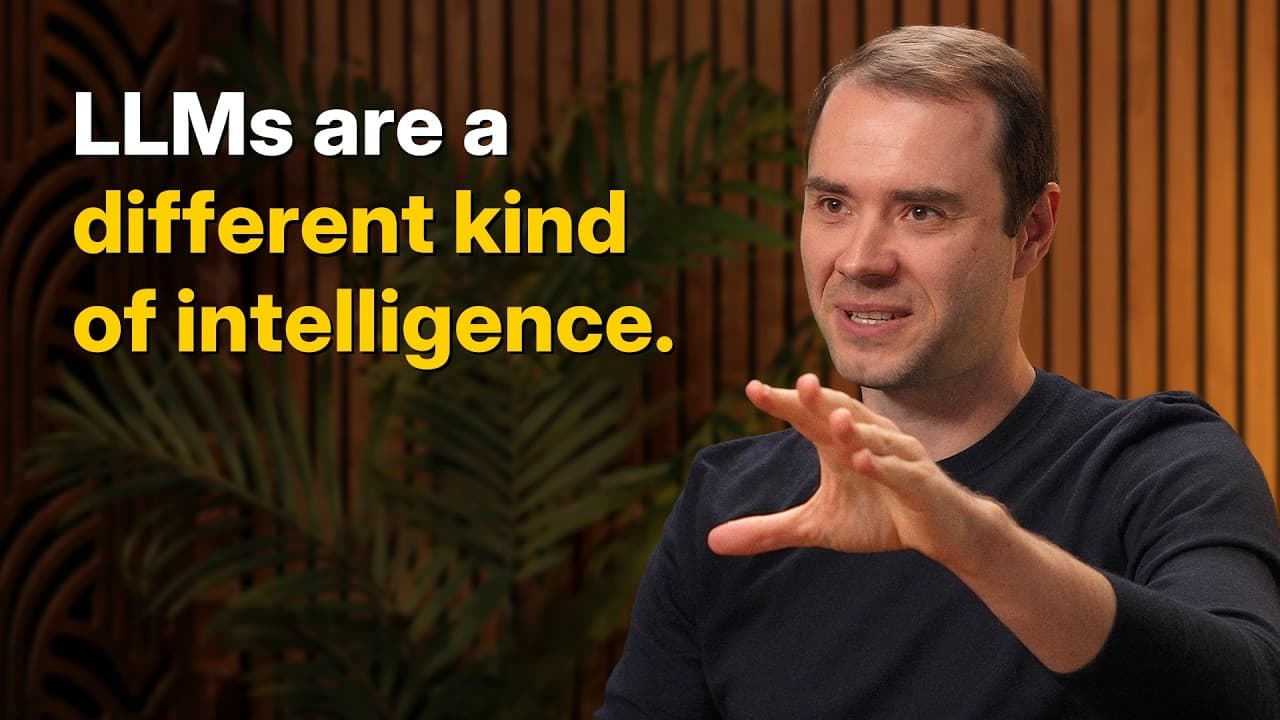
Andrej Karpathy suggests that achieving AGI will take a decade due to current limitations in AI, such as reinforcement learning's inefficiencies and the gradual nature of technological integration. He emphasizes that AI advancements will blend into existing economic growth patterns, continuing the historical trend of gradual automation and innovation rather than causing abrupt disruptions.
Transcript
Today I'm speaking with Andrej Karpathy. Andrej, why do you say that this will be the decade of agents and not the year of agents? First of all, thank you for having me here. I'm excited to be here. The quote you've just mentioned, "It's the decade of agents," is actually a reaction to a pre-existing quote. I'm not actually sure who said this ... Read More
Key Insights
- Reinforcement learning is inefficient, often upweighting incorrect steps due to high variance in estimations.
- Current AI models have cognitive deficits, lacking continual learning and multimodal capabilities.
- AGI will likely blend into the historical trend of 2% GDP growth, rather than causing a sudden economic spike.
- The evolution of intelligence is rare; animal intelligence might have emerged quickly post-oxygenation.
- Self-driving technology faced delays due to the complexity of real-world environments and safety requirements.
- Future AI advancements will likely focus on improving dataset quality and refining cognitive capabilities.
- Reinforcement learning's limitations highlight the need for process-based supervision to enhance AI learning.
- The current economic impact of AI is more visible in coding tasks due to their text-based nature.
Install to Summarize YouTube Videos and Get Transcripts
Explore YouTube Video Summarizer or Get YouTube Transcript Extractor
Questions & Answers
Q: Why is AGI expected to take a decade to achieve?
AGI is expected to take a decade due to current limitations in AI technologies, such as the inefficiencies of reinforcement learning and the absence of continual learning and multimodal capabilities. Andrej Karpathy suggests that these challenges require significant research and development to overcome, predicting a gradual integration of AI advancements into existing economic growth patterns.
Q: What are the main limitations of reinforcement learning?
Reinforcement learning is limited by its high variance in estimations, which often leads to upweighting incorrect steps within a learning process. This inefficiency arises because reinforcement learning typically assigns credit or blame to entire sequences of actions based on final outcomes, rather than accurately evaluating each step's contribution to the result.
Q: How does Karpathy view the economic impact of AI?
Karpathy views the economic impact of AI as a continuation of historical trends in automation and innovation, contributing to the existing 2% GDP growth rather than causing abrupt changes. He believes AI advancements will primarily enhance productivity in specific tasks, such as coding, which align with AI's text-based strengths and existing infrastructure.
Q: Why does Karpathy believe AI advancements will blend into existing economic growth?
Karpathy believes AI advancements will blend into existing economic growth due to the gradual nature of technological integration and the historical pattern of automation. He suggests that AI will continue to enhance productivity and innovation over time, contributing to the long-term trend of economic growth without causing sudden disruptions.
Q: What challenges does AI face in achieving continual learning?
AI faces challenges in achieving continual learning due to its current inability to retain and build upon knowledge over long periods. Models often lack mechanisms for distilling and integrating new information into their existing frameworks, leading to a reliance on static datasets and limited adaptability to new contexts or tasks.
Q: How does Karpathy view the evolution of intelligence?
Karpathy views the evolution of intelligence as a rare event, potentially facilitated by specific environmental conditions such as the Cambrian explosion's oxygenation event. He suggests that while intelligence may have emerged rapidly in some instances, its development is not guaranteed and may require unique evolutionary pressures.
Q: What are the implications of AI's current cognitive deficits?
AI's current cognitive deficits, such as the lack of continual learning and multimodal capabilities, limit its ability to perform complex tasks autonomously. These deficits highlight the need for further research and development to enhance AI's adaptability and intelligence, ensuring it can effectively integrate into diverse economic and social contexts.
Q: Why is the economic impact of AI most visible in coding tasks?
The economic impact of AI is most visible in coding tasks due to their text-based nature, which aligns with AI's strengths in processing and generating text. Additionally, the existing infrastructure for coding, such as IDEs and version control systems, facilitates AI integration, making coding an ideal domain for early AI adoption and productivity improvements.
Summary & Key Takeaways
-
Andrej Karpathy argues that AGI is still a decade away due to current AI limitations like reinforcement learning inefficiencies and lack of continual learning. He believes AI advancements will blend into the historical trend of economic growth, rather than causing abrupt changes. The evolution of intelligence is considered rare, with animal intelligence emerging quickly post-oxygenation.
-
Karpathy highlights the inefficiencies in reinforcement learning, which often upweights incorrect steps due to high variance. He emphasizes the need for process-based supervision to improve AI learning. Current AI models have cognitive deficits, lacking capabilities like continual learning and multimodal processing.
-
The economic impact of AI is currently most visible in coding tasks, which are inherently text-based and thus more aligned with AI's strengths. Future advancements will likely focus on improving dataset quality and refining cognitive capabilities, continuing the trend of gradual automation and innovation.
Read in Other Languages (beta)
Share This Summary 📚
Summarize YouTube Videos and Get Video Transcripts with 1-Click
Try YouTube Summary with ChatGPT & Claude or YouTube Transcript Generator
Explore More Summaries from Dwarkesh Patel 📚



Summarize YouTube Videos and Get Video Transcripts with 1-Click
Try YouTube Summary with ChatGPT & Claude or YouTube Transcript Generator