How Do the 5 Stages of AI Integration Help Build a Business That Runs Itself?
TL;DR
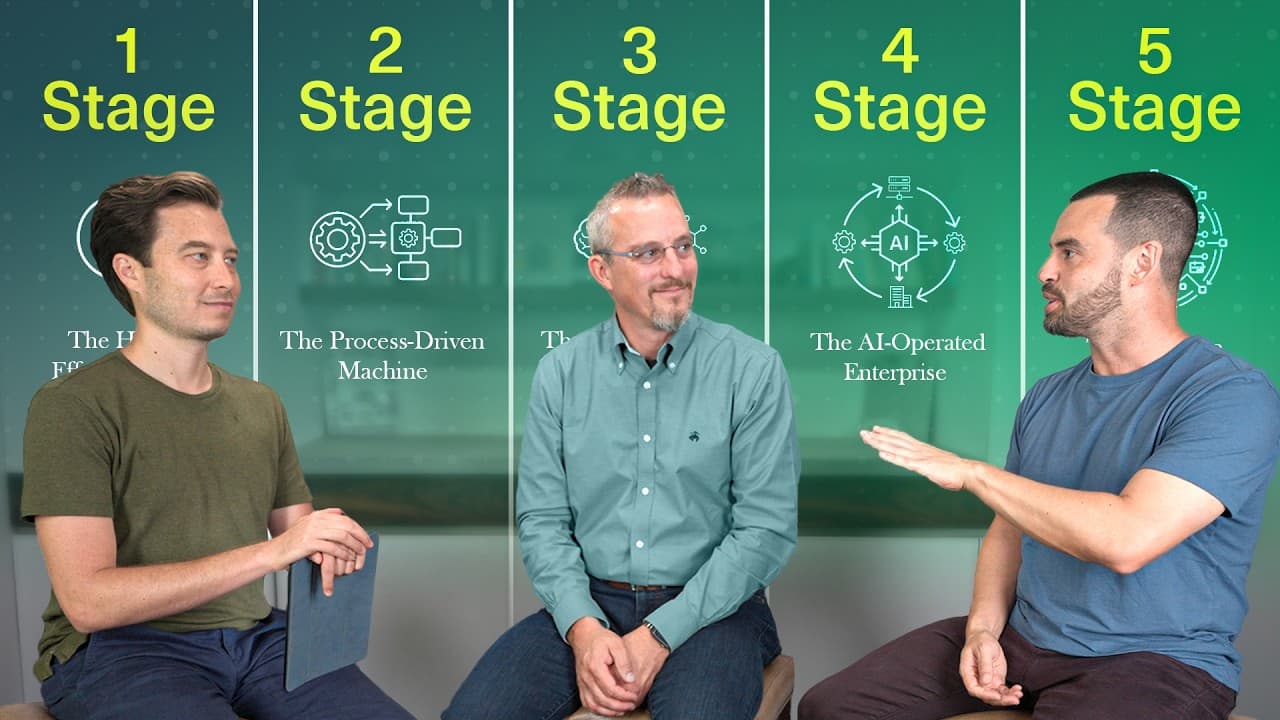
A business can become less founder-dependent by progressing through five stages: heroic founder, delegation, documented processes, AI-augmented talent, and AI-operated functions. The framework moves owners from making nearly every major decision to having AI automatically run certain aspects of the company, while a diagnostic identifies the current stage in under 5 minutes. Read on to recognize each stage and understand the next transition.
Transcript
What if I show you that the journey from I am the business to the business runs itself isn't just possible, it's actually predictable. Stage one is you're the hero, but you're also exhausted. Stage two is you've begun to delegate to a team, but you still lack consistency. At stage three, you have your processes documented and you can grow predictab... Read More
Key Insights
- Stage one businesses are owner-centric, with founders making all major decisions, often leading to burnout.
- Delegation in stage two involves assigning roles and responsibilities to a leadership team to reduce bottlenecks.
- Stage three focuses on process documentation and technology implementation to enhance consistency and efficiency.
- AI in stage four augments human capabilities, handling routine tasks and allowing humans to focus on exceptions.
- Stage five businesses are AI-operated, with systems that self-monitor and optimize, requiring minimal human intervention.
- AI can accelerate the transition between stages by documenting processes, predicting outcomes, and personalizing interactions.
- Building moats in an AI-driven market involves leveraging data, brand, and network effects for competitive advantage.
- The transition from doer to designer involves shifting focus from daily operations to strategic business development.
Install to Summarize YouTube Videos and Get Transcripts
Explore YouTube Video Summarizer or Get YouTube Transcript Extractor
Questions & Answers
Q: What are the five stages of AI integration for building a business that runs itself?
Stage one is the heroic founder business, where major decisions depend on the owner. Stage two introduces delegation, stage three adds documented processes, stage four uses AI to augment talent, and stage five has AI automatically running certain parts of the business.
Q: How can AI help a business become less dependent on its founder?
AI can augment employees, automate routine work, support decisions, document processes, predict outcomes, and personalize interactions. As the company progresses toward stage five, AI agents can manage operations while people concentrate on exceptions and strategic oversight.
Q: What does a stage-one heroic founder business look like?
The founder makes most or all major decisions and may be involved in sales, fulfillment, hiring, and finance. Because the business depends on one decision-making bottleneck, the owner is constantly working in the business and has little time to plan where it is going.
Q: Why do founders struggle to leave the heroic stage?
The business depends on their decisions, and growing teams introduce more communication complexity. Working this way can also become part of the founder's identity and ego, making control harder to release; recognizing that dependency is described as necessary before beginning the transition.
Q: How demanding is the workload in a heroic founder business?
The transcript says owners commonly work 70, 80, or more hours per week, including nights and weekends. They may be the first to arrive and the last to leave, with little ability to take time off or go on vacation.
Q: What changes when a business reaches stage two?
At stage two, the founder has begun delegating work and decisions to a team. The business is less completely centered on the owner, but it still lacks consistency.
Q: Why are documented processes important at stage three?
Stage three establishes documented processes and technology-supported operations. This makes results more consistent and allows the business to grow predictably, although the framework describes that growth as still linear.
Q: What happens in stages four and five of AI integration?
At stage four, AI augments human talent by handling routine work and supporting activities such as documentation, research, prediction, and personalization. At stage five, AI automatically runs certain aspects of the business, with AI agents managing operations and people handling exceptions and strategic oversight.
Summary & Key Takeaways
-
The journey from a founder-led business to one that operates independently involves five stages of AI integration. Initially, founders handle all decisions, but as the business evolves, roles are delegated, processes are documented, and AI is used to enhance efficiency. This progression enables businesses to grow and operate autonomously, with humans managing only exceptions.
-
AI can significantly reduce time spent on routine tasks, allowing businesses to scale more effectively. By automating processes and leveraging AI for decision support, businesses can increase productivity and profitability. The key is to update standards and processes to align with AI capabilities, ensuring that human roles focus on tasks requiring creativity and judgment.
-
Stage five businesses operate with minimal human involvement, as AI agents manage entire departments and self-optimize operations. This level of automation allows for hyper-personalization and scalability, creating opportunities for innovative business models. However, building strong competitive moats remains crucial to protect against the ease of replication in an AI-driven market.
Read in Other Languages (beta)
Share This Summary 📚
Summarize YouTube Videos and Get Video Transcripts with 1-Click
Try YouTube Summary with ChatGPT & Claude or YouTube Transcript Generator
Explore More Summaries from Tiago Forte 📚


Summarize YouTube Videos and Get Video Transcripts with 1-Click
Try YouTube Summary with ChatGPT & Claude or YouTube Transcript Generator