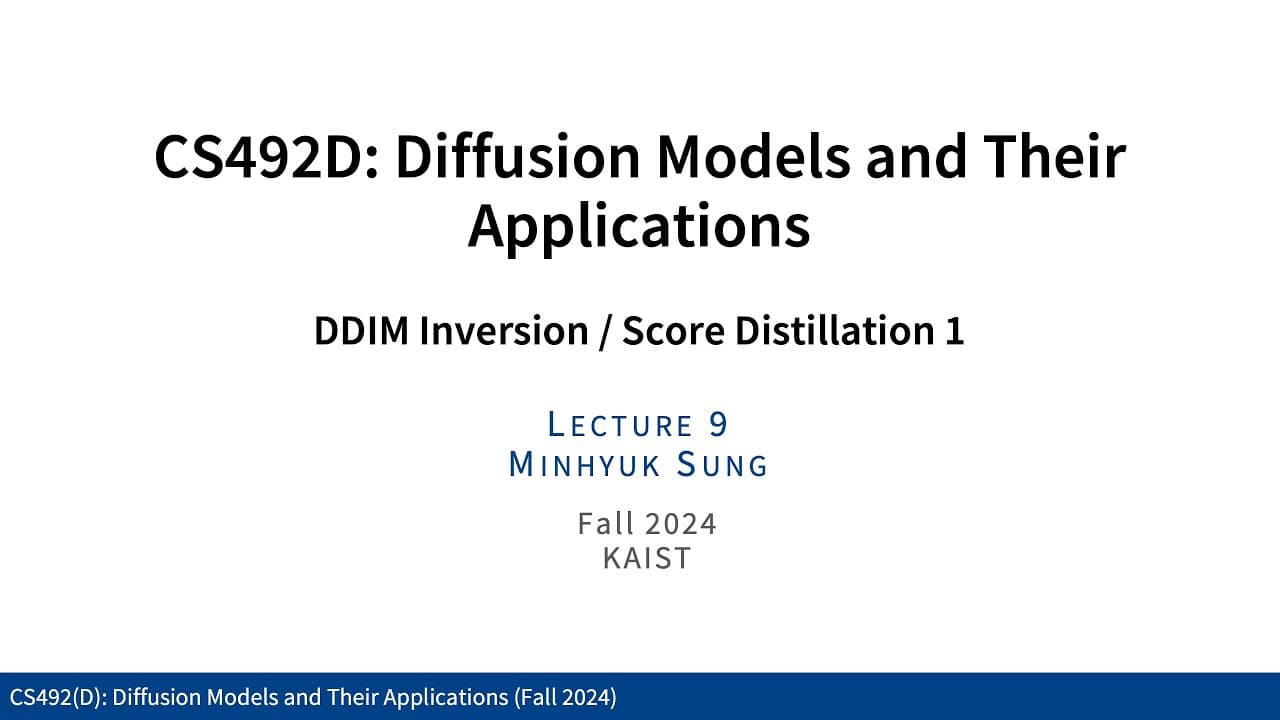
Lecture 09: DDIM Inversion / Score Distillation 1 (KAIST CS492D, Fall 2024)
TL;DR
Lecture explores DDIM inversion and score distillation for image and 3D generation.
Transcript
okay so today we are going to uh briefly discuss the idea the DD inversion which has been briefly also discussed in the previous gas strcture by or and then we're going to move on to some kind of a new topic which is about this school distillation so in the last lecture given by the or so she has discussed like lots of some kind of interest... Read More
Key Insights
- DDIM inversion allows deterministic sampling by setting variance to zero, enabling direct computation and consistent results.
- The inverse mapping from x0 to xT in DDIM inversion is complex but can be approximated by modifying time steps.
- DDIM inversion can be applied to image editing, allowing changes without fine-tuning by altering text prompts.
- Score distillation sampling leverages pre-trained image diffusion models for various applications, including 3D generation.
- 3D generation using score distillation sampling can produce diverse outputs by distilling knowledge from image diffusion models.
- Challenges in 3D generation include limited large-scale datasets and ensuring consistency across different viewpoints.
- The lecture introduces techniques to improve 3D reconstruction using text-image models like CLIP.
- Limitations of score distillation sampling include potential failures in convergence and maintaining diversity in outputs.
Install to Summarize YouTube Videos and Get Transcripts
Explore YouTube Video Summarizer or Get YouTube Transcript Extractor
Questions & Answers
Q: What is DDIM inversion and how is it applied?
DDIM inversion is a technique that involves deterministic sampling by setting the variance to zero, which allows direct computation and consistent results. It is applied in image editing and manipulation tasks, where it enables changes without the need for fine-tuning by altering text prompts. The inverse mapping from x0 to xT is complex but can be approximated by modifying time steps.
Q: How does score distillation sampling work?
Score distillation sampling utilizes pre-trained image diffusion models to generate diverse outputs, including 3D models. By distilling the knowledge learned by these models, it can produce realistic visual content without relying on large-scale 3D datasets. The technique involves using the loss function of diffusion models as a measure of alignment between rendered images and text prompts.
Q: What are the challenges in 3D generation using these techniques?
One major challenge in 3D generation is the limited availability of large-scale datasets, which affects the diversity and quality of outputs. Additionally, ensuring consistency across different viewpoints and maintaining convergence during the generation process are significant challenges. Techniques like using text-image models such as CLIP can help improve 3D reconstruction.
Q: How can CLIP be used to improve 3D reconstruction?
CLIP, a text-image model, can be used to improve 3D reconstruction by providing alignment scores between text descriptions and rendered images. By maximizing this alignment, CLIP helps ensure that the generated 3D models accurately reflect the intended visual content, even with a limited number of input images. This approach leverages CLIP's ability to link text and images effectively.
Q: What are the limitations of score distillation sampling?
Limitations of score distillation sampling include potential failures in convergence, especially when using low safety weights, which can result in empty outputs. Additionally, maintaining diversity in the generated outputs can be challenging, as increasing safety weights for better convergence may lead to less diverse results. Balancing these factors is crucial for effective 3D generation.
Q: Can score distillation sampling be applied to other types of visual content?
Yes, score distillation sampling can be applied to various types of visual content beyond 3D generation. It can be used for generating and editing visual content like vector images, textures, and panoramas. The technique's flexibility in distilling knowledge from pre-trained image diffusion models makes it adaptable to different visual domains, provided they can be mapped to images.
Q: What is the 'Janus problem' in 3D generation?
The 'Janus problem' refers to the issue of having multiple faces or inconsistent features in a 3D model when viewed from different angles. This problem arises when the generation process focuses on creating realistic images for specific views without ensuring overall 3D consistency. It highlights the need for integrating 3D priors alongside 2D image priors to achieve realistic and coherent 3D shapes.
Q: How can the convergence of score distillation sampling be improved?
Improving convergence in score distillation sampling can be achieved by increasing the safety weight, which helps ensure better alignment and convergence of the generated outputs. However, this may reduce diversity. Alternative approaches include using dedicated random noise or fine-tuning noise prediction networks to guide the generation process more effectively, balancing convergence with diversity.
Summary & Key Takeaways
-
The lecture covers DDIM inversion, a technique that allows deterministic sampling by setting variance to zero, enabling consistent image editing and manipulation without fine-tuning. The inverse mapping from x0 to xT is complex but can be approximated by modifying time steps.
-
Score distillation sampling leverages pre-trained image diffusion models to generate diverse 3D outputs. Despite challenges like limited datasets, it allows the creation of realistic 3D shapes by distilling knowledge from image models, with applications in various visual content.
-
Challenges in 3D generation include maintaining consistency across viewpoints and ensuring convergence. The lecture discusses using text-image models like CLIP for improved 3D reconstruction, while highlighting limitations such as potential failures in convergence and diversity.
Read in Other Languages (beta)
Share This Summary 📚
Summarize YouTube Videos and Get Video Transcripts with 1-Click
Try YouTube Summary with ChatGPT & Claude or YouTube Transcript Generator
Explore More Summaries from Minhyuk Sung 📚
Summarize YouTube Videos and Get Video Transcripts with 1-Click
Try YouTube Summary with ChatGPT & Claude or YouTube Transcript Generator