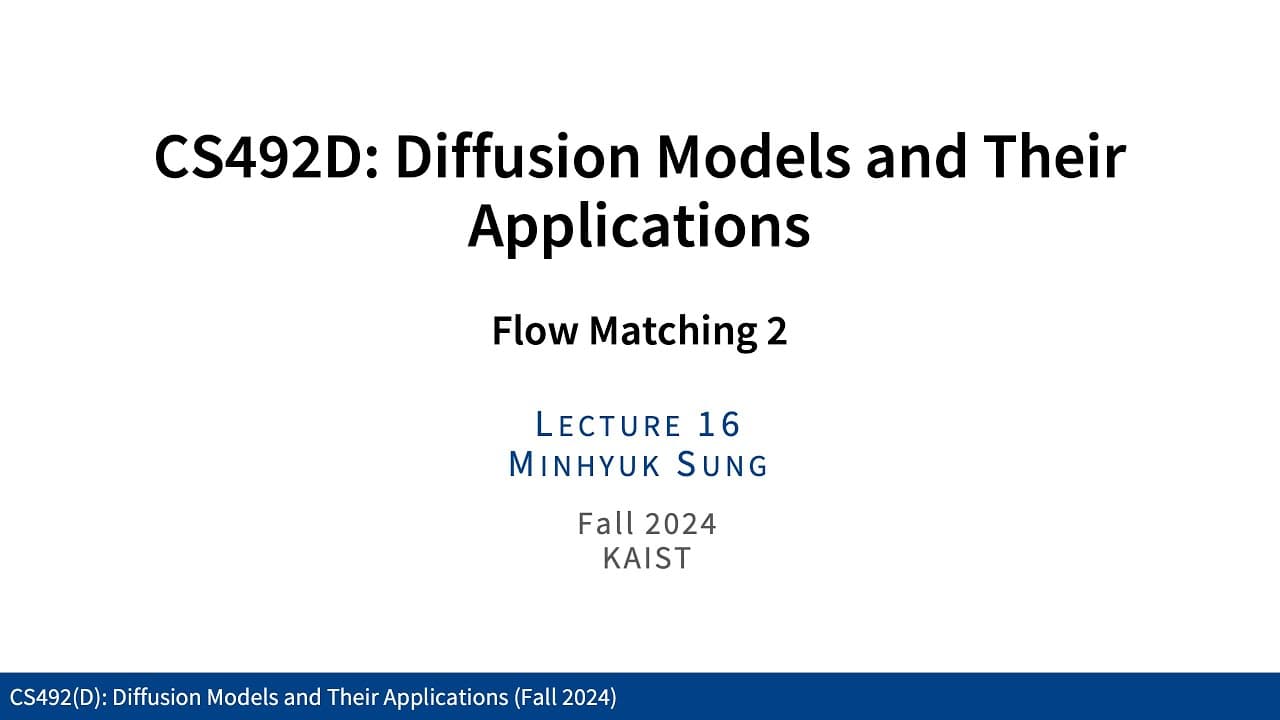
Lecture 16: Flow Matching 2 (KAIST CS492D, Fall 2024)
TL;DR
Flow matching simplifies generative models, enhancing speed and efficiency.
Transcript
okay so let's get started with the full okay so last time we discussed some kind of the some fundamental things about the flow matching which is the another type of the model we especially saw some kind of the details the math in terms of how we can derive some kind of exactly L function for the training and we're going to get into ... Read More
Key Insights
- Flow matching models aim to map base distributions to data distributions using a mapping function, enhancing generative model efficiency.
- The push-forward operation is crucial in flow matching, pushing base distributions into data distributions via a mapping function.
- Conditional vector fields are employed to train neural networks without backfield information, simplifying the flow matching process.
- Flow matching models can be trained multiple times to achieve straighter trajectories, reducing computational steps.
- Reflow technique involves retraining flow models using pre-trained models to improve trajectory straightness and efficiency.
- Flow matching models can significantly reduce generation time, achieving good results with fewer computational steps.
- The technique can be applied to existing generative models, like diffusion models, to enhance speed without sacrificing quality.
- Reducing iteration steps in generative models may limit guided generation capabilities, requiring alternative approaches for conditional outputs.
Install to Summarize YouTube Videos and Get Transcripts
Explore YouTube Video Summarizer or Get YouTube Transcript Extractor
Questions & Answers
Q: What is the primary goal of flow matching models?
The primary goal of flow matching models is to map base distributions to data distributions using a mapping function, which enhances the efficiency of generative models. This process involves the push-forward operation, where base distributions are transformed into data distributions via a mapping function, streamlining the generative process.
Q: How do flow matching models simplify the training process?
Flow matching models simplify the training process by employing conditional vector fields, which eliminate the need for backfield information. This approach allows neural networks to be trained more efficiently, focusing on capturing velocity information over time without relying on detailed mapping data, thus simplifying the overall process.
Q: What is the Reflow technique in flow matching?
The Reflow technique involves retraining flow models using pre-trained models to improve trajectory straightness and efficiency. By sampling pairs from a pre-trained model and using them to train a new flow model, the technique achieves straighter trajectories, reducing computational steps and enhancing the model's performance.
Q: How do flow matching models reduce generation time?
Flow matching models reduce generation time by achieving straighter trajectories through multiple training iterations. This approach allows for fewer computational steps during the generative process, enabling the models to produce high-quality outputs more quickly. The technique can be applied to existing models, significantly enhancing their speed.
Q: Can flow matching techniques be applied to existing generative models?
Yes, flow matching techniques can be applied to existing generative models, such as diffusion models, to enhance their speed and efficiency. By using the Reflow technique, pre-trained models can be leveraged to train new flow models, resulting in faster generation times without sacrificing output quality.
Q: What are the potential limitations of reducing iteration steps in generative models?
Reducing iteration steps in generative models may limit guided generation capabilities, as the iterative process allows for more conditional generation and guided outputs. Single-step generation might require alternative approaches to achieve the same level of guidance, presenting a trade-off between speed and flexibility in output customization.
Q: How does trajectory straightness impact generative model performance?
Trajectory straightness in generative models impacts performance by reducing the computational steps needed for generation. Straighter trajectories allow for more direct mapping from base distributions to data distributions, enabling faster generation times and more efficient processing, ultimately improving the model's overall performance.
Q: What challenges exist in applying flow matching techniques to real-world applications?
Applying flow matching techniques to real-world applications involves challenges such as ensuring sufficient data samples for training and balancing speed with output quality. While the technique reduces computational steps, it may require extensive pre-training and careful consideration of guided generation capabilities to meet specific application needs.
Summary & Key Takeaways
-
Flow matching models utilize a mapping function to transform base distributions into data distributions, enhancing generative model efficiency. By employing conditional vector fields, these models simplify the training process, eliminating the need for backfield information. This approach significantly reduces the computational steps required for generative processes.
-
The Reflow technique involves retraining flow models using pre-trained models, resulting in straighter trajectories and improved efficiency. This method can be applied to existing generative models, like diffusion models, to enhance speed without sacrificing quality. However, reducing iteration steps may limit guided generation capabilities.
-
Flow matching models offer a promising approach to improving the speed and efficiency of generative models. By training flow models multiple times, the technique achieves straighter trajectories, reducing computational steps and generation time. This approach can be applied to various generative models, enhancing their performance in real-world applications.
Read in Other Languages (beta)
Share This Summary 📚
Summarize YouTube Videos and Get Video Transcripts with 1-Click
Try YouTube Summary with ChatGPT & Claude or YouTube Transcript Generator
Explore More Summaries from Minhyuk Sung 📚
Summarize YouTube Videos and Get Video Transcripts with 1-Click
Try YouTube Summary with ChatGPT & Claude or YouTube Transcript Generator