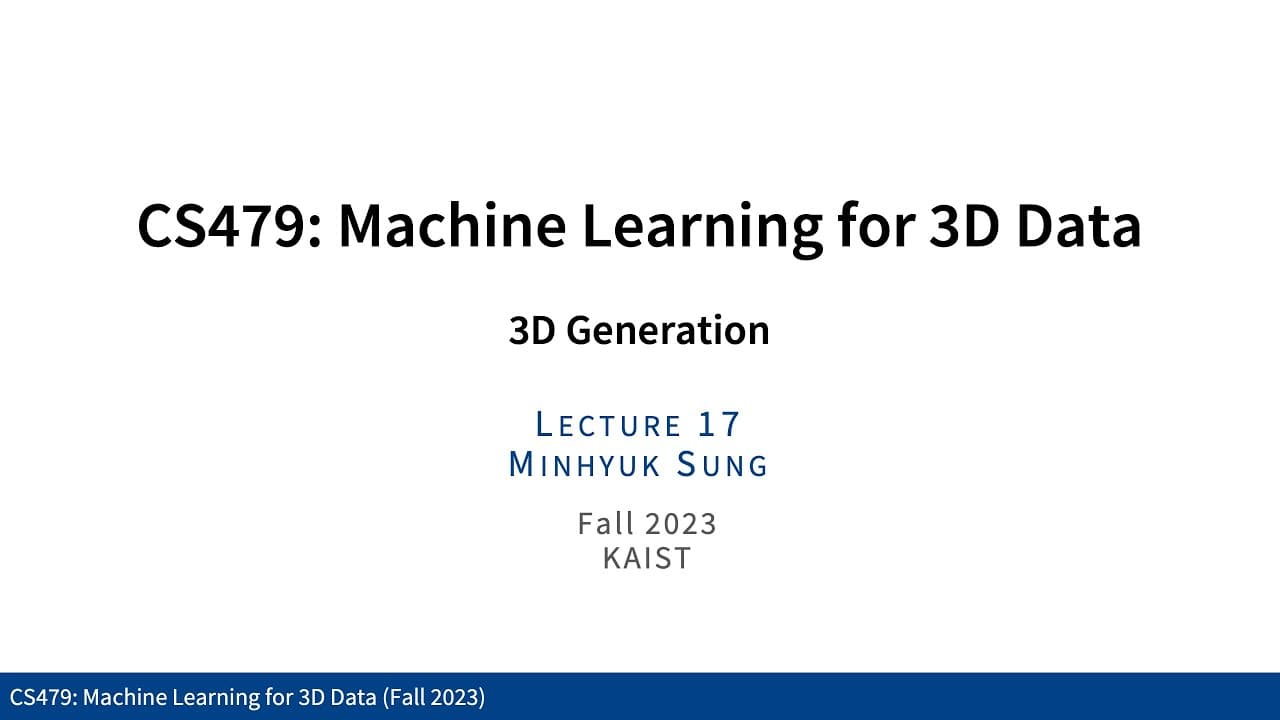
Lecture 17: 3D Generation (KAIST CS479, Fall 2023)
TL;DR
Lecture on diffusion models for 3D generation, focusing on practical applications and techniques.
Transcript
oh so yeah let's briefly recap the things that we discussed last time so we actually discussed some kind of the very practical the ideas in terms of like how we can also utilize the pre-trained the defusion models for some many kind of the applications especially for some of the cases that we are doing some kind of the conditional degenerat... Read More
Key Insights
- Pre-trained diffusion models can be adapted for various applications, including image editing and 3D generation, by leveraging large-scale datasets.
- Conditional generation using diffusion models involves manipulating pixel space and utilizing representations like latent space for efficient training.
- Guided reverse processes in diffusion models allow for texture creation and consistency across multiple views, enhancing 3D object rendering.
- Control Net and LoRA techniques enable efficient adaptation of pre-trained models to specific domains with limited data.
- Diffusion models can be applied to different 3D representations, such as voxels and tri-plane representations, with pros and cons in quality and resolution.
- Score distillation sampling leverages pre-trained 2D models to guide 3D generation, optimizing NeRF representations for realistic rendering.
- Challenges in 3D generation include limited large-scale 3D datasets, but leveraging 2D data can enhance 3D model quality.
- Project tips include starting with working code, making incremental changes, and focusing on both qualitative and quantitative evaluations.
Install to Summarize YouTube Videos and Get Transcripts
Explore YouTube Video Summarizer or Get YouTube Transcript Extractor
Questions & Answers
Q: How can pre-trained diffusion models be used in 3D generation?
Pre-trained diffusion models can be adapted for 3D generation by leveraging their ability to manipulate pixel space and utilize representations like latent space. Techniques such as guided reverse processes and score distillation sampling allow these models to create realistic textures and maintain consistency across views. Additionally, diffusion models can be applied to different 3D representations, enhancing the quality and efficiency of 3D object rendering.
Q: What are the benefits and drawbacks of using diffusion models for 3D generation?
The benefits of using diffusion models for 3D generation include the ability to leverage large-scale datasets for realistic rendering, efficient training through latent representations, and adaptability to specific domains using Control Net and LoRA. However, drawbacks include challenges in achieving high-quality outputs due to high dimensionality and limited resolution control. Additionally, the lack of large-scale 3D datasets poses a challenge, but solutions like score distillation sampling can mitigate this by utilizing 2D data.
Q: What is score distillation sampling, and how does it aid in 3D generation?
Score distillation sampling is a technique that leverages pre-trained 2D diffusion models to guide 3D generation. It involves using the noise prediction network of the diffusion model to assess the realism of rendered images from a 3D representation, such as NeRF. By optimizing the NeRF parameters through backpropagation, score distillation sampling enables the creation of realistic 3D objects that align with the learned priors from the 2D model, overcoming the limitations of small 3D datasets.
Q: How do Control Net and LoRA improve model adaptation for specific domains?
Control Net and LoRA improve model adaptation for specific domains by efficiently fine-tuning pre-trained models with a small number of input-output pairs. Control Net focuses on processing conditional image data alongside noisy data, while LoRA personalizes pre-trained models for specific styles or domains. Both techniques allow for effective adaptation without retraining the entire model, enabling the generation of high-quality outputs even with limited domain-specific data.
Q: What challenges exist in creating large-scale 3D datasets for model training?
Creating large-scale 3D datasets poses challenges due to the complexity and diversity required to cover all possible 3D objects. While the scale of 3D datasets is increasing, they remain significantly smaller compared to 2D datasets. This limitation affects the quality of 3D models generated by diffusion models. To address this, researchers are exploring methods to leverage existing 2D data, such as score distillation sampling, to enhance 3D generation quality and overcome dataset limitations.
Q: How can project work in neural network-based courses be managed effectively?
Effective project management in neural network-based courses involves starting with a working codebase and making small, incremental modifications to ensure predictability in experimental outcomes. It is crucial to modularize the project, reduce dependencies, and utilize visualization tools for both qualitative and quantitative evaluations. Fast iteration cycles, using toy datasets, and preparing for qualitative and quantitative evaluations in reports and presentations are essential for successful project completion.
Q: What role does guided reverse processing play in 3D generation?
Guided reverse processing plays a crucial role in 3D generation by allowing for the creation of realistic textures and maintaining consistency across multiple views. By guiding the reverse diffusion process with specific constraints, such as texture alignment and silhouette matching, this technique enables the generation of coherent 3D objects. It enhances the quality of 3D models by ensuring that the rendered outputs align with the desired visual characteristics, contributing to more realistic and visually appealing results.
Q: Why is the combination of 2D and 3D data important for 3D generation?
Combining 2D and 3D data is important for 3D generation because it allows models to leverage the extensive knowledge and priors learned from large-scale 2D datasets. This combination enhances the quality of 3D models by providing guidance on realistic rendering and overcoming the limitations of small 3D datasets. Techniques like score distillation sampling utilize 2D-trained models to inform 3D generation, enabling the creation of high-quality 3D objects even with limited 3D data availability.
Summary & Key Takeaways
-
The lecture discusses the application of pre-trained diffusion models for 3D generation, highlighting practical techniques like guided reverse processes and Control Net for efficient model adaptation. It emphasizes the challenges and solutions in leveraging large-scale datasets for conditional generation.
-
Key techniques include manipulating pixel space, utilizing latent representations, and applying guided reverse processes to achieve texture consistency and realistic rendering in 3D models. Control Net and LoRA enable efficient adaptation of models to specific domains with limited data.
-
The lecture addresses challenges in 3D generation, such as limited datasets, and proposes solutions like score distillation sampling to leverage pre-trained 2D models for guiding 3D generation. Project tips focus on starting with working code, making incremental changes, and emphasizing qualitative and quantitative evaluations.
Read in Other Languages (beta)
Share This Summary 📚
Summarize YouTube Videos and Get Video Transcripts with 1-Click
Try YouTube Summary with ChatGPT & Claude or YouTube Transcript Generator
Explore More Summaries from Minhyuk Sung 📚
Summarize YouTube Videos and Get Video Transcripts with 1-Click
Try YouTube Summary with ChatGPT & Claude or YouTube Transcript Generator