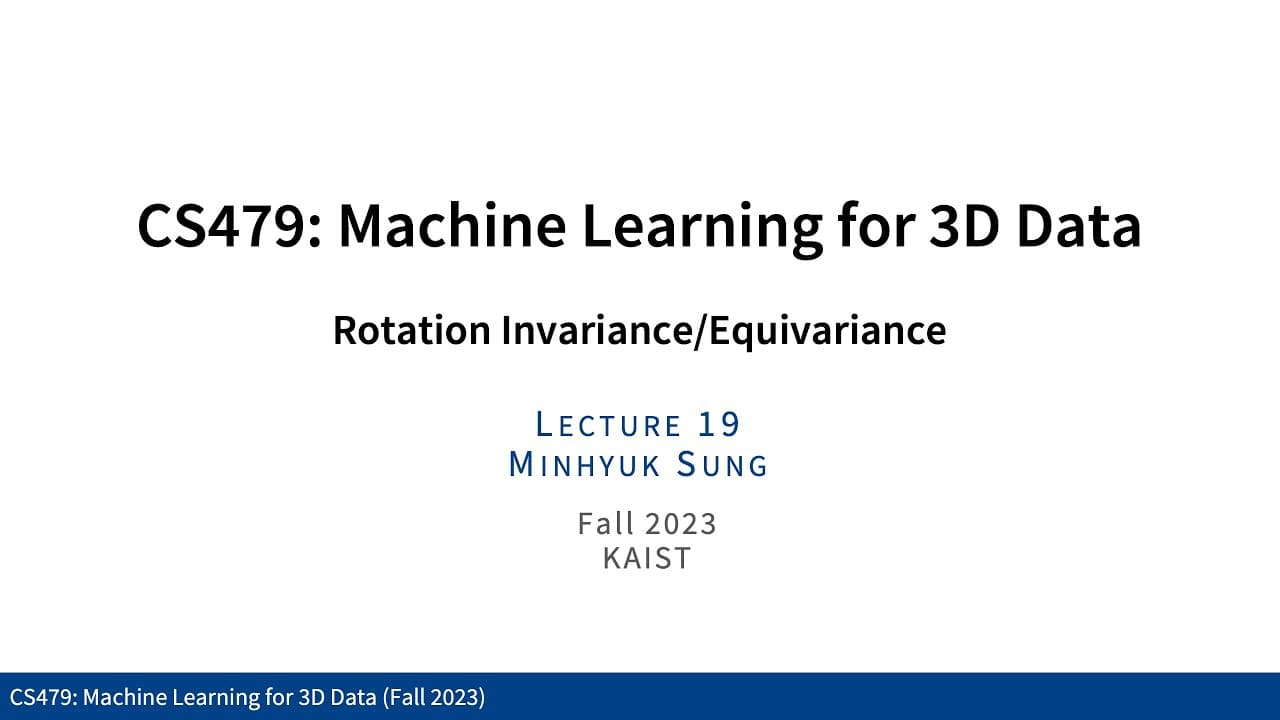
Lecture 19: Rotation Invariance/Equivariance (KAIST CS479, Fall 2023)
TL;DR
Lecture on achieving rotation invariance/equivalence in neural networks for 3D data processing.
Transcript
okay so welcome to the last lecture of the Cs 479 uh data and today we're going to talk about so some new topic before I get started where are we supposed to print the a poster so we are going to print your posters so you don't need to print your poster yourself so if you submit your poster by this Wednesday we are going to print al... Read More
Key Insights
- The lecture focuses on achieving rotation invariance and equivariance in neural networks, crucial for 3D data processing.
- Permutation invariance and equivariance are essential for handling unordered input data like point clouds in neural networks.
- Rotation invariance is significant for classifying 3D objects regardless of their orientation in the input data.
- The lecture introduces the concept of vector neurons to handle rotation invariance by transforming scalar features into vector features.
- The lecture discusses the limitations of current architectures in achieving true rotation invariance, emphasizing the need for innovative solutions.
- Data augmentation with random rotations can help teach neural networks rotation invariance but may increase training time and complexity.
- The lecture highlights the importance of designing neural architectures that are both efficient and capable of handling rotation invariance.
- Applications of these concepts include 3D classification, segmentation, and reconstruction, with potential improvements in accuracy and robustness.
Install to Summarize YouTube Videos and Get Transcripts
Explore YouTube Video Summarizer or Get YouTube Transcript Extractor
Questions & Answers
Q: What is the significance of rotation invariance in neural networks?
Rotation invariance in neural networks is crucial for accurately classifying and processing 3D objects regardless of their orientation. This property ensures that the network's output remains consistent even when the input data is rotated, which is essential for applications like 3D object recognition, segmentation, and reconstruction. Achieving rotation invariance allows the network to generalize better and perform robustly across different orientations of the input data.
Q: How are vector neurons used to achieve rotation invariance?
Vector neurons are used to achieve rotation invariance by transforming scalar features into vector features. This transformation allows the neural network to handle 3D data more effectively by considering the orientation of input data. Vector neurons process features as lists of vectors rather than scalars, enabling the network to maintain consistent outputs despite rotations. This approach helps achieve rotation equivariance and invariance in neural architectures, improving their accuracy and robustness in 3D data processing tasks.
Q: What are the limitations of using data augmentation for rotation invariance?
Using data augmentation to achieve rotation invariance involves applying random rotations to the training data, teaching the network to recognize objects in various orientations. However, this approach has limitations, such as increased training time and complexity, as the network needs to learn from a larger and more diverse dataset. Additionally, data augmentation does not guarantee true rotation invariance, as it relies on statistical learning rather than architectural changes, which may not fully capture all possible rotations.
Q: Why is permutation invariance important in neural networks?
Permutation invariance is important in neural networks for handling unordered input data, such as point clouds, where the order of points does not affect the overall structure. Achieving permutation invariance ensures that the network's output remains consistent regardless of the order of input points. This property is crucial for tasks like 3D object recognition and segmentation, where the network must accurately process and analyze unordered data without being influenced by point ordering.
Q: What are the applications of rotation invariance in 3D data processing?
Rotation invariance has several applications in 3D data processing, including 3D object classification, segmentation, and reconstruction. In classification, it allows the network to accurately identify objects regardless of their orientation. In segmentation, it ensures that the network can correctly label parts of an object even when its orientation changes. In reconstruction, rotation invariance helps the network generate consistent 3D models from various viewpoints, enhancing the overall accuracy and robustness of 3D data processing tasks.
Q: How does the lecture address the limitations of current architectures in achieving rotation invariance?
The lecture addresses the limitations of current architectures in achieving rotation invariance by introducing vector neurons, which transform scalar features into vector features. This transformation allows neural networks to handle 3D data more effectively by considering the orientation of input data. The lecture emphasizes the need for innovative solutions and efficient architectures that can achieve rotation invariance without relying heavily on data augmentation, ultimately improving the accuracy and robustness of 3D data processing tasks.
Q: What are the challenges in achieving true rotation invariance in neural networks?
Achieving true rotation invariance in neural networks presents challenges, such as designing architectures that can handle arbitrary rotations without increasing complexity or training time. Current solutions like data augmentation may not fully capture all possible rotations, leading to limitations in generalization. Additionally, ensuring that the network's output remains consistent across different orientations requires innovative approaches, such as vector neurons, to transform scalar features into vector features, improving the network's ability to process 3D data effectively.
Q: What improvements can be expected from architectures incorporating rotation invariance?
Architectures incorporating rotation invariance can expect improvements in accuracy, robustness, and generalization in 3D data processing tasks. By ensuring consistent outputs regardless of input orientation, these architectures can better handle classification, segmentation, and reconstruction tasks. The use of vector neurons and other innovative solutions allows for efficient processing of 3D data, reducing reliance on data augmentation and improving the network's ability to generalize across different rotations, ultimately enhancing the overall performance of neural networks in 3D applications.
Summary & Key Takeaways
-
The lecture discusses methods to achieve rotation invariance and equivariance in neural networks, particularly for 3D data processing. It introduces vector neurons as a means to transform scalar features into vector features for better handling of 3D data.
-
Permutation invariance and equivariance are crucial for processing unordered input data like point clouds in neural networks. The lecture emphasizes the importance of designing architectures that efficiently handle rotation invariance without relying heavily on data augmentation.
-
Applications of these concepts include 3D classification, segmentation, and reconstruction. The lecture highlights the potential improvements in accuracy and robustness when using architectures that incorporate rotation invariance and equivariance.
Read in Other Languages (beta)
Share This Summary 📚
Summarize YouTube Videos and Get Video Transcripts with 1-Click
Try YouTube Summary with ChatGPT & Claude or YouTube Transcript Generator
Explore More Summaries from Minhyuk Sung 📚
Summarize YouTube Videos and Get Video Transcripts with 1-Click
Try YouTube Summary with ChatGPT & Claude or YouTube Transcript Generator