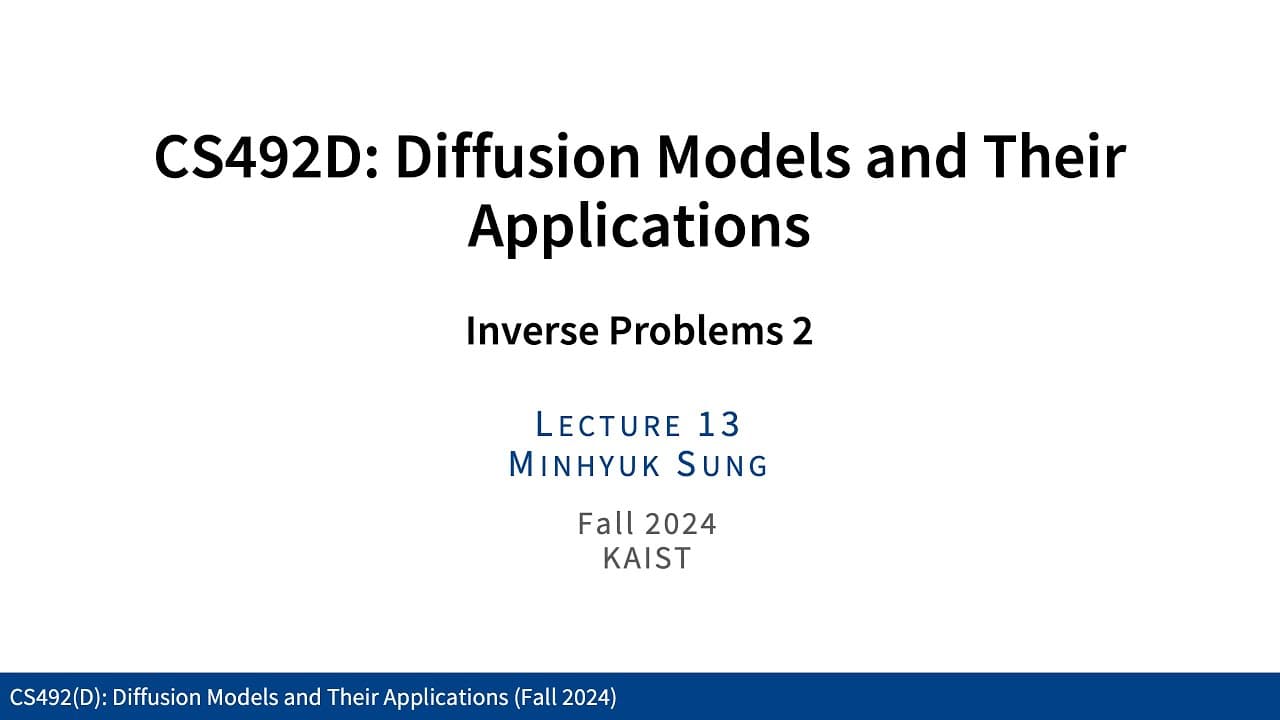
Lecture 13: Inverse Problems 2 (KAIST CS492D, Fall 2024)
TL;DR
Exploration of inverse problems and diffusion models for image generation.
Transcript
okay uh so last time uh we started discuss the idea about the inverse problems and before that actually we also discussed some techniques about some conditional generation either based on the fine tuning or without any kind of the training and the inverse problem was kind of some the more the general case in terms of like basically how we can basic... Read More
Key Insights
- Inverse problems involve aligning generated outputs with observations, often using linear functions to define relationships between outputs and observations.
- Applications of inverse problems include deblurring, super-resolution, and inpainting, where the goal is to generate higher quality images from lower quality inputs.
- Diffusion models leverage score information to guide the generation process, allowing for the alignment of generated data with observed data.
- The lecture discusses the use of conditional generation techniques, such as classifier-free guidance, to enhance image generation without additional training.
- The power of diffusion models lies in their ability to handle various conditional generation tasks with a single model, unlike GANs which require separate models.
- Various techniques like control nets and classifier-free guidance are explored for conditional generation, with specific use cases outlined for each method.
- The lecture emphasizes the importance of defining objective functions for guiding the generation process, especially in cases where traditional training data is unavailable.
- Generalization of these techniques to other applications, such as style transfer and synchronized image generation, demonstrates the flexibility of diffusion models.
Install to Summarize YouTube Videos and Get Transcripts
Explore YouTube Video Summarizer or Get YouTube Transcript Extractor
Questions & Answers
Q: What are inverse problems and how are they applied?
Inverse problems involve aligning generated outputs with observations, often using linear functions to define relationships between outputs and observations. They are applied in scenarios such as deblurring, super-resolution, and inpainting, where the goal is to generate higher quality images from lower quality inputs by reconstructing missing or degraded information.
Q: How do diffusion models contribute to solving inverse problems?
Diffusion models contribute by leveraging score information to guide the generation process. They allow for the alignment of generated data with observed data through an iterative process, making it possible to handle various conditional generation tasks with a single model. This approach simplifies the implementation and enhances the flexibility of image generation.
Q: What are the key benefits of using diffusion models over GANs?
The key benefits of diffusion models over GANs include their ability to handle multiple conditional generation tasks with a single model, eliminating the need for separate models for each task. This is possible because diffusion models incorporate score information to guide the generation process, allowing for more versatile and efficient image generation compared to GANs.
Q: How are conditional generation techniques like control nets used?
Conditional generation techniques like control nets are used when there is a sufficient amount of training data available. They involve fine-tuning a network with paired input-output data, typically requiring the condition and output to be of the same modality and spatially aligned. This approach allows for precise control over the generation process, producing high-quality outputs.
Q: What is classifier-free guidance and when is it used?
Classifier-free guidance is a technique used for conditional generation when training data is limited or when the input and output are not of the same modality or spatially aligned. It involves modifying the noise prediction process by integrating a condition into the generation process, allowing for flexible adaptation to various input conditions without additional training.
Q: How can diffusion models be generalized to other applications?
Diffusion models can be generalized to other applications, such as style transfer and synchronized image generation, by defining appropriate objective functions. These functions guide the generation process, allowing the models to adapt to different tasks without the need for extensive retraining. This demonstrates the flexibility and power of diffusion models in handling diverse applications.
Q: What role do objective functions play in guided generation?
Objective functions play a crucial role in guided generation by providing a framework for defining constraints and goals for the generation process. They allow for the incorporation of specific conditions or styles into the generated outputs, enabling the models to produce results that align with desired characteristics or requirements, even in the absence of traditional training data.
Q: How does the lecture address the challenges of conditional generation?
The lecture addresses the challenges of conditional generation by exploring various techniques and their applications. It emphasizes the importance of defining objective functions, discusses the use of diffusion models for handling multiple tasks with a single model, and outlines scenarios where different techniques, such as control nets and classifier-free guidance, are most effective. This comprehensive approach provides a robust framework for tackling diverse generation challenges.
Summary & Key Takeaways
-
The lecture explores inverse problems, focusing on aligning generated outputs with observed data using linear functions. Applications such as deblurring and super-resolution are discussed, highlighting the role of inverse problems in improving image quality.
-
Diffusion models are introduced as a powerful tool for conditional generation, allowing the integration of score information to guide the generation process. The simplicity of implementing these models is emphasized, with practical examples provided.
-
Various techniques for conditional generation, including control nets and classifier-free guidance, are examined. The lecture outlines specific scenarios where each technique is most effective, demonstrating the versatility of diffusion models in handling diverse generation tasks.
Read in Other Languages (beta)
Share This Summary 📚
Summarize YouTube Videos and Get Video Transcripts with 1-Click
Try YouTube Summary with ChatGPT & Claude or YouTube Transcript Generator
Explore More Summaries from Minhyuk Sung 📚
Summarize YouTube Videos and Get Video Transcripts with 1-Click
Try YouTube Summary with ChatGPT & Claude or YouTube Transcript Generator