Lecture 05: Denoising Diffusion Implicit Models 1 (KAIST CS492D, Fall 2024)
TL;DR
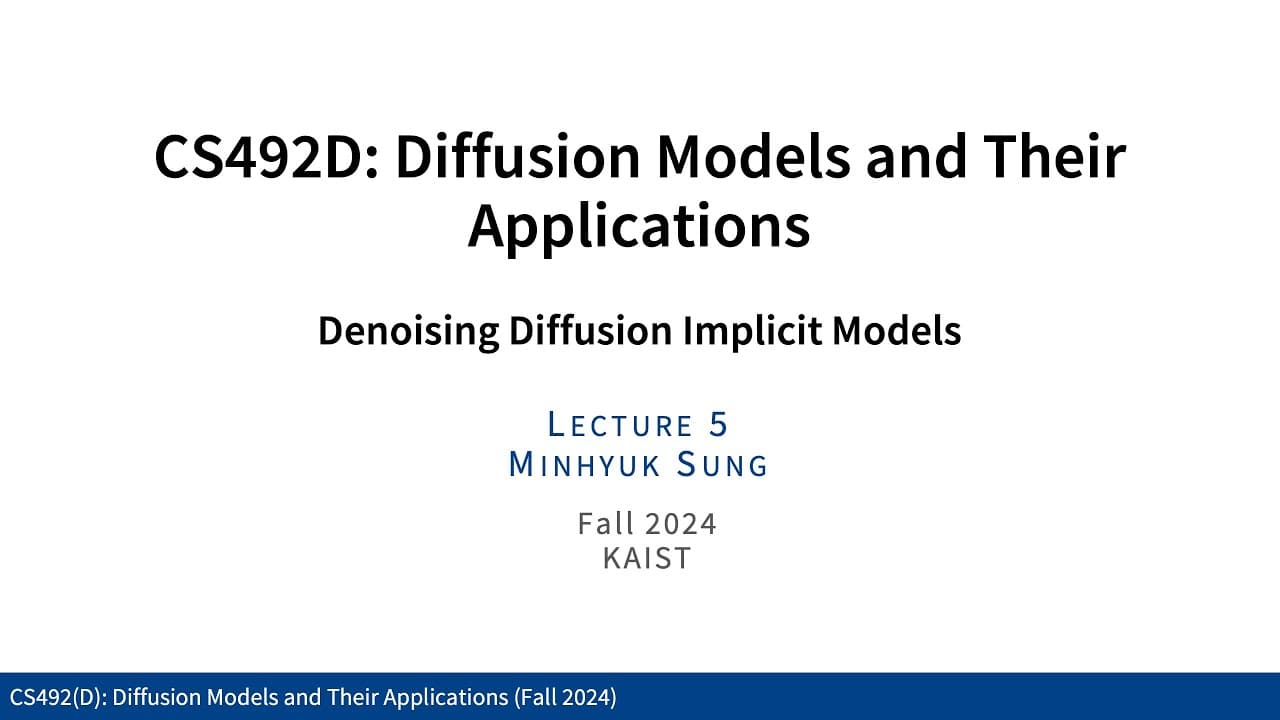
Exploration of diffusion models, focusing on DDPM and DDIM.
Transcript
so yeah let's get started uh so today we are going to uh briefly recap the things that we discuss for the ddpm and we're going to move on to the other the division models so last time we basically last week we started to discuss the basic ideas about the defion models uh which was basically having some of the uh some key uh characte... Read More
Key Insights
- Diffusion models involve defining forward and reverse processes, with key characteristics like pre-defined procedures and noise addition.
- DDPM defines forward and reverse processes as Markov processes, gradually adding noise to data points.
- Three training methods for diffusion models include mean predictor, original data point predictor, and noise predictor.
- Loss functions in diffusion models are simplified to L2 functions, offering computational advantages.
- DDIM introduces non-Markovian processes, allowing deterministic sampling and faster generation.
- Score-based models relate to diffusion models by predicting the score of the posterior distribution.
- Training diffusion models with large datasets compresses information, offering efficiency and privacy advantages.
- DDPM and DDIM can be generalized, with DDIM offering faster generation without compromising quality.
Install to Summarize YouTube Videos and Get Transcripts
Explore YouTube Video Summarizer or Get YouTube Transcript Extractor
Questions & Answers
Q: What are the key characteristics of diffusion models?
Diffusion models are characterized by defining both forward and reverse processes, often as Markov processes. They involve adding noise to data points while increasing variance, with the full process being pre-defined rather than learned. These models use simplified loss functions, allowing for computational advantages.
Q: How does DDPM define its processes?
DDPM defines its forward and reverse processes as Markov processes. The forward process involves gradually adding noise to data points, while the reverse process involves sampling from the posterior distribution. The model uses a specific form of distribution to ensure that the processes are well-defined and computationally feasible.
Q: What are the different training methods for diffusion models?
Diffusion models can be trained using three main methods: mean predictor, original data point predictor, and noise predictor. The mean predictor directly predicts the mean of the posterior distribution, while the original data point predictor computes the mean using both the current and predicted values. The noise predictor focuses on predicting the noise used in sampling.
Q: What advantages do diffusion models offer in terms of loss functions?
Diffusion models simplify loss functions to L2 functions, which are computationally efficient and easier to optimize. This simplification allows for more straightforward training and implementation, making diffusion models an attractive choice for various applications, especially when dealing with large datasets.
Q: How does DDIM differ from DDPM?
DDIM differs from DDPM by introducing non-Markovian processes, allowing for deterministic sampling and faster generation. Unlike DDPM, which relies on stochastic processes, DDIM can reduce the number of time steps needed for generation without compromising the quality of the output, making it more efficient in practice.
Q: What is the relationship between score-based models and diffusion models?
Score-based models are related to diffusion models through the prediction of the score of the posterior distribution. The score represents the gradient of the log-likelihood with respect to data points. By predicting this score, score-based models can sample data points even without explicit probability distributions, aligning closely with the principles of diffusion models.
Q: What are the benefits of training diffusion models with large datasets?
Training diffusion models with large datasets compresses the information into neural network parameters, improving efficiency and scalability. This approach allows the model to generate new, realistic images not present in the training set, addressing privacy and copyright concerns while offering potential for novel data generation.
Q: How can DDPM and DDIM be generalized?
DDPM and DDIM can be generalized by adjusting the variance parameters. DDIM offers a way to maintain quality with fewer time steps by allowing deterministic sampling. By setting variance parameters appropriately, DDIM can operate as a non-Markovian process, offering faster generation times while still achieving high-quality outputs.
Summary & Key Takeaways
-
The lecture covers diffusion models, specifically DDPM and DDIM, explaining their processes and training methods. DDPM uses Markov processes, adding noise to data points, while DDIM introduces non-Markovian processes for faster generation.
-
Key insights include the benefits of simplified loss functions, the relationship between score-based models and diffusion models, and the advantages of training with large datasets. The lecture also highlights the potential for deterministic sampling in DDIM.
-
The lecture concludes with a discussion on the generalization of DDPM and DDIM, emphasizing DDIM's ability to maintain quality with fewer time steps. The next session will explore these models further, focusing on stochastic differential equations.
Read in Other Languages (beta)
Share This Summary 📚
Summarize YouTube Videos and Get Video Transcripts with 1-Click
Try YouTube Summary with ChatGPT & Claude or YouTube Transcript Generator
Explore More Summaries from Minhyuk Sung 📚
Summarize YouTube Videos and Get Video Transcripts with 1-Click
Try YouTube Summary with ChatGPT & Claude or YouTube Transcript Generator