How Does AI Concentration Affect the S&P 500?
TL;DR
S&P 500 investors now depend heavily on a small group of technology companies, with the top five representing nearly 30% of the index and the top ten accounting for about 40%. This concentration has amplified AI-driven gains, but it also increases portfolio risk, making exposure checks and diversification across company sizes, sectors, regions, value stocks, and bonds increasingly important.
Transcript
If you're invested in a fund that follows the S&P 500, about 40% of your money is effectively tied to the performance of just ten companies, most of which are deeply invested in AI development. The S&P 500 is an index that is made up of publicly traded stocks of the 500 largest companies in the United States, and each one is given a weightin... Read More
Key Insights
- The S&P 500 is a market-cap-weighted index, which means companies with larger market values have greater influence on its movements. A rising stock price increases market capitalization and can consequently increase that company’s weight inside the index.
- The index’s recent performance is heavily connected to AI momentum, with the S&P 500 rising more than 40% since October 2021. Much of its earnings and revenue growth over recent years has come from technology and AI-related companies.
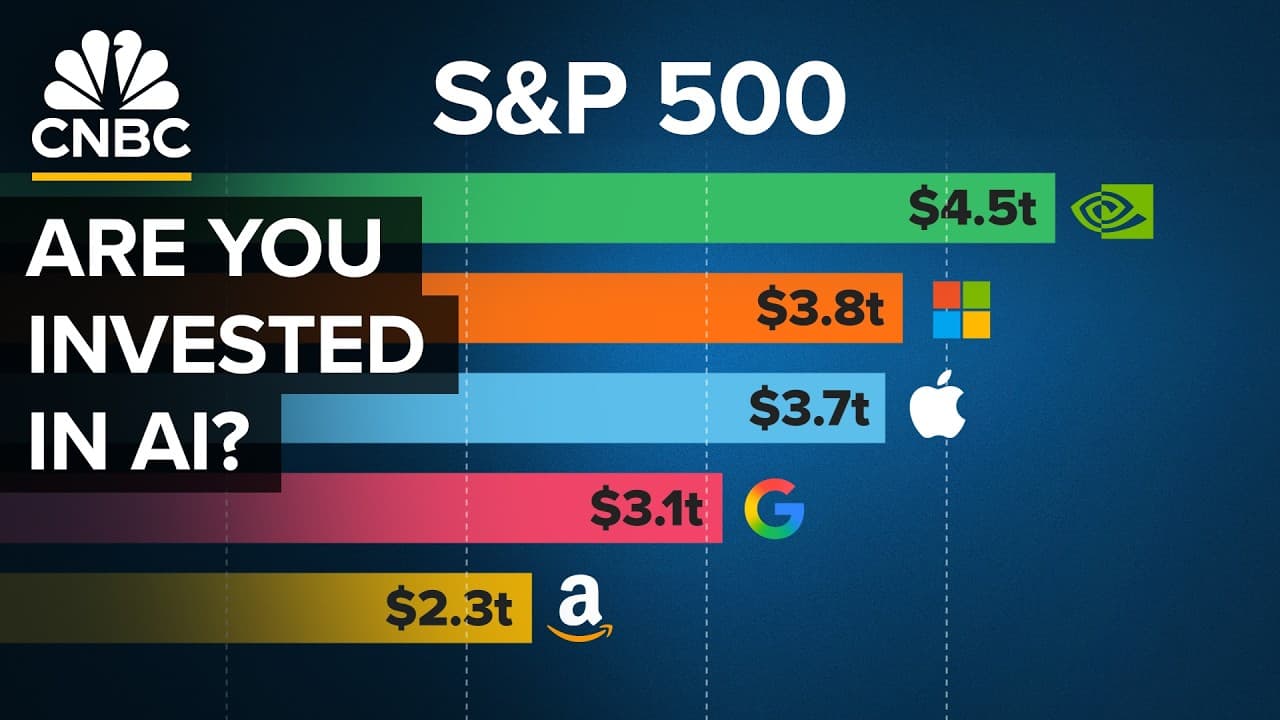
- Nvidia is more than 7% of the S&P 500 after rising more than 230% in 2023 and 170% in 2024. Its index influence is now equal to the combined weight of the bottom 224 companies.
- The top five S&P 500 companies are Nvidia, Microsoft, Apple, Alphabet, and Amazon, and together they represent nearly 30% of the index. Many retirement and taxable portfolios are therefore highly dependent on the performance of these companies.
- Nearly half of the S&P 500’s market capitalization has medium to high AI exposure, according to the Citigroup estimate cited in the transcript. This reflects both direct AI development and large corporate bets on emerging technology.
- The S&P 500 is still composed of 500 companies, but it is much more concentrated than during most of its history. Its current structure resembles a megacap technology fund more closely than many investors may realize.
- Diversification is most effective when it extends beyond the number of holdings to include different company sizes, sectors, regions, value stocks, and bonds. Such a portfolio may rise less dramatically, but it may also fall less dramatically during market declines.
- An equal-weighted S&P 500 fund gives every member the same weight, reducing the influence of the largest technology companies. Its tradeoff is that it can miss some upside during bull markets when the biggest companies are leading returns.
Install to Summarize YouTube Videos and Get Transcripts
Explore YouTube Video Summarizer or Get YouTube Transcript Extractor
Questions & Answers
Q: Why has the S&P 500 become concentrated in AI stocks?
The S&P 500 has become concentrated in AI-related companies because it weights members according to market capitalization. Investor optimism has driven up the share prices of major technology companies, increasing their market values and index weights. This creates a reinforcing process in which successful, highly valued companies exert progressively greater influence over the index’s overall performance.
Q: How concentrated is the S&P 500 in its largest companies?
About 40% of money invested in an S&P 500 fund is effectively tied to the performance of ten companies, most of which are deeply involved in AI development. The five largest companies alone, Nvidia, Microsoft, Apple, Alphabet, and Amazon, represent nearly 30% of the index, making overall returns unusually dependent on a small group.
Q: How does market-cap weighting affect S&P 500 investors?
Market-cap weighting gives larger companies more influence over index returns. Market capitalization is calculated by multiplying a company’s issued shares by its stock price. When investors bid up a company’s shares, its market value and S&P 500 weight can increase, causing index investors to gain greater exposure to that company without deliberately choosing to buy more of it.
Q: Why can S&P 500 concentration create retirement risk?
S&P 500 concentration can create retirement risk because losses among a few dominant technology companies may have an outsized effect on a portfolio. If those losses occur near retirement or another investment goal, they may interfere with an investor’s personal timeline. Sharp market moves can also encourage emotional reactions that undermine a long-term investment strategy.
Q: Is the S&P 500 still a diversified investment?
The S&P 500 remains diversified in the sense that it contains 500 companies, but it is considerably more concentrated than it has been throughout most of its history. A small group of megacap technology companies now controls a large share of the index, so owning hundreds of names does not necessarily prevent substantial dependence on one sector or investment theme.
Q: How can investors check their exposure to AI companies?
Investors can check AI exposure by examining the underlying holdings and weightings of every ETF and mutual fund they own. They should then compare those holdings with any individual stocks they purchase. Buying a technology stock already held heavily inside several funds can unintentionally increase concentration, even when the overall account appears to contain many separate investments.
Q: How can investors diversify beyond the S&P 500?
Investors can diversify by spreading assets across different company sizes, sectors, and world regions, while also considering international stocks, value stocks, small-cap stocks, and bonds. The appropriate mix depends on the investor’s time horizon. A diversified portfolio may capture less of a technology-led surge, but it may also experience less severe declines.
Q: What is an equal-weighted S&P 500 fund?
An equal-weighted S&P 500 fund assigns the same weight to every company rather than weighting each member by market capitalization. This reduces the outsized influence of the largest technology and AI-related companies while preserving exposure to the index’s members. The drawback is that it may capture less upside when the largest companies lead a bull market.
Summary & Key Takeaways
-
The S&P 500 uses market-cap weighting, so rising share prices increase a company’s market capitalization and influence within the index. AI enthusiasm has therefore elevated large technology companies, particularly Nvidia, whose weight exceeds 7% and matches the combined influence of the bottom 224 stocks in the index.
-
The index still contains 500 companies, but its returns increasingly follow a small group of technology leaders. The top five companies represent nearly 30% of the index, while the top ten account for about 40%. This structure can produce strong gains while creating greater dependence on a few companies.
-
Investors can manage concentration by reviewing the holdings inside their ETFs and mutual funds, avoiding unintended duplication through individual stocks, and diversifying across sectors, company sizes, regions, value stocks, and bonds. An equal-weighted S&P 500 fund can also reduce megacap influence, although it may lag when the largest companies lead.
-
Key Insights
Read in Other Languages (beta)
Share This Summary 📚
Summarize YouTube Videos and Get Video Transcripts with 1-Click
Try YouTube Summary with ChatGPT & Claude or YouTube Transcript Generator
Explore More Summaries from CNBC 📚





Summarize YouTube Videos and Get Video Transcripts with 1-Click
Try YouTube Summary with ChatGPT & Claude or YouTube Transcript Generator