How Does Steric Hindrance Affect Reactions?
TL;DR
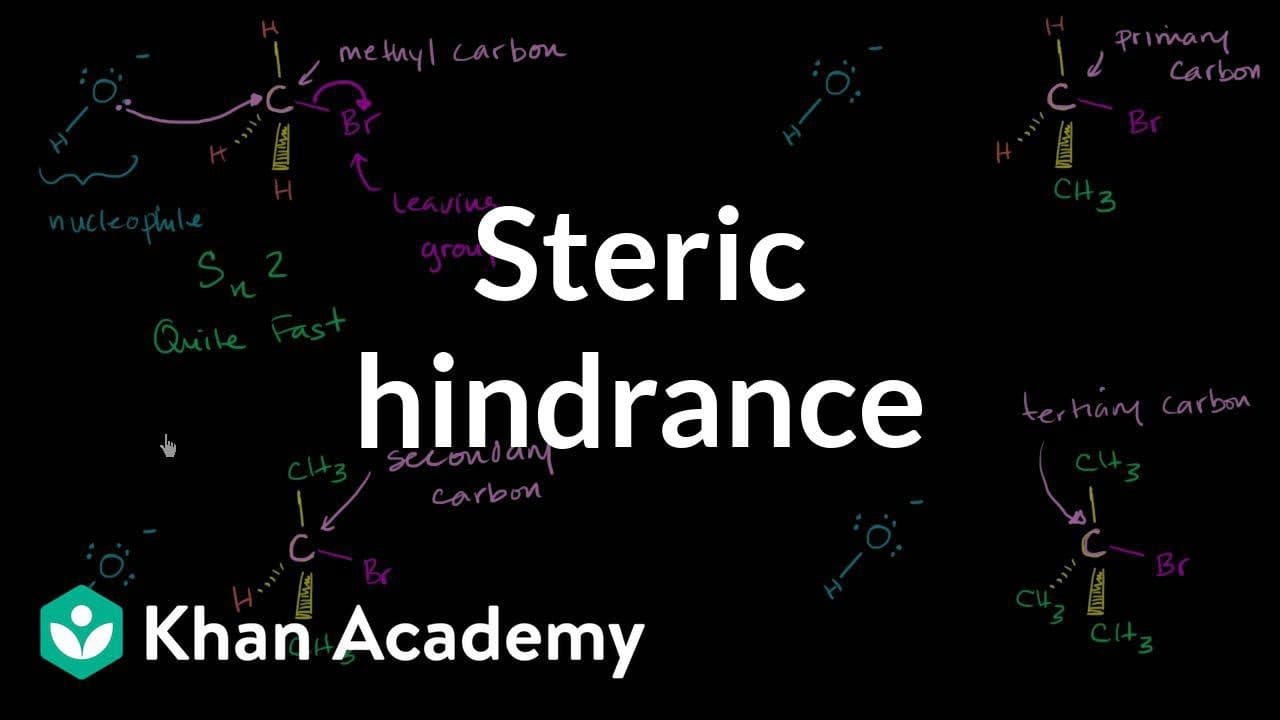
Steric hindrance significantly impacts the speed of nucleophilic substitution reactions based on carbon structure. Primary carbons allow for fast Sn2 reactions, while secondary and tertiary carbons experience increasing hindrance that slows down or prevents these reactions, highlighting the importance of molecular shape in organic chemistry.
Transcript
We've got four scenarios right over here. In each scenario, we have a hydroxide anion. And then, we have another molecule. And right over here, this molecule, this is a bromomethane. So it's a bromo group attached to a carbon. And this carbon isn't attached to any other carbons. It's only attached to other hydrogens. So carbon like this we call a p... Read More
Key Insights
- 🖐️ Steric hindrance, caused by size and shape, plays a crucial role in determining the speed and occurrence of nucleophilic substitution reactions.
- 👻 Reacting carbons attached to no other carbons (primary carbons) experience minimal hindrance and allow for faster Sn2 reactions.
- 🐢 Secondary carbons, attached to two other carbons, hinder Sn2 reactions, making them slower.
- ✋ Tertiary carbons, attached to three other carbons, have the highest steric hindrance and may not undergo Sn2 reactions at all.
- 💄 Steric hindrance impacts the three-dimensional approach of nucleophiles, making some directions more accessible than others.
- 👊 Sn2 reactions involve both the nucleophile and the leaving group, whereas Sn1 reactions involve the formation of a stable carbocation before nucleophilic attack.
Install to Summarize YouTube Videos and Get Transcripts
Explore YouTube Video Summarizer or Get YouTube Transcript Extractor
Questions & Answers
Q: What is steric hindrance in organic chemistry?
Steric hindrance refers to the obstruction or hindrance of a reaction due to the size and shape of molecules in three dimensions. It can impact the speed and occurrence of reactions.
Q: How does steric hindrance affect nucleophilic substitution reactions?
In nucleophilic substitution reactions, steric hindrance can slow down or prevent the reaction from occurring. The larger and more complex the molecule, the more hindrance there is for the nucleophile to approach the reacting carbon.
Q: What is an Sn2 reaction?
An Sn2 (substitution nucleophilic bimolecular) reaction is a type of nucleophilic substitution reaction where both the nucleophile and the leaving group are involved in the rate-determining step. It occurs when the nucleophile attacks the reacted carbon and the leaving group simultaneously leaves.
Q: How does steric hindrance differ in primary, secondary, and tertiary carbons?
In primary carbon scenarios (not attached to any other carbons), steric hindrance is minimal, allowing for a faster Sn2 reaction. As the number of carbons attached to the reacting carbon increases (secondary and tertiary carbons), hindrance increases, resulting in slower or no Sn2 reaction.
Summary & Key Takeaways
-
Steric hindrance, caused by the size and shape of molecules, can impact the speed and occurrence of nucleophilic substitution reactions in organic chemistry.
-
In scenarios with a primary carbon (attached to no other carbons), a hydroxide anion and a bromo group can easily undergo an Sn2 reaction, resulting in the formation of a bond.
-
As the number of carbons attached to the reacting carbon increases (secondary and tertiary carbons), steric hindrance slows down or prevents the Sn2 reaction.
Read in Other Languages (beta)
Share This Summary 📚
Summarize YouTube Videos and Get Video Transcripts with 1-Click
Try YouTube Summary with ChatGPT & Claude or YouTube Transcript Generator
Explore More Summaries from Khan Academy 📚



Summarize YouTube Videos and Get Video Transcripts with 1-Click
Try YouTube Summary with ChatGPT & Claude or YouTube Transcript Generator