Making Methyl Iodide
TL;DR
Methyl iodide is made by reacting iodine and red phosphorus in methanol, then distilling and purifying the product. The demonstrated preparation uses about 83.3 g of iodine, 120 mL of methanol, and 42.3 g of red phosphorus; methyl iodide distills at around 42°C. Read on for the reaction sequence, temperature controls, purification steps, and storage method.
Transcript
methyl iodide has almost no real world applications and it's mostly just used as a chemical building block the structure of methyl iodide is quite simple with a chemical formula of ch3i the bond between the carbon and the iodide is not very strong and in many situations the iodide carbon bond can be broken and replaced with something more stable li... Read More
Key Insights
- 🏛️ Methyl iodide is mainly used as a chemical building block in the synthesis of various compounds.
- 👻 The bond between carbon and iodide in methyl iodide is not very strong, allowing for easy replacement with other stable bonds.
- 😪 The synthesis of methyl iodide involves the reaction of iodine, red phosphorus, and methanol, followed by distillation and purification steps.
- 😪 The yield of methyl iodide in the synthesis process was around 71%, with most of the red phosphorus being recoverable in the end.
- 🙂 Methyl iodide should be stored in a light-protected container to prevent breakdown.
- 😒 The content creator plans to use methyl iodide for the synthesis of caffeine and invites suggestions for other uses.
- 😒 The process involved in the synthesis of methyl iodide requires careful temperature control and the use of various reagents for purification.
Install to Summarize YouTube Videos and Get Transcripts
Explore YouTube Video Summarizer or Get YouTube Transcript Extractor
Questions & Answers
Q: How is methyl iodide made from iodine, red phosphorus, and methanol?
About 83.3 g of iodine is dissolved in 120 mL of methanol, and 42.3 g of red phosphorus is added gradually while the mixture is stirred in an ice bath. The product is then collected by simple distillation, washed with saturated sodium chloride and sodium thiosulfate, dried with calcium chloride, and transferred to storage.
Q: Why is red phosphorus added slowly in an ice bath?
Adding red phosphorus initiates an exothermic reaction, meaning that it releases heat. Because methyl iodide boils at around 42°C, gradual addition and cooling help prevent the product from boiling away.
Q: What reactions produce methyl iodide in this method?
Red phosphorus first reacts with iodine to form phosphorus triiodide. This highly reactive intermediate immediately reacts with methanol to produce methyl iodide, with phosphorus acid formed as a side product.
Q: How is methyl iodide collected by distillation?
A simple distillation apparatus is heated with a hot-water bath at around 70°C, while aluminum foil helps prevent condensation on the flask walls. Methyl iodide comes over at around 42°C into a receiving flask cooled with an ice bath, and collection stops when the temperature begins to rise.
Q: How are iodine impurities removed from methyl iodide?
The collected yellow methyl iodide is washed with about 60 mL of saturated sodium chloride solution containing a small crystal of sodium thiosulfate. The sodium thiosulfate reacts with the iodine impurity to form colorless sodium iodide, causing the yellow color to disappear.
Q: Which layer contains methyl iodide in the separatory funnel?
Methyl iodide forms the bottom layer because it is much denser than water and saturated sodium chloride solution. After shaking with frequent venting and allowing the layers to separate, the bottom layer is drained and retained.
Q: How are residual water and methanol removed from methyl iodide?
Calcium chloride is added to remove methanol or water that may remain in the product. The initially cloudy liquid quickly clears, and the calcium chloride is later filtered out through a funnel containing cotton.
Q: How should methyl iodide be stored to limit breakdown?
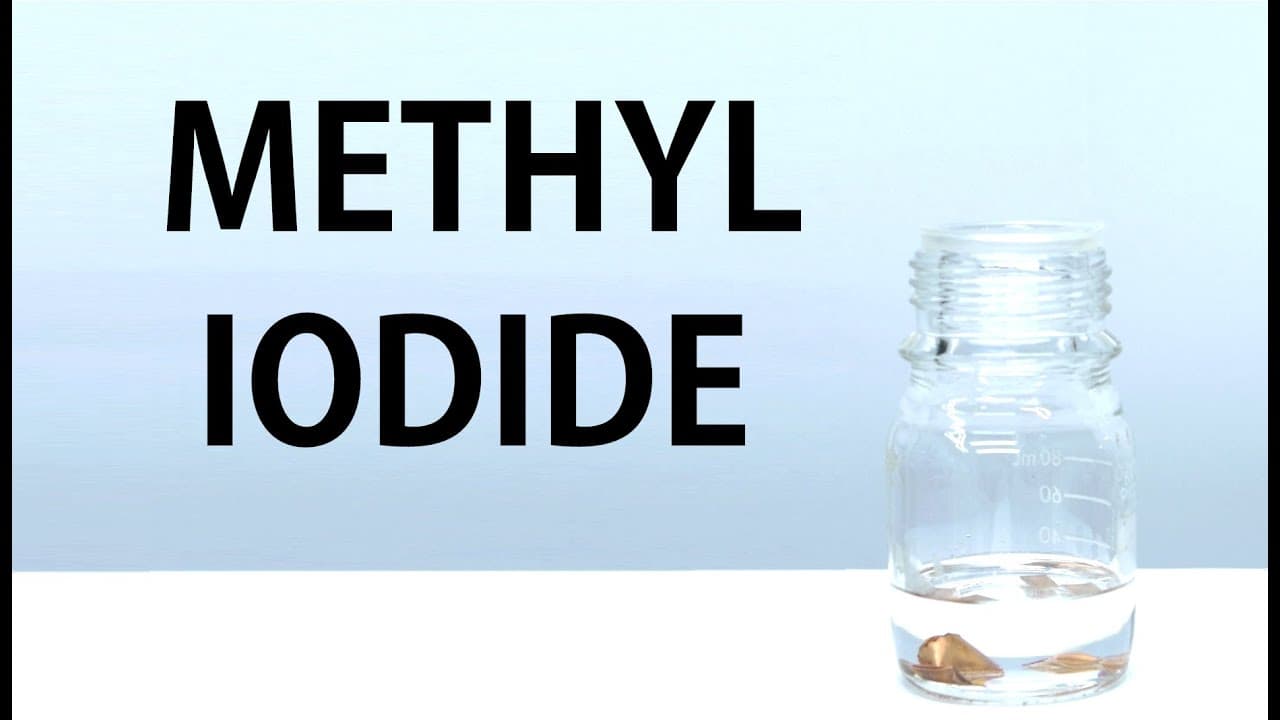
The methyl iodide is placed in a capped Pyrex jar with freshly polished copper at the bottom. It has a strong tendency to break down when exposed to light, while the copper helps prevent or limit this degradation; iodine formation may eventually give it a slight yellow or purple color.
Summary & Key Takeaways
-
Methyl iodide is mainly used as a chemical building block and has limited practical uses beyond that.
-
The structure of methyl iodide is simple, with a chemical formula of CH3I.
-
The bond between carbon and iodide in methyl iodide is weak and can be easily broken in various reactions.
Read in Other Languages (beta)
Share This Summary 📚
Summarize YouTube Videos and Get Video Transcripts with 1-Click
Try YouTube Summary with ChatGPT & Claude or YouTube Transcript Generator
Explore More Summaries from NileRed 📚

Summarize YouTube Videos and Get Video Transcripts with 1-Click
Try YouTube Summary with ChatGPT & Claude or YouTube Transcript Generator