How to Stack Peltier Units for Maximum Cooling Efficiency?
TL;DR
To effectively stack Peltier units for greater cooling, first identify the necessary temperature difference (DT) to reach your target cold side temperature. Use higher temperature differences to maximize cooling, but be aware that this will reduce overall cooling capacity. Employ good insulation and a suitable heatsink to handle the heat load from multiple units, ensuring the system performs as expected.
Transcript
welcome everyone in this video I'm going to talk about the stacking of the patio coolers so first I will show you some calculations and we will have some sort of brainstorming and then I will test the calculated things or something like that in reality so we will see what kind of numbers we can get as compared to our calculations so first let's see... Read More
Key Insights
- 😘 Stacking patio coolers can achieve extremely low temperatures but introduces additional complexities in calculations and performance metrics.
- 🥶 The temperature difference attained has a dual effect: it can create colder outputs but sacrifice the overall cooling capacity of the units.
- 🥵 Experimental setups need robust insulation strategies to minimize heat loss and optimize cooling efficiency.
- 😎 Understanding the interplay between current, voltage, and cooling power is fundamental to maximizing the effectiveness of stacked cooling solutions.
- 🧑🏭 Real-world performance may deviate from theoretical predictions due to environmental factors and efficiency losses, necessitating empirical testing.
- 😎 Selecting the right cooling unit design is essential to balance high cooling performance with manageable heat loads.
- 🥵 Effective heat sink design is crucial to dissipate the substantial heat generated in multi-unit systems and maintain desired cooling temperatures.
Install to Summarize YouTube Videos and Get Transcripts
Explore YouTube Video Summarizer or Get YouTube Transcript Extractor
Questions & Answers
Q: Why is it important to maximize the temperature difference (DT) when stacking patio coolers?
Maximizing the temperature difference (DT) is crucial because it directly influences the effectiveness of cooling. A larger DT allows for lower temperatures on the cold side, but managing the balance between cooling power and DT is vital, as high DT can limit cooling efficiency.
Q: What challenges arise from stacking multiple patio cooling units?
Stacking additional units complicates the heat transfer process, as heat must travel through various layers. The need to accommodate the required power and cooling output for each unit poses challenges regarding insulation and heat sink efficiency, potentially leading to higher cooling demands than typical units can handle.
Q: How does the choice of heat sink affect the overall cooling performance?
The heat sink choice is vital as it determines the efficiency of heat dissipation from the cooling units. Using a water cooler can be more effective than air coolers due to water's superior heat capacity, allowing for better thermal management of the high heat loads generated by stacked cooling units.
Q: What did the calculations reveal about the heating load on the heat sink?
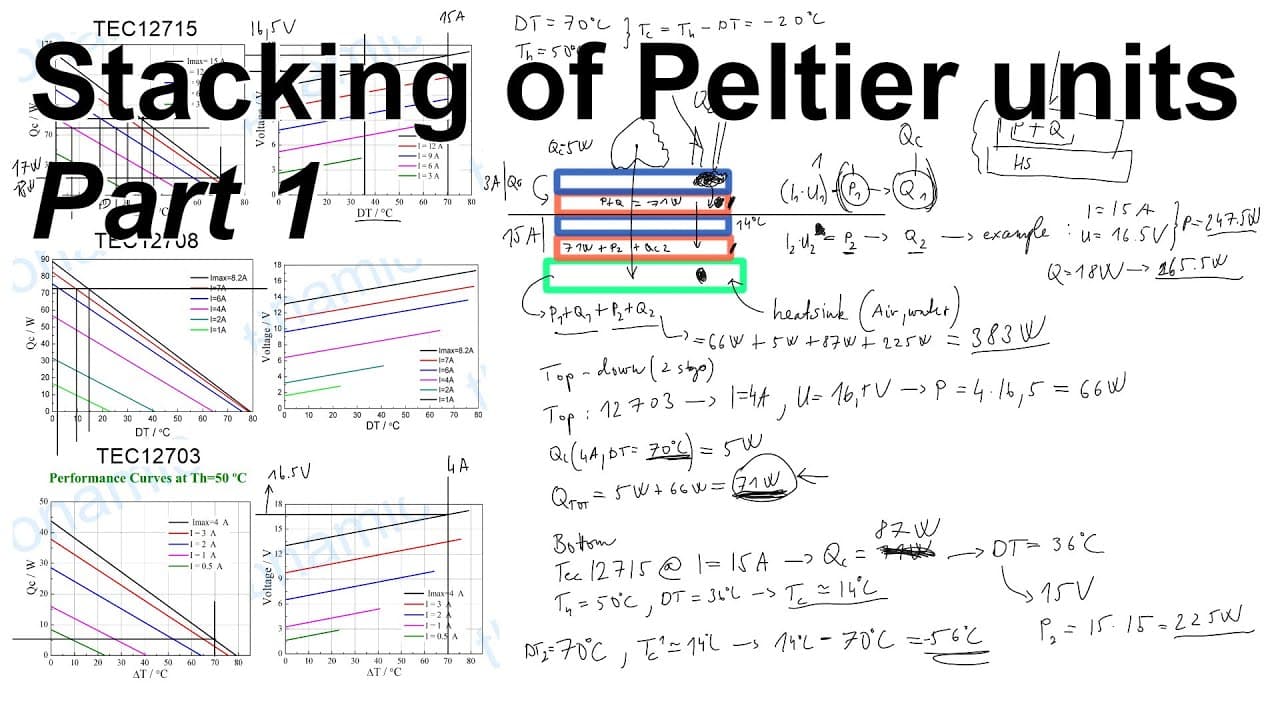
The calculations indicated that the total heating load on the heat sink could reach 383 watts when using stacked cooling units. This significant load highlights the difficulties in maintaining optimal temperatures and suggests that conventional CPU coolers would be inadequate for this application.
Summary & Key Takeaways
-
The video begins with a discussion on the benefits and limitations of stacking patio coolers, focusing on reaching low temperatures. Performance charts depict how temperature differences affect cooling power.
-
It breaks down the calculations for determining essential parameters like current, voltage, and cooling efficiency, emphasizing that higher temperature differences result in lower cooling capacity.
-
The presenter outlines practical experiments comparing theoretical calculations with real-world outcomes, planning to utilize insulation and a water cooler to enhance performance.
Read in Other Languages (beta)
Share This Summary 📚
Summarize YouTube Videos and Get Video Transcripts with 1-Click
Try YouTube Summary with ChatGPT & Claude or YouTube Transcript Generator
Explore More Summaries from Curious Scientist 📚






Summarize YouTube Videos and Get Video Transcripts with 1-Click
Try YouTube Summary with ChatGPT & Claude or YouTube Transcript Generator