How Will AI Agents and Robots Reshape Work?
TL;DR
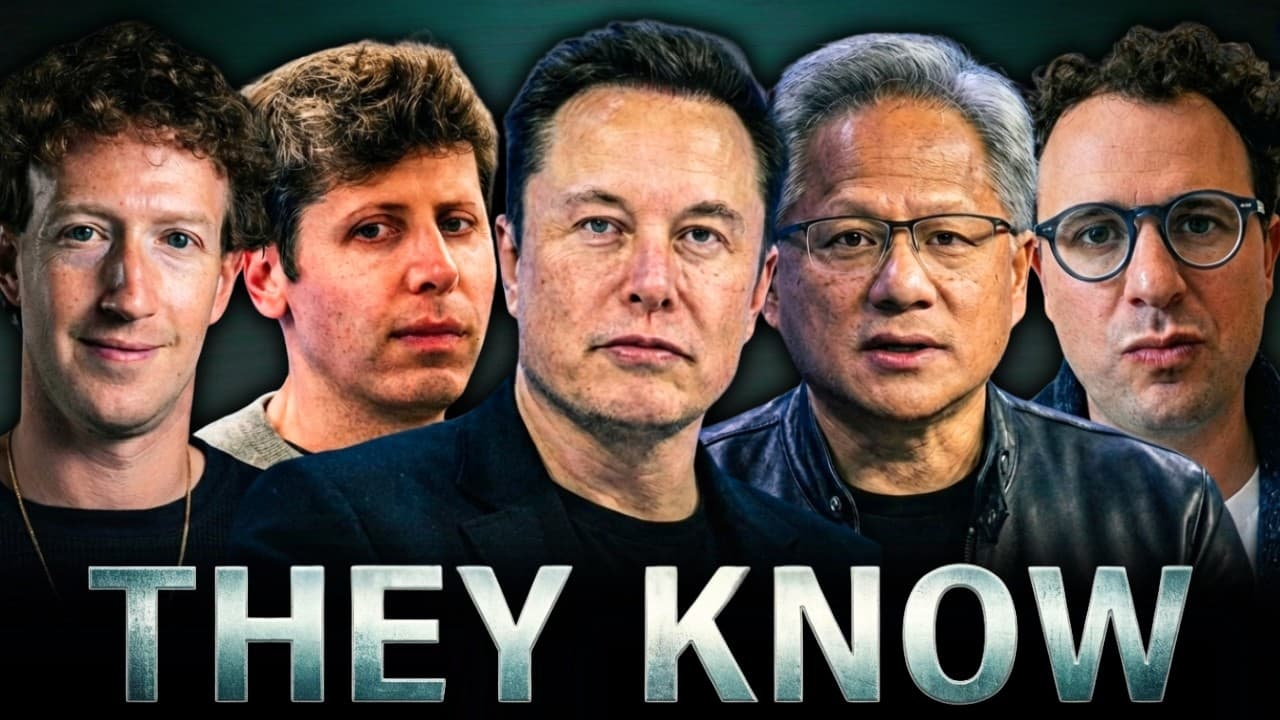
AI leaders are converging on a near-term shift toward autonomous agents, physical AI, and dramatically greater worker productivity. The practical warning is that companies may need fewer employees as AI completes previously lengthy tasks in minutes, while the broader challenge is whether society can responsibly manage increasingly capable systems, workforce disruption, and infrastructure expansion.
Transcript
Five of the most powerful people in artificial intelligence just said the same thing in the same month. They didn't make some handwavy vague statements. They all agreed on the same direction. They used almost the same words, the same timelines, the same warnings. Five CEOs who are actively competing against each other, who are spending hundreds of ... Read More
Key Insights
- The shared direction is a transition from conversational AI toward autonomous systems that can perform computer-based and physical tasks. The presenter treats agreement among five competing executives as stronger evidence than any single prediction, although their precise claims and timelines still vary.
- Elon Musk's stated vision is that work could become optional within 10 to 20 years and money could eventually lose relevance. The presenter cautions that Musk frequently misses deadlines, arguing that the direction of his prediction matters more than its exact timing.
- Physical AI is Nvidia's term for robots, autonomous vehicles, and machines that can understand, reason, and act in the real world. Jensen Huang presented robotics and vehicle platforms at CES as evidence that AI development is moving beyond text, images, and cloud-based interactions.
- Nvidia's Reuben platform is described as containing 336 billion transistors on one GPU and 220 trillion across a 72-GPU rack. The system is claimed to generate AI tokens at one-tenth the cost of previous generations, potentially making advanced AI systems cheaper to operate.
- AI productivity is changing OpenAI's approach to hiring, according to Sam Altman. He described testing whether candidates can use AI to finish in 10 to 20 minutes a task that would have been impossible for one person to complete within two weeks a year earlier.
- Aggressive hiring could leave companies facing uncomfortable workforce decisions when they discover that AI can perform more work than expected. The presenter interprets Altman's warning as a signal of potential mass layoffs, though Altman is quoted using the less explicit phrase, uncomfortable conversations.
- Meta's personal superintelligence vision centers on AI that knows an individual deeply and can act on that person's behalf. Zuckerberg expects engineers to function more like technical leads, directing groups of agents that set goals, run tests, identify problems, and write code.
- Powerful AI creates a maturity problem, according to Dario Amodei's adolescence analogy. His essay argues that humanity may gain nearly unimaginable technological power before developing adequate judgment, and it places AI capable of senior software engineering work as potentially only 1 to 2 years away.
Install to Summarize YouTube Videos and Get Transcripts
Explore YouTube Video Summarizer or Get YouTube Transcript Extractor
Questions & Answers
Q: Why are similar AI predictions from competing CEOs significant?
The predictions are presented as significant because the executives lead companies that compete with one another and spend hundreds of billions of dollars trying to gain an advantage. Despite those conflicting incentives, they describe a similar direction involving autonomous agents, physical AI, rapid productivity gains, and fewer human workers. The presenter treats this convergence as five separate data points rather than one leader's isolated speculation.
Q: How could AI make work optional according to Elon Musk?
Elon Musk predicts that AI and robots could create enough abundance for work to become optional within 10 to 20 years. He also suggests that money could eventually stop being relevant, referencing science fiction societies without currency. The presenter does not accept Musk's timeline uncritically and notes his history of missed deadlines, but considers the long-term direction of the claim important.
Q: What is physical AI and how does it differ from a chatbot?
Physical AI refers to robots, autonomous vehicles, and other machines that understand, reason, and act in the real world. Unlike chatbots that primarily generate text or systems that create images, physical AI connects intelligence to real-world perception and action. Jensen Huang's CES presentation included robots, robotic simulation, embodied intelligence, and an end-to-end autonomous vehicle system as examples of this transition.
Q: What AI technologies did Nvidia present at CES?
Nvidia presented the Reuben next-generation AI chip architecture, Alpa Mayo for reasoning autonomous vehicles, Cosmos for robotic simulation, and Groot for embodied intelligence. The Reuben GPU was described as containing 336 billion transistors, while a full 72-GPU rack contains 220 trillion. Jensen Huang said the platform could produce AI tokens at one-tenth the cost of previous generations.
Q: How is OpenAI changing hiring because of AI productivity?
Sam Altman said OpenAI plans to slow its growth dramatically because fewer people may be able to accomplish much more with AI. He described an interview exercise in which a candidate receives a task that would have been impossible for one person to finish in two weeks a year earlier, then attempts to complete it within 10 to 20 minutes using AI tools.
Q: Why does the presenter believe AI could lead to layoffs?
Sam Altman warned companies against hiring aggressively because they may soon discover that AI can perform much of the work for which they added employees. He said those employers could then face uncomfortable conversations. The presenter interprets that phrase as a restrained warning about mass layoffs, based on the expectation that AI will allow organizations to produce more with fewer people.
Q: How does Mark Zuckerberg expect AI agents to change software engineering?
Mark Zuckerberg predicts that within 12 to 18 months, most code at Meta will be written by AI. His vision goes beyond autocomplete because agents would set goals, run tests, find problems, and produce code. Human engineers would increasingly act as technical leads, each directing an army of AI agents rather than personally completing every programming task.
Q: What warning does Dario Amodei give about powerful AI?
Dario Amodei argues that humanity is approaching an adolescence of technology, a stage where it may possess adult-level power without adult-level judgment. He says powerful AI capable of completing the end-to-end work of a senior software engineer could arrive in as little as 1 to 2 years. His central concern is whether humanity has enough maturity to manage such capabilities safely.
Summary & Key Takeaways
-
The central argument is that competing AI executives converged in January 2026 on a common direction: increasingly capable AI will move beyond chatbots into autonomous agents, software development, robotics, and vehicles. Their agreement is presented as a meaningful signal because their companies compete intensely and invest heavily to outperform one another.
-
Elon Musk predicts that work could become optional within 10 to 20 years, while Jensen Huang describes a ChatGPT moment for physical AI. Nvidia's announced platforms target reasoning vehicles, robotic simulation, and embodied intelligence, supported by hardware designed to reduce AI token costs to one-tenth of previous generations.
-
Sam Altman expects AI productivity to let OpenAI accomplish more with fewer employees, while Mark Zuckerberg anticipates AI writing most Meta code and agents outnumbering humans. Dario Amodei frames powerful AI as an adolescence problem: humanity may soon receive extraordinary capabilities without having developed sufficient judgment to manage them responsibly.
Read in Other Languages (beta)
Share This Summary 📚
Summarize YouTube Videos and Get Video Transcripts with 1-Click
Try YouTube Summary with ChatGPT & Claude or YouTube Transcript Generator
Explore More Summaries from Farzad 📚
Summarize YouTube Videos and Get Video Transcripts with 1-Click
Try YouTube Summary with ChatGPT & Claude or YouTube Transcript Generator