How to Build Business Systems That Run Without You
TL;DR
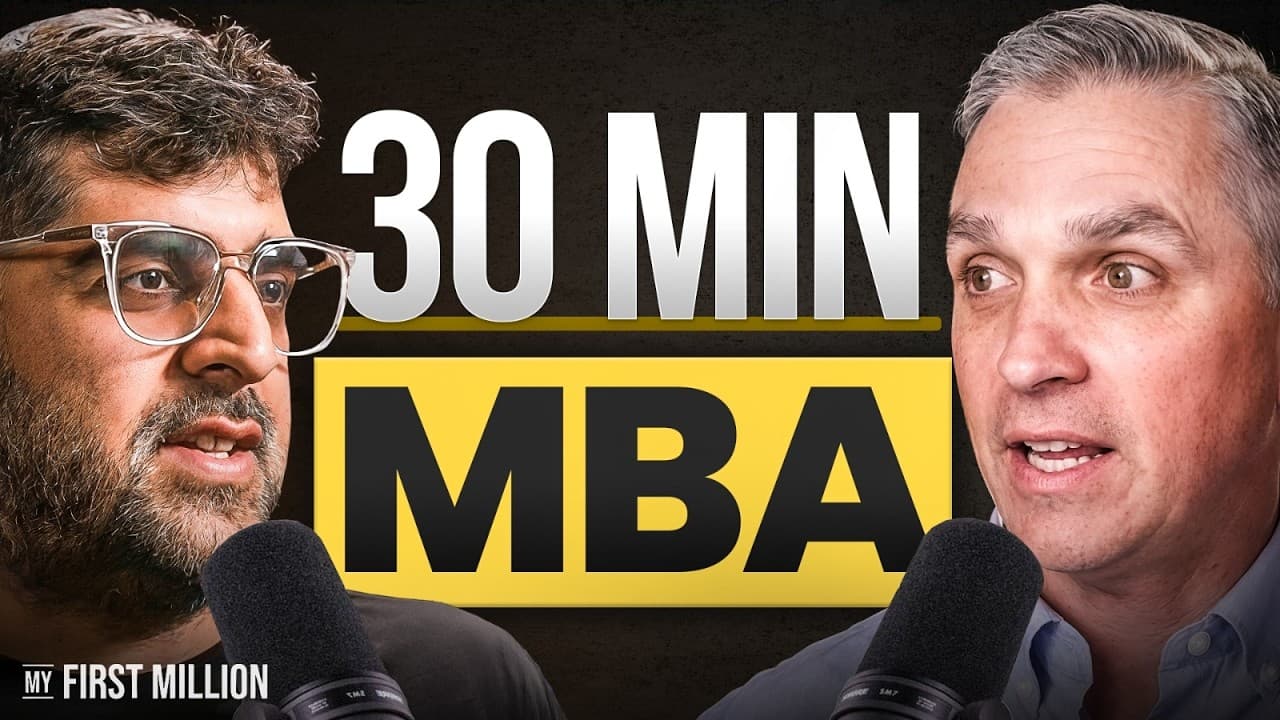
The more valuable you are to your company, the less valuable the company is, because a business that depends on its founder cannot be left alone or sold. The fix runs in four steps: establish default constraints on your own time, identify whether the current bottleneck is supply or demand, map your core processes visually, then assign one uniquely responsible owner to each step.
Transcript
So, I've been running businesses for 15 years and I've hit this wall multiple times. It's somewhere around seven, eight, nine, 10 million in revenue where suddenly your biggest problem, it's not a lack of ideas. It's a issue with you. You're the bottleneck. And so, I've got this buddy named Ryan Dice. He's got this amazing quote. He says, "The more... Read More
Key Insights
- The more valuable a founder is to the business, the less valuable the business is. Ryan Deiss's quote captures why founder-dependence feels good for the ego and for control, but blocks both vacations and a sale, because the value cannot be transferred to a buyer.
- The core decision is whether you want to be the player hitting the last-minute jump shot or the owner sitting in the box. Most entrepreneurs would rather be valuable than own the team, and they do the things that let them get started rather than the things that get them what they say they want.
- Wanting the change is not enough because the real obstacle is impulse control. Twenty years of previous behaviors have to be broken, and Sam notes that evolving as a person is far more challenging than most people assume, even when the desire is genuine.
- Establishing defaults is the first practical step: commit to leaving at 5:30 and not showing up before 9. The constrained block forces the work to fit and forces you to stack rank priorities, because you can no longer pretend to do everything.
- Ideas are like chocolate cake, not cotton candy: they are delicious but you can only consume so much. Entrepreneurs are trained and adept at spotting problems everywhere and will never stop seeing them, so the only useful question is what the right next thing is.
- Every business problem reduces to either a supply constraint or a demand constraint. A demand constraint means you need more leads and sales. A supply constraint means the opposite: please do not send more leads, because you cannot fulfill the ones you already have.
- Every business does three things: it makes stuff, sells stuff, and fulfills stuff. Business process mapping visualizes how that happens, using a whiteboard and sticky notes in flowchart form, then repeatedly asking 'then what?' from a defined start point to a defined end point.
- A high output team canvas turns each sticky note into a named owner. For every step, you ask who is uniquely responsible for this one, then attach critical accountability bullets, which is how roles and responsibilities get assigned rather than defaulting back to the founder.
Install to Summarize YouTube Videos and Get Transcripts
Explore YouTube Video Summarizer or Get YouTube Transcript Extractor
Questions & Answers
Q: Why does being valuable to your own company make the company less valuable?
Ryan Deiss's quote is that the more valuable you are, the less valuable the company is. When the founder creates all the value, takes all the shots, and has their name, face, and fingerprints all over the business, that value sits with the person rather than the asset. It feels good from an ego perspective and gives a sense of control, but it means you cannot go on vacation and cannot sell, because the business is too dependent on you. The business ends up owning you rather than you owning the business.
Q: What is the first step to building a business that runs without you?
Establish defaults, meaning certain default constraints on your own time. The concrete example given is deciding you will leave at 5:30 every day and will not show up until 9, then actually holding to it. What happens is that the work gets done inside that block because it has to. The prioritization forced by the constraint is the real mechanism: you cannot do everything, so a hard boundary on hours forces you to stack rank your priorities and pick what gets done first.
Q: How do you identify the constraint in a business?
Every problem in business comes down to one of two categories: a supply constraint or a demand constraint. A demand constraint means you simply need more leads and sales. A supply constraint is the reverse, where the message is please do not give me more leads and sales because I cannot fulfill the ones I already have. Once the category is identified, the next question is how to get it done, and if the founder is not going to do it, who needs to be brought in to do it instead.
Q: What is business process mapping and how do you do it?
Business process mapping is a visual technique, not something Deiss invented, for laying out how value gets created. You go to a whiteboard with sticky notes and lay the process out in flowchart form, defining where it starts and where it ends. The method is to keep asking 'then what?' at every stage. For a growth engine, that might start with initial awareness through Facebook and Instagram ads, Google ads, reels and stories, then traffic to an email challenge sign-up page, then a branch: if they do not register, retarget them; if they do, deliver the challenge.
Q: What should you do with a process map once you have built it?
There are several uses. First, overlay numbers on the arrows, such as how much is being spent on Facebook ads and how many clicks those drive, then circle where the leak in the bucket is to find the constraint. Second, decide which steps you cannot afford to screw up and document only those. Third, use the map to figure out hiring, by assigning a uniquely responsible person to every single sticky note through the high output team canvas.
Q: What is the biggest mistake companies make when trying to systemize?
They try to document everything. Deiss is explicit that you should not do this. Instead, look at the process map and ask which of these steps you really cannot afford to screw up, then document only those. The reason is practical: documentation effort spread evenly across every step of the business consumes enormous time while the steps that actually determine outcomes get no more attention than trivial ones.
Q: What is the high output team canvas?
It is the tool used to convert a process map into roles. Every single sticky note, every step or stage on the map, gets the question: who is uniquely responsible for this one. The example given is going to the marketing team and identifying John, who collaborates with agencies to establish budgets, while the agency itself manages and optimizes the campaigns. Every box then carries corresponding critical accountability bullets, and that is how roles and responsibilities begin to get assigned.
Q: What does a business look like before and after this transformation?
Before, the messy entrepreneur works 80 hours a week, is in the weeds, answers 'me' when asked who owns each area, gets 'got a minute to talk about X' from the team 200 times a day, misses soccer games, and cannot sell the business because it is too dependent on them. After, the founder is involved about an hour a week, the team executes, optimizes and decides without them, a 30-day vacation is possible, revenue records get broken while they are gone, and the business is exit ready.
Summary & Key Takeaways
-
Founders often hit a wall around seven to ten million in revenue where the bottleneck is no longer a lack of ideas but the founder personally. Ryan Deiss frames the choice as being the most valuable player on the court or owning the team, and argues most entrepreneurs quietly prefer feeling important to building something that runs without them.
-
The messy state looks like 80-hour weeks, being in the weeds, answering 'who owns this' with 'me' for every area, fielding the same question 200 times a day, missing soccer games, and being unable to sell. The target state is roughly an hour a week of founder involvement, a team that executes, optimizes and decides alone, a 30-day vacation, and exit readiness.
-
The transformation runs through four steps: establish defaults such as arriving at 9 and leaving at 5:30, identify whether the constraint is supply or demand, build a business process map by repeatedly asking 'then what?', and turn each box on that map into a named owner on a high output team canvas with critical accountability bullets.
Read in Other Languages (beta)
Share This Summary 📚
Summarize YouTube Videos and Get Video Transcripts with 1-Click
Try YouTube Summary with ChatGPT & Claude or YouTube Transcript Generator
Explore More Summaries from My First Million 📚




Summarize YouTube Videos and Get Video Transcripts with 1-Click
Try YouTube Summary with ChatGPT & Claude or YouTube Transcript Generator