How to Make Phenolphthalein Using Common Chemicals
TL;DR
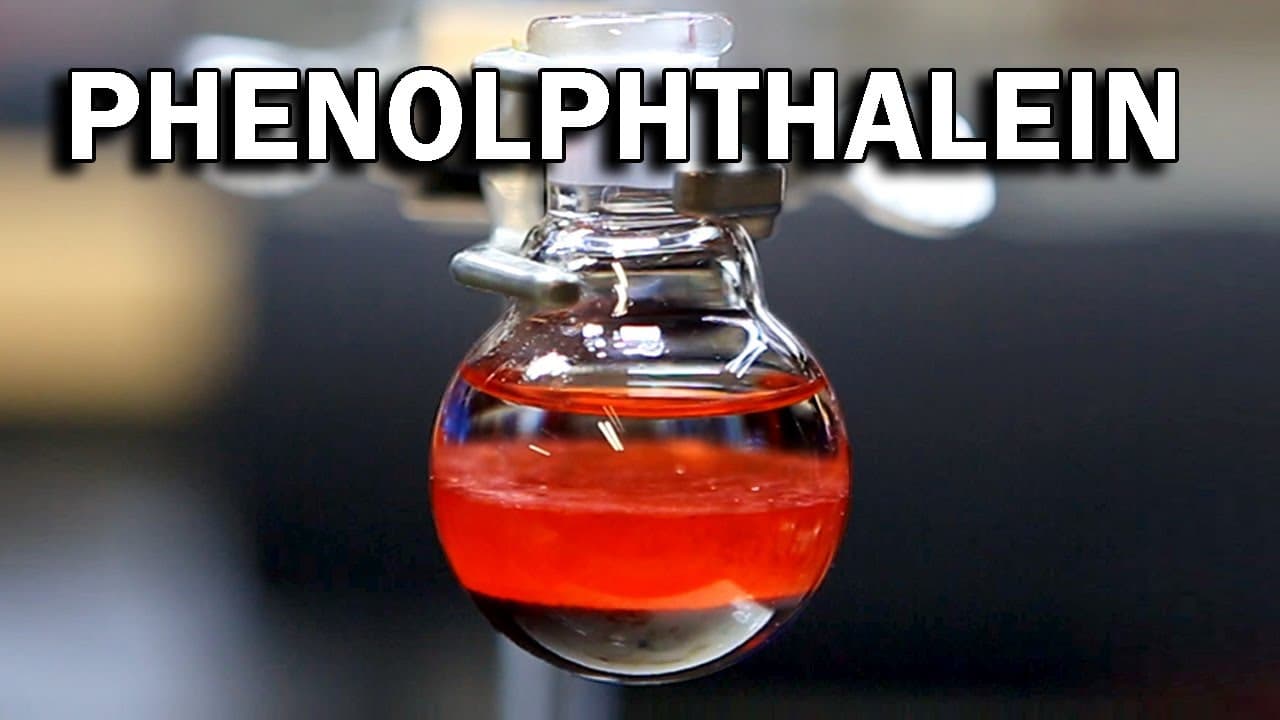
Phenolphthalein is made by heating 2 grams of phenol with 1.5 grams of phthalic anhydride and a few drops of concentrated sulfuric acid at 150 °C for 2 hours, during which two phenol molecules react with one phthalic anhydride to form phenolphthalein and water. The crude product is extracted with dichloromethane, converted to its purple sodium salt with 2 molar sodium hydroxide, then crashed out with hydrochloric acid and filtered. See how a small demo run still yielded about 1 gram.
Transcript
Phenolphthalein is an extremely useful acid-base indicator and medically it used to be used as a laxative. For this experiment I used: 2 grams of phenol, 1.5 grams of phtalic anhydride. And, I think having about 50 milliliters of DCM would be good As a side note, in previous videos I've shown how all three of these chemicals can be obtained from ho... Read More
Key Insights
- ⚾ Phenolphthalein is a valuable acid-base indicator and was historically used as a laxative.
- ❓ The synthesis of phenolphthalein can be achieved using household chemicals, such as phenol and phthalic anhydride.
- 😪 Heating the mixture promotes the reaction and the formation of the red phenolphthalein molecule.
- ❓ Separation techniques, such as using a separatory funnel, are used to obtain the desired phenolphthalein product.
- 💦 Phenolphthalein can be converted into a water-soluble salt by adding sodium hydroxide.
- 🚱 The non-salt form of phenolphthalein is insoluble in water, leading to its precipitation and subsequent filtration.
- ✋ The final yield of phenolphthalein can be significantly higher than what is shown in the video.
Install to Summarize YouTube Videos and Get Transcripts
Explore YouTube Video Summarizer or Get YouTube Transcript Extractor
Questions & Answers
Q: How do you make phenolphthalein?
Combine 2 grams of phenol and 1.5 grams of phthalic anhydride in a round bottom flask, add a few drops of concentrated sulfuric acid, and heat to 150 °C for 2 hours. Two molecules of phenol react with one molecule of phthalic anhydride to form phenolphthalein and water. The red color of phenolphthalein appears as the mixture melts and reacts.
Q: What chemicals are used to synthesize phenolphthalein?
The synthesis uses phenol, phthalic anhydride, and concentrated sulfuric acid, plus dichloromethane (DCM) for extraction. The video uses 2 grams of phenol and 1.5 grams of phthalic anhydride, with about 50 milliliters of DCM. The creator notes that all three main chemicals can be obtained from household products, as shown in previous videos.
Q: How do you convert phenol into phenolphthalein?
Two molecules of phenol react with one molecule of phthalic anhydride, catalyzed by concentrated sulfuric acid, to form the phenolphthalein molecule and water. Because the reaction happens above 100 °C, it is pushed forward by boiling the water away. The mixture turns from cloudy red to a clearer red and finally nearly black as the reaction proceeds.
Q: Why is the mixture heated at 150 °C for 2 hours?
Heating melts the phenol and liquifies the mixture so the reaction can occur, and the 150 °C temperature drives off the water produced. Since the reaction takes place above 100 °C, boiling the water away pushes the reaction forward. The color deepening from red to nearly black over the two hours signals the reaction progressing.
Q: How is the phenolphthalein product separated and purified?
After cooling, 10 milliliters each of distilled water and dichloromethane are added, forming a layered mixture that is stirred and transferred to a separatory funnel. The lower DCM layer containing phenolphthalein is drained and combined across extractions, while the aqueous layer with unreacted phenol and sulfuric acid is discarded. Adding 5 milliliters of 2 molar sodium hydroxide converts the phenolphthalein into its water-soluble purple salt for further separation.
Q: How do you get the final solid phenolphthalein?
The concentrated, nearly black phenolphthalein salt solution is poured into 100 milliliters of 2 molar hydrochloric acid, which converts phenolphthalein back to its non-salt form. This form is insoluble in water, so it crashes out of solution. The precipitate is then vacuum filtered and dried under vacuum.
Q: How much phenolphthalein does this method yield?
The video shows only about 0.1 grams of product, but the creator states the actual final yield was around 1 gram. In theory you could expect about ten times the amount shown in the video.
Q: How do you test that the phenolphthalein works as an indicator?
A couple of small grains of the phenolphthalein are added to a basic solution. Immediately upon addition, the solution quickly turns purple, confirming it works as an acid-base indicator. Phenolphthalein is a widely used indicator and was historically used medically as a laxative.
Summary & Key Takeaways
-
Phenolphthalein is synthesized using 2 grams of phenol, 1.5 grams of phthalic anhydride, and concentrated sulfuric acid.
-
The synthesis involves heating the mixture at 150 °C for 2 hours, resulting in the formation of the phenolphthalein molecule and water.
-
After cooling, distilled water and dichloromethane are added, creating a three-layered mixture that is separated to obtain the phenolphthalein product.
Read in Other Languages (beta)
Share This Summary 📚
Summarize YouTube Videos and Get Video Transcripts with 1-Click
Try YouTube Summary with ChatGPT & Claude or YouTube Transcript Generator
Explore More Summaries from NileRed 📚
Summarize YouTube Videos and Get Video Transcripts with 1-Click
Try YouTube Summary with ChatGPT & Claude or YouTube Transcript Generator