What Is the Chemical Reactivity of Lanthanides?
TL;DR
Lanthanoids exhibit chemical reactivity similar to calcium and aluminum, with their reactivity increasing as atomic numbers rise. They react with carbon, oxygen, nitrogen, mineral acids, water, sulfur, and hydrogen to form compounds like carbides, oxides, hydroxides, chlorides, sulfides, and hydrides. Reaction conditions, especially temperature, significantly influence the products formed.
Transcript
click the bell icon to get latest videos from Ikeda Halfords in the previous topic we have discussed about the electronic configuration of the lanthanides as well as lanthanum and now in this topic we are going to talk about the chemical reactivity of length or heads so what are the different chemical reactions that is what we are going to talk abo... Read More
Key Insights
- 🫀 Lanthanides exhibit varying chemical reactivity as their atomic numbers increase.
- 💦 Interactions with carbon, oxygen, nitrogen, mineral acids, water, sulfur, and hydrogen showcase different reactions.
- 🖐️ Temperature plays a crucial role in determining the products of lanthanide reactions.
- 💁 Lanthanides form compounds like lanthanide carbides, oxides, hydroxides, chlorides, sulfides, and hydrides.
- ⚖️ Balancing chemical equations is essential when discussing lanthanide reactions.
- 💁 Lanthanides are reactive elements, forming compounds with different chemical elements and compounds.
- ❓ Chemical reactivity of lanthanides is a topic of interest due to their unique properties.
Install to Summarize YouTube Videos and Get Transcripts
Explore YouTube Video Summarizer or Get YouTube Transcript Extractor
Questions & Answers
Q: What is the general behavior of lanthanides in terms of chemical reactivity?
Lanthanides show chemical reactivity akin to calcium, shifting towards aluminum as atomic number increases.
Q: Describe the reaction of lanthanides with carbon.
Lanthanides react with carbon at high temperatures, forming lanthanide carbides like Ln3C, LnC2, or Ln2CT.
Q: How do lanthanides react with oxygen?
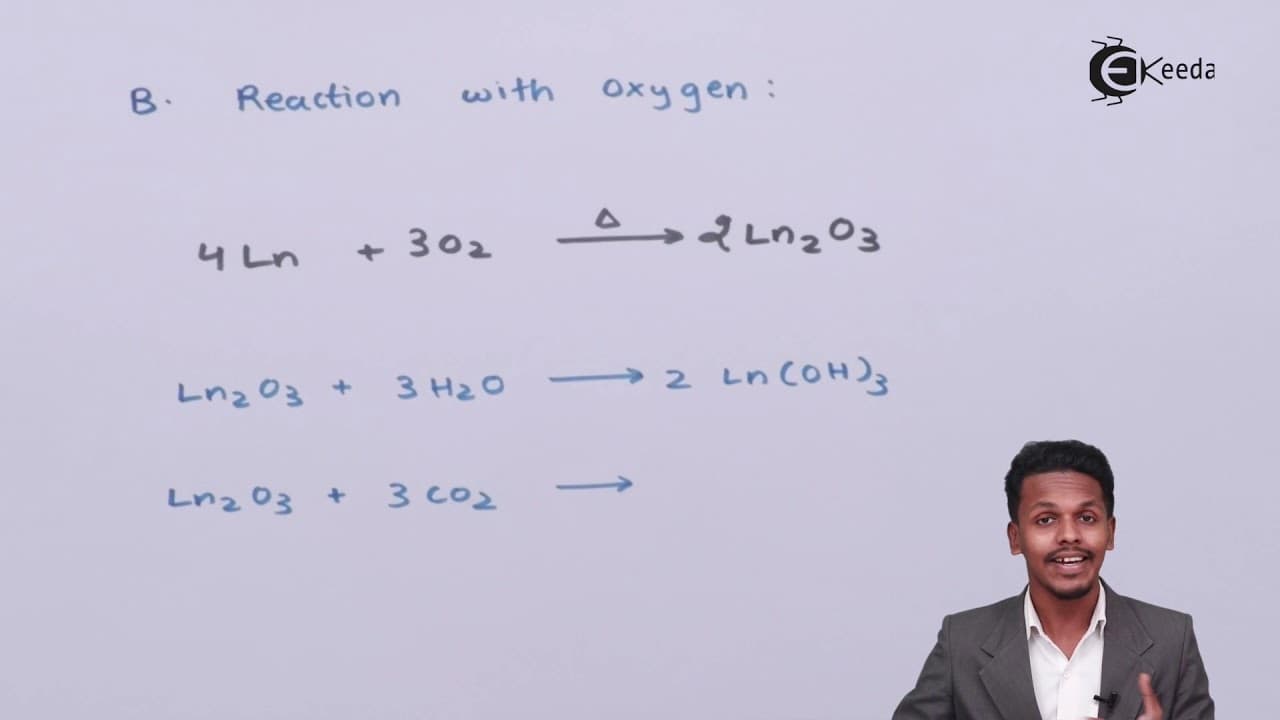
Lanthanides react with oxygen to produce lanthanide oxides, such as Ln2O3, which can further react with water or carbon dioxide.
Q: What happens when lanthanides react with mineral acids?
Lanthanides react with mineral acids to form lanthanide chlorides and release hydrogen gas.
Summary & Key Takeaways
-
Lanthanides exhibit chemical reactivity similar to calcium and aluminum.
-
Reactions include interactions with carbon, oxygen, nitrogen, mineral acids, water, sulfur, and hydrogen.
-
Lanthanides produce different compounds based on the reaction conditions.
Read in Other Languages (beta)
Share This Summary 📚
Summarize YouTube Videos and Get Video Transcripts with 1-Click
Try YouTube Summary with ChatGPT & Claude or YouTube Transcript Generator
Explore More Summaries from Ekeeda 📚






Summarize YouTube Videos and Get Video Transcripts with 1-Click
Try YouTube Summary with ChatGPT & Claude or YouTube Transcript Generator